Becoming a domain reseller means signing up for an existing accredited registrar's reseller program, not becoming an ICANN-accredited registrar yourself. You choose a program such as ResellerClub, Enom, GoDaddy Reseller, or Namecheap, then fund a small deposit. From there, set your markup and put a working domain search on your own site.
This guide walks through choosing a registrar program, signing up, and setting pricing. It also covers integrating a storefront with WHMCS, adding TLDs and add-ons, launching, and the mistakes that cost new resellers the most margin.
How to Become a Domain Reseller at a Glance
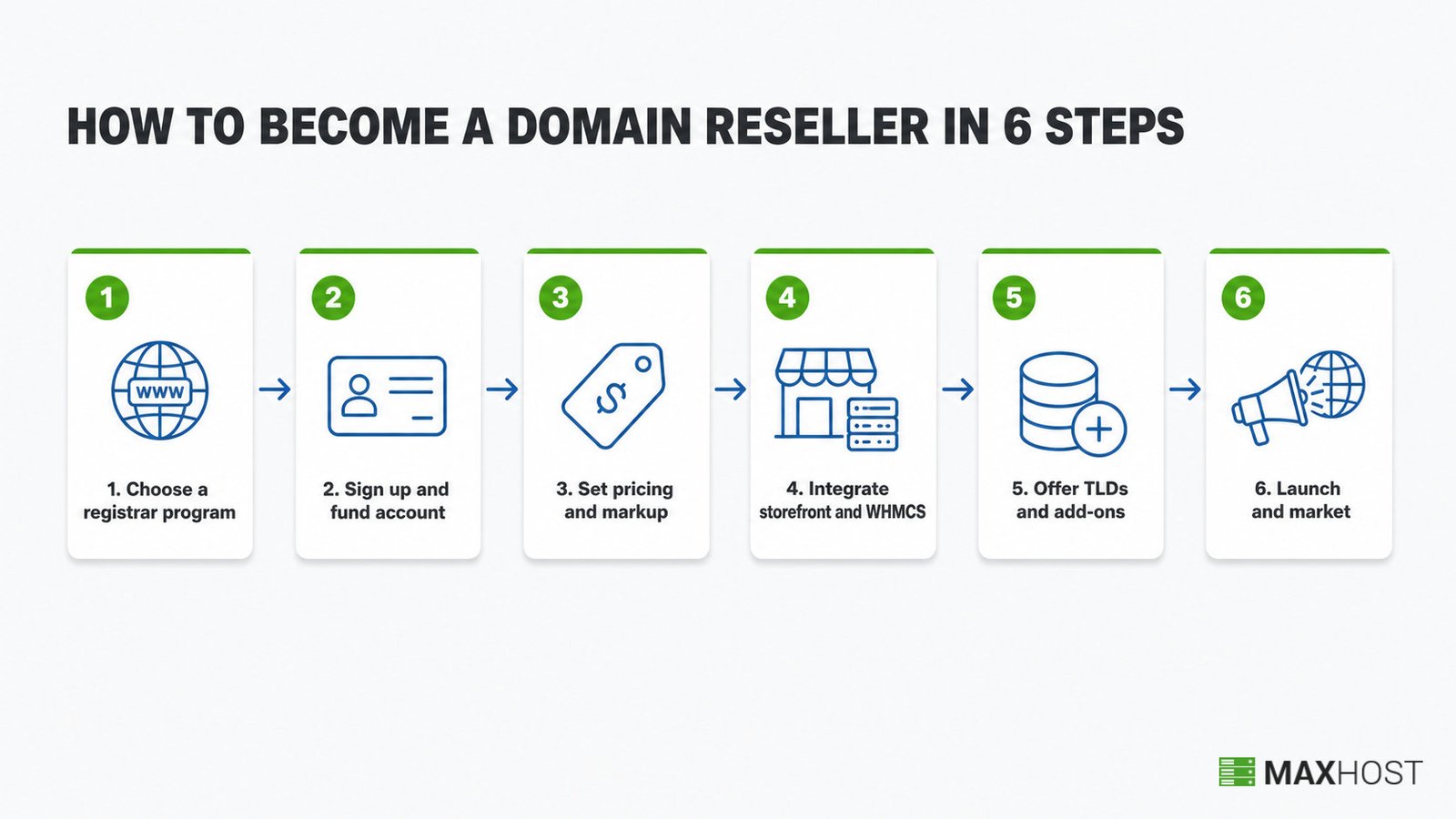
Becoming a domain reseller takes six moves. Choose an ICANN-accredited registrar's reseller program, then sign up and fund the account. Set your pricing and markup, then put a working storefront and WHMCS domain module on your own site. Add extra TLDs and add-ons, then launch and market to customers directly.
What You Need Before You Start
You do not need ICANN accreditation, your own servers, or a registrar relationship of your own to become a domain reseller. All you need is a reseller account with an existing accredited registrar, a brand name, and a small prepaid deposit.
A solo operator or a two-person team handles this setup alone. No legal team or dedicated technical staff is required at this stage.
Most resellers finish registrar research and sign-up within a single afternoon. Branding a storefront and wiring a working domain search into an existing site takes longer. Expect a few days to two weeks, depending on the platform.
Three prerequisites need to exist before Step 1, listed below.
- A business or brand name to register and sell domains under.
- A small prepaid deposit, usually $25 to $95 depending on the program.
- A website, or a clear plan to build one, where customers search and buy domains.
Domain reselling adds a second revenue line rather than a new venture, when you already run or are launching a web hosting business.
Confirm what a domain reseller actually is and how it differs from a domain name before comparing programs. The two terms get confused often. That distinction matters once you start pricing.
The only tool required at this stage is a registrar reseller program. A billing or automation platform becomes useful once you integrate a storefront in Step 4.
Step 1: Choose a Registrar Reseller Program
This step locks in which accredited registrar's reseller program you operate under for every domain you sell. Five programs dominate new-reseller sign-ups: ResellerClub, Enom, GoDaddy Reseller, Namecheap's API-based option, and NameSilo. The table below compares them on wholesale entry cost, TLD range, and WHMCS support.
| Program | Wholesale Entry | TLD Range | WHMCS Integration |
|---|---|---|---|
| ResellerClub | $25 fully usable Base Slab deposit, no activation fee | 500+ TLDs | Official WHMCS registrar module |
| Enom | $50 one time signup fee, then tiered volume pricing across four tiers | 500+ TLDs | Native WHMCS module, plus Plesk, cPanel, and ClientExec |
| GoDaddy Reseller | $53.88 first year on Basic (renews at $107.88), 20 percent off retail; Pro runs $179.88 a year at 40 percent off retail | Full GoDaddy TLD catalog | WHMCS registrar module, plus a dedicated WordPress plugin |
| Namecheap | No formal program; API access needs 20+ domains, a $50 balance, or $50 in total receipts | 567+ TLDs | WHMCS registrar module available, self-built storefront |
| NameSilo | No separate reseller fee; account based, with low base prices but no bulk discount tier | Broad TLD catalog | WHMCS and HostBill billing integrations |
WHMCS is the billing and client-area platform most hosting resellers already run. A registrar's own WHMCS module often decides the choice as much as price does. What WHMCS actually does is worth a quick read before you compare modules, if the term is new to you.
ResellerClub's $25 deposit is the lowest cash barrier to entry, and it is fully usable against your first registrations. Enom's flat $50 signup fee moves you straight into tiered volume pricing as you scale. GoDaddy Reseller trades a higher published buy rate for a ready-made WordPress plugin and storefront. Namecheap skips a formal program entirely: you build your own site and connect it to their API once your account clears the threshold. NameSilo takes the same account-based route, leaning on already-low base prices and native WHMCS and HostBill hooks rather than a discount tier.
One caution comes from resellers themselves: the wholesale price gap between these programs is often marginal. Weight WHMCS support and TLD range over a headline discount, because the discount rarely decides your real margin.
Step 2: Sign Up and Fund Your Reseller Account
Signing up means applying for the registrar's reseller program, paying any activation fee, and prepaying a deposit that covers your first registrations. Most programs activate within hours, and card or PayPal funding clears the account the same day in most cases.
ResellerClub's account typically activates within four hours of a PayPal-funded deposit. GoDaddy Reseller and Enom process card payments immediately, so the account is usable the same day. Namecheap's path is different. You fund your existing Namecheap account past the $50 threshold, then request API access. Support confirms that access manually rather than instantly.
Budget the deposit alongside your other startup costs. This deposit is a natural first line item to add to your web hosting business plan, if you have not written one yet.
Step 3: Set Your Pricing and Markup
Setting your pricing means picking a markup over your registrar's wholesale cost, and most reseller consoles calculate the retail price for you automatically. A 10 percent markup is the common default, but per-domain registration margins stay thin regardless of the number you choose.
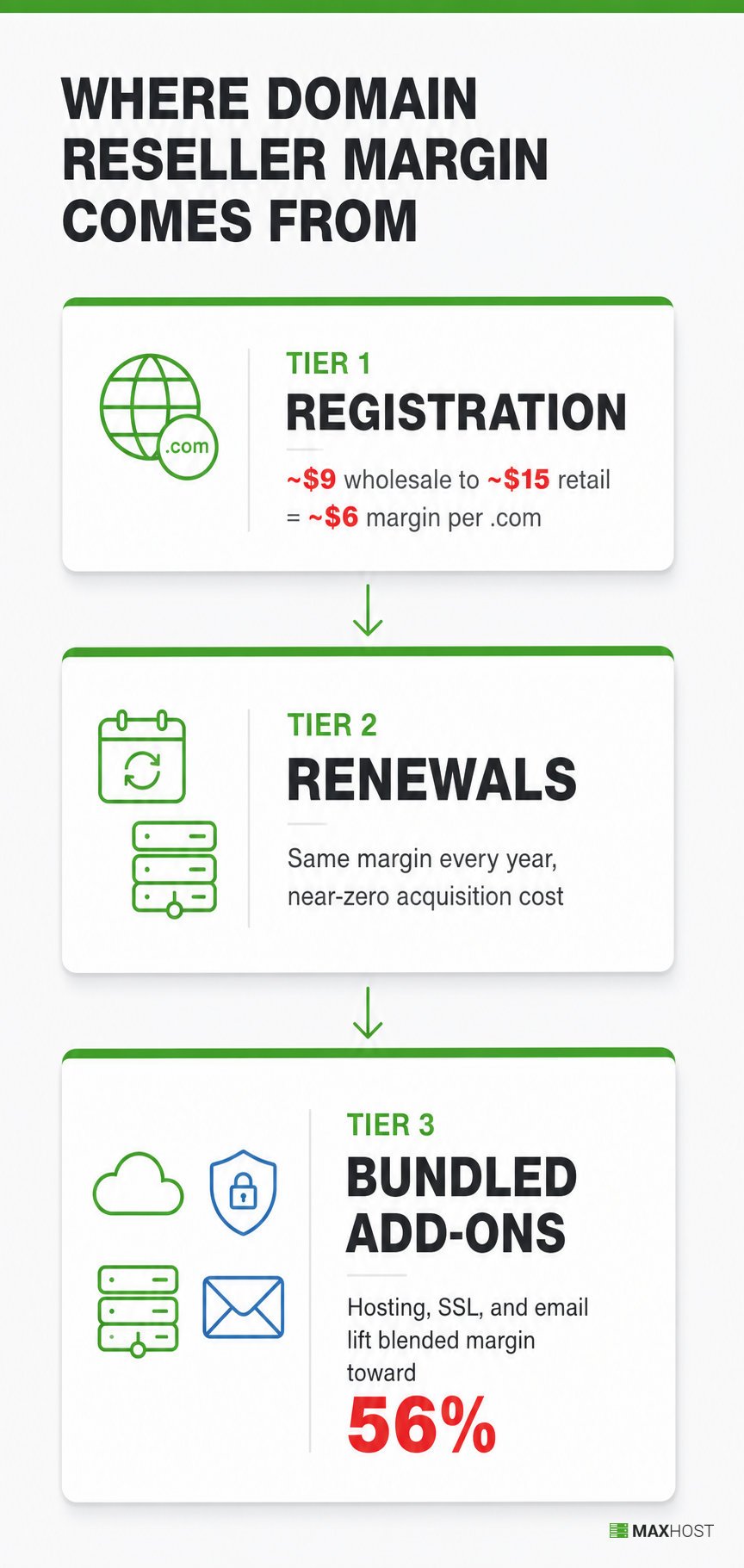
A wholesale .com registration costs a reseller around $9; a common retail price sits near $15, a margin of about $6 per registration. Large-volume resellers reach blended margins near 56 percent, but only by combining bulk pricing with bundled services like hosting, SSL, and email, not registration alone. Renewals are where the real profit sits: every renewal repeats the same margin with near-zero acquisition cost, year after year.
The same margin discipline that applies to pricing and selling web hosting plans applies here. Chase renewal revenue and bundled services, not the lowest possible headline domain price.
Step 4: Integrate a Storefront and WHMCS Domain Module
This step puts a working domain search and checkout on your own site. Three integration paths are common: a registrar's hosted storefront, a WHMCS domain module on your own site, or an API-driven custom build.
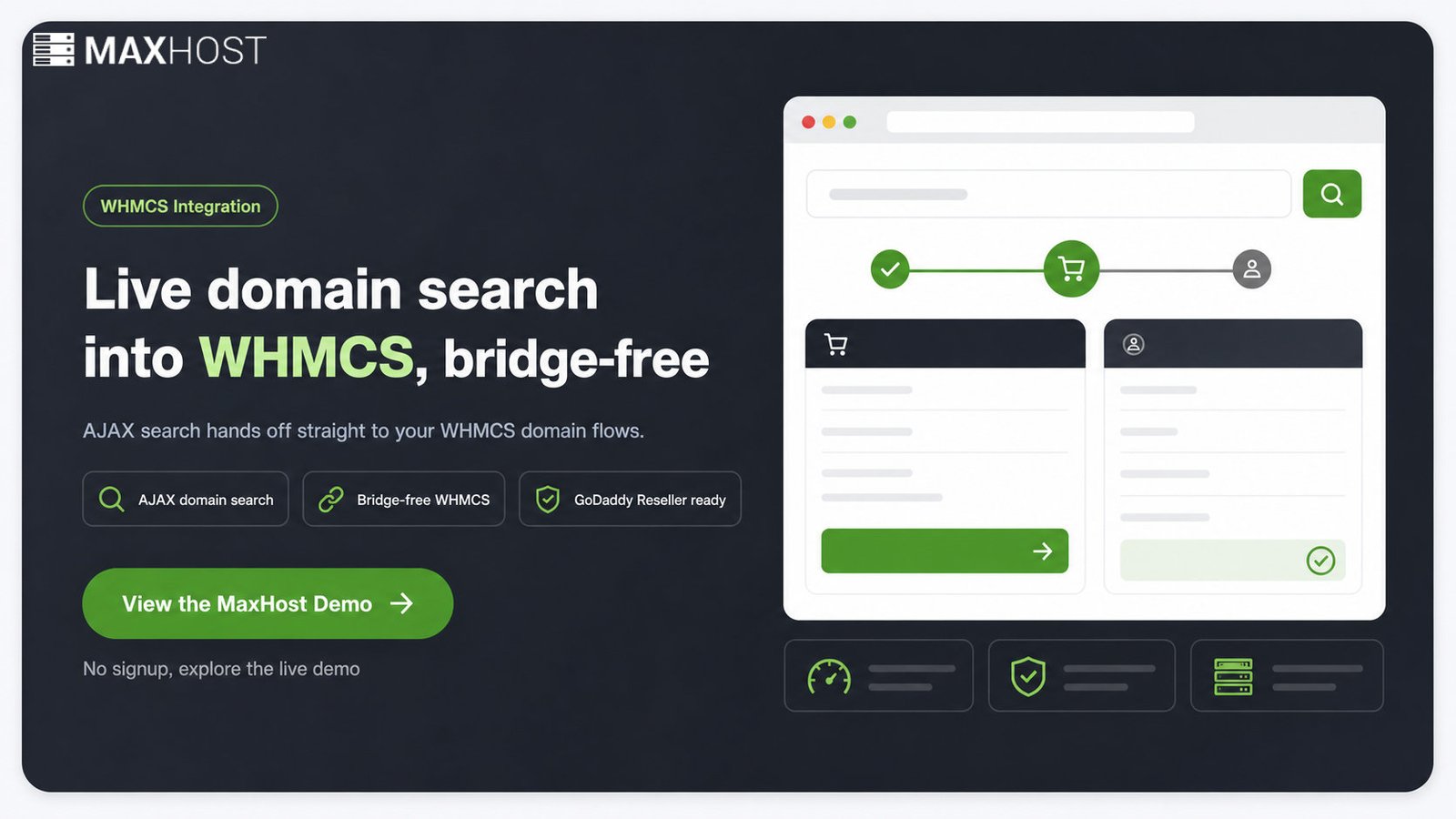
MaxHost ships an AJAX-style live domain search on WordPress sites, and it hands off directly to your WHMCS domain search, transfer, and reseller flows. No separate storefront plugin is required to bridge the two. MaxHost also supports the GoDaddy Reseller Store plugin as an alternative backend, matching whichever program you picked in Step 1. The full build walkthrough covers each integration path step by step, including adding a live domain search to a WordPress site.
Step 5: Offer TLDs and Add-Ons
Offering more than the obvious .com and .net extensions is what separates a reseller who captures niche demand from one who does not. Layer WHOIS privacy, business email, and SSL onto every domain sale to add margin beyond the thin registration fee itself.
Specialty extensions like .ai, .io, .store, and city-based TLDs such as .nyc and .berlin carry better margins than crowded .com inventory. Fewer resellers compete for them on price. Country-code TLDs like .de, .co, and .us convert well when your customer's brand or audience is local to that region. WHOIS privacy typically costs the reseller under $5 per year and resells for a markup with almost no support burden. Domain-linked email and SSL certificates round out the add-on stack most registrar consoles expose natively. No separate vendor relationship is required to offer either one.
Step 6: Launch and Market Your Domain Reseller Business
Launching means testing the full search-to-checkout flow end to end, then going live with visible support channels for customers. A working test purchase catches broken WHMCS integrations before a real customer does.
Test every step yourself: search a domain, add it to cart, complete checkout, and confirm the WHMCS welcome email arrives. Announce your launch on the channels your customers already use: a hosting community, a local business network, or a direct message to past clients.
Marketing a domain reseller business rewards focus over reach. Four tactics move the most volume early on:
- Pick a niche and sell to it. A defined audience, such as local businesses or one industry, converts better than everyone at once.
- Cross-sell hosting on every domain sale. Domains are the entry product; hosting, email, and SSL carry the real margin.
- Price specialty extensions competitively. Your .ai, .io, and country-code rates are where niche buyers compare you against the big registrars.
- Work your existing client list first. An existing hosting or web-design customer is the cheapest domain sale you will ever make.
Using MaxHost? A mismatched storefront and WHMCS checkout is exactly where a new customer hesitates mid-purchase. MaxHost's bridge-free WHMCS templates keep checkout looking like the same site the customer just searched a domain on. That consistency is part of a WordPress theme built for web hosting companies, not a separate add-on.
Common Domain Reseller Mistakes to Avoid
The costliest domain reseller mistake is picking a registrar on headline price alone, without checking per-TLD markups or independent reliability reviews first. Five mistakes account for most of the margin resellers lose in their first year.
- Chasing headline price over per-TLD markup. A registrar's advertised price can hide a marked-up wholesale cost on a specific TLD. A domain that costs $6 at the registry can resell for $40 once a padded transfer fee gets added. Check the wholesale rate per TLD before committing to a program.
- Selling only the obvious TLDs. Limiting sales to .com and .net caps your addressable margin from the start. Add .ai, .io, .store, or a relevant country or city TLD your customers already search for.
- Skipping automation. Manual renewal tracking leads to missed renewals and domains lost to expiration. Automate registrations and renewals through your registrar's API or a billing platform instead.
- Selling domains alone instead of bundling. Registration margins stay thin no matter which program you choose. Bundling domains with reseller hosting or email captures far more revenue per customer.
- Underestimating support load. A customer who cannot reach anyone after a failed transfer churns fast and often leaves a public complaint. Publish a visible support channel before launch, not after the first ticket arrives.
FAQs
Do you need to be an ICANN-accredited registrar to become a domain reseller?
No. A domain reseller operates under an existing accredited registrar's contractual umbrella and is not subject to ICANN's direct accreditation requirements. Only the registrar itself needs ICANN accreditation, not the reseller selling under its program.
How much does it cost to become a domain reseller?
Entry costs range from $25 to $95 depending on the program. ResellerClub asks for a $25 fully usable deposit, and Enom charges a flat $50 signup fee. GoDaddy's Basic plan runs $53.88 in the first year, and Namecheap charges nothing beyond a $50 account balance threshold.
How much can a domain reseller actually earn per domain?
Per-domain registration margins are thin, often just a few dollars on a wholesale .com priced around $9 against a $15 retail rate. Most resellers earn real profit from renewals, which repeat the same margin every year at near-zero acquisition cost. Bundled add-ons like hosting, SSL, and email add further margin on top.
What's the difference between a domain reseller and a reseller hosting business?
A domain reseller sells domain name registrations under someone else's registrar accreditation. Reseller hosting sells server space instead, purchased wholesale from an upstream host and resold as branded hosting plans. Many operators run both side by side, since domains and hosting are natural companion sales.
Can I become a domain reseller without technical skills?
Yes. ResellerClub's Control Panel and SuperSite storefront, and GoDaddy's pre-built storefront, all let a non-technical operator launch without writing code. A custom WHMCS module integration or an API-driven build is the only path that benefits from developer help.
How long does it take to launch a domain reseller business?
Most operators finish registrar sign-up and funding within a single afternoon. Building a branded storefront and wiring a working domain search typically adds a few days to two weeks, depending on the platform. A web hosting business plan template shortcuts the planning step if that is what is slowing you down.
Is domain reselling profitable on its own, or do I need to bundle it with hosting?
Domain reselling alone produces thin registration margins, often just a few dollars per domain. Bundling with hosting, email, and SSL turns a domain reseller business into a meaningfully profitable one. Each bundled product adds its own margin on the same customer relationship.
Which registrar reseller program works best for a small number of domains?
ResellerClub's $25 deposit is the lowest commitment for testing the waters with a handful of domains. Namecheap's API path works too if you already hold an account past the $50 threshold, without paying any separate reseller fee.
Do I need WHMCS to resell domains from my website?
No. A registrar's own hosted storefront or a direct API integration both work without WHMCS. WHMCS becomes useful once you are already billing hosting or other services and want domains to appear on the same invoice and client area.
Building this storefront on WordPress puts the design work in reach without custom development. MaxHost's domain reseller website template ships the live domain search, pricing tables, and bridge-free WHMCS templates already assembled for exactly this business. See the demo to check the storefront against your own domain and TLD lineup before you build.