A web hosting business plan turns a reseller or hosting startup idea into a costed, sellable business. It covers the market, the pricing model, and the financial projections, sized to your actual scale, not a $350,000 enterprise template.
This guide walks through all 9 sections in order, with a worked reseller-scale startup cost table. It closes with the mistakes that keep hosting business plans from ever getting finished.
What a Web Hosting Business Plan Is, at a Glance
A web hosting business plan is a written case for the business plus a financial forecast. It states what the business is, who it serves, and why a customer picks it over a big-box host. The numbers prove the model can pay for itself.
Anyone financing the business needs one. So does an owner who wants a real numbers check before quitting a day job or spending savings on a reseller plan.
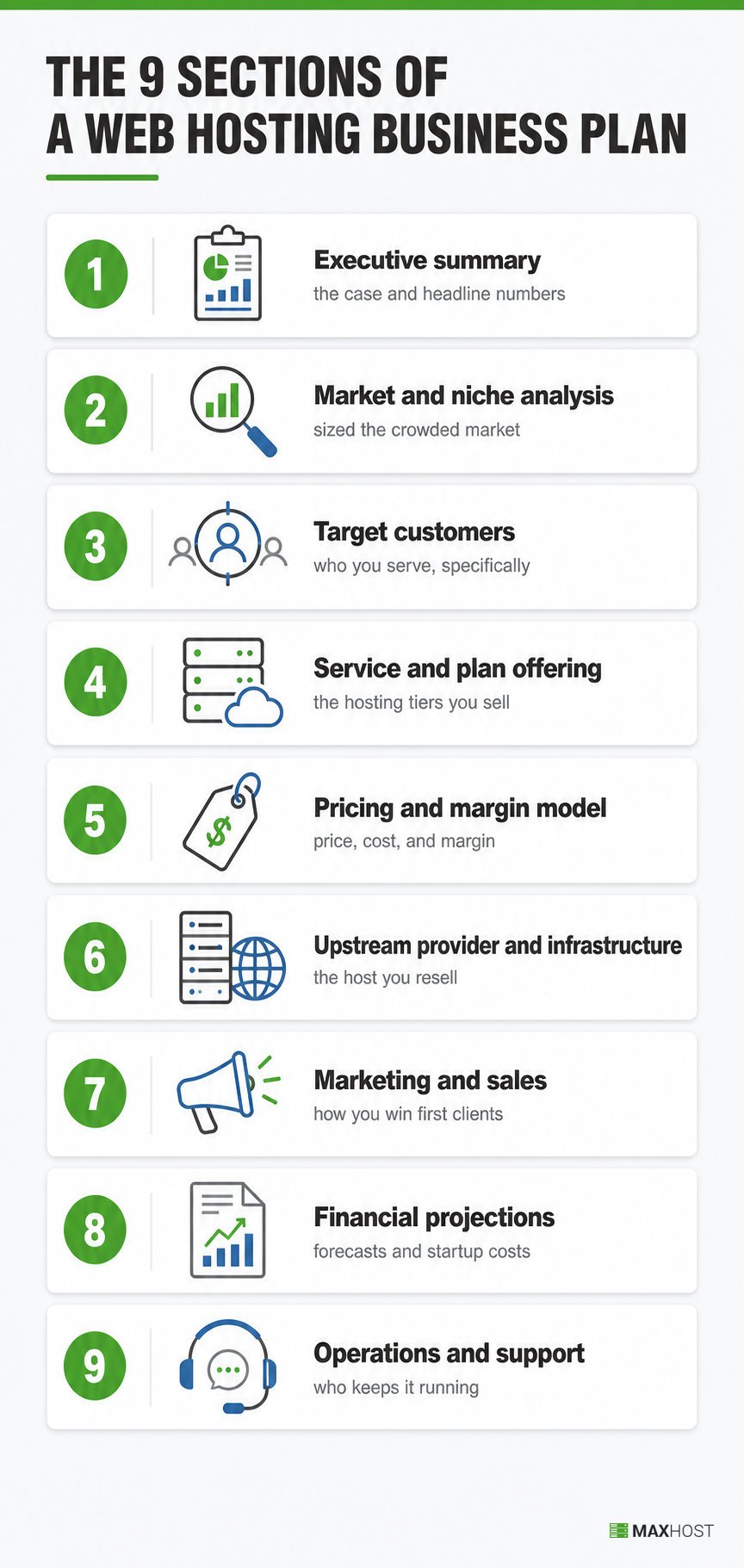
A complete plan covers 9 sections.
- Executive summary
- Market and niche analysis
- Target customers
- Service and plan offering
- Pricing and margin model
- Upstream provider and infrastructure
- Marketing and sales
- Financial projections
- Operations and support
Most small-business plans run 10 to 20 pages. A one-page lean plan works too, especially for a first draft or a microlender conversation. It expands into a full plan once the numbers firm up.
What You Need Before You Start
Four things need to be on hand before you open a blank document.
- A niche idea: shared hosting for local businesses, reseller hosting for agencies, or a domain-reseller storefront
- Real numbers: actual reseller-plan pricing, billing-software cost, and domain fees, not rounded guesses
- One focused hour: drafting the plan itself takes about an hour once the numbers are gathered, though gathering them takes longer
- A length decision: a full 10-to-20-page plan for outside financing, or a one-page lean plan for a first draft or a small loan
If you would rather start from a filled-in template than a blank page, a web hosting business plan template does the section-by-section work for you. This guide covers the plan document itself. For the full operational launch sequence, see how to start a web hosting business.
Step 1: Write Your Executive Summary
The executive summary covers four things: what the business is, who it serves, the market opportunity, and the headline numbers. Those numbers are the startup capital needed and the target margin.
Write this section last, even though it sits first in the finished plan. Summarizing 9 sections you have not written yet is the most common early-drafting mistake. Every other section supplies the summary's raw material.
Once the rest of the plan is done, compress it into 3 to 5 short paragraphs.
- The hosting niche (reseller, shared, or domain resale)
- The target customer, in one sentence
- The competitive angle
- The starting numbers (startup capital and target margin)
Step 2: Analyze Your Market and Niche
Market analysis needs two outputs: context on the hosting market, and a list of real, named competitors in your niche. Never claim that no competitors exist.
Web hosting is a large, mature, crowded market. Fortune Business Insights valued it at $149.30 billion in 2025, projected to reach $178.76 billion in 2026. Big-box hosts compete on price at the bottom, while specialized resellers and niche hosts compete on service, support speed, and audience fit.
Name the niche you are entering and the 3 to 5 real companies already serving it. A market with zero named competitors signals unproven demand, not open opportunity.
Cover four points in this section.
- Segment your market by industry, business size, or geography, not "everyone who needs a website"
- State why your target segment fits a reseller model better than a data-center-scale host
- Name 3 to 5 real competitors serving the same niche, with their pricing tier
- Note the real barriers to entry: brand trust, support responsiveness, and price, since capital is not one
Step 3: Define Your Target Customers
Target customers need two specifics: who they are by industry, company size, and geography, and why they would choose a reseller over a big-box host.
Vague targeting like "small businesses that need hosting" produces a plan no lender or co-founder can act on. Name the segment specifically enough that you could list 10 real prospects today.
If you have not settled on the reseller model yet, start with what reseller hosting is and how it differs from running your own servers.
Three segment patterns work well for a first hosting business.
- Web agencies that need white-label hosting for client sites
- Local businesses in one city or region that want a provider who answers the phone
- A vertical niche (WordPress-only shops, e-commerce stores, one specific industry) where you speak the customer's language
Step 4: Outline Your Service and Plan Offering
This section lists the actual hosting tiers you will sell and what each includes. Cover storage, bandwidth, email accounts, and support level, not a vague "hosting plans" placeholder.
Three tiers cover most reseller catalogs.
- A starter plan for a single small site
- A business plan with more storage and email accounts
- A premium or managed add-on for customers who want updates and backups handled
Domain resale is a specific, addressable niche worth naming here if it fits your plan. See how to become a domain reseller for that setup.
Each tier listing needs four details.
- Storage and bandwidth allowance
- Number of email accounts and domains included
- Support level (ticket only, live chat, or phone)
- Any managed add-ons (backups, updates, staging sites)
Step 5: Build Your Pricing and Margin Model
Pricing and margin math live in a single table: plan tier, customer price, wholesale cost, and resulting margin. The worked example below targets the 30% to 60% margin range reseller hosting operations typically report. Use it as a modeling method, not a universal number.
| Plan Tier | Customer Price / Month | Wholesale + Overhead Cost / Month | Resulting Margin |
|---|---|---|---|
| Starter | $9.99 | $6.50 | 35% |
| Business | $19.99 | $10.50 | 47% |
| Premium / Managed | $39.99 | $18.00 | 55% |
Two real inputs anchor the wholesale side of any version of this table you build. A reseller hosting plan runs $19.88 to $58.88 a month across a typical provider's three tiers. Billing software adds roughly $8 to $85 a month, depending on the client-count cap.
Divide those costs by your active account count for a true per-customer figure. Add support time and a churn buffer before setting the margin.
Reseller hosting margins typically land between 30% and 60%. They rise to 50% to 70% or higher once an operation has real scale and repeat customers. Cross-check your own numbers against the full margin breakdown in is a web hosting business profitable before you lock in a price.
The model above sets the math. How to price your hosting plans covers how to actually set the number your customers see.
Step 6: Plan Your Upstream Provider and Infrastructure
Five criteria decide your upstream provider.
- Uptime SLA of 99.9% or better, with a stated compensation policy
- Full WHM or reseller-panel access, not a stripped-down control panel
- Storage and bandwidth headroom for your target account count
- Automated daily backups included, not a paid add-on
- Support response time, tested before you commit, not just promised
Your upstream provider is the infrastructure your entire business rests on. A slow or unreliable upstream host becomes your customers' complaint, not theirs.
If reselling under an upstream provider fits your plan, see how to start a reseller hosting business for the narrower setup details.
Step 7: Write Your Marketing and Sales Plan
A marketing and sales plan needs three things covered.
- How you will acquire your first clients
- Which channel carries that acquisition
- What budget backs it
Most first-time hosting businesses acquire early clients through existing relationships: past freelance or agency clients, local business networking, and referrals from a first happy customer.
Paid acquisition, search ads and directory listings, rarely pays back at reseller-hosting margins until volume is high. Budget for it as a later-stage lever, not a launch-day requirement.
State one primary channel and one backup channel in this section, with a monthly budget for each, even if the number is small. A plan with no channel named is not a marketing plan.
Step 8: Build Your Financial Projections
A complete financial forecast produces five outputs.
- Profit and loss statement
- Balance sheet
- Cash flow forecast
- Break-even analysis
- Sources-and-uses table
Project the first 12 months month by month, then annual figures for years 2 and 3. Lenders expect that horizon, scaled to a reseller, not a five-year enterprise forecast.
Most hosting business plan templates found online model a $350,000, 14-section enterprise or data-center operation. That scale fits a venture-funded infrastructure company, not a 1-to-5-person reseller launching this month. Build your own itemized startup-cost table instead.
| Line Item | Typical Cost | Notes |
|---|---|---|
| Reseller hosting plan | $19.88 to $58.88 / month | Entry through top wholesale tier, by account capacity |
| Billing software (WHMCS) | $8 to $84.95 / month | Bundled resale license through self-hosted top tier, by client-count cap |
| Domain name | About $10 / year | One domain for the business itself |
| Website and branding | $49 one time to several hundred dollars | A hosting-specific WordPress and WHMCS theme versus a custom build |
| Total starting capital | Approximately $1,000 | Reseller plan, billing software, domain, and basic branding combined |
���� Cutting the website line item honestly: a custom build plus a hand-styled WHMCS skin easily runs past a few hundred dollars in developer time. MaxHost is one such theme, a WordPress and WHMCS theme built for hosting companies, for a one-time $49. Its WHMCS client-area templates install directly, with no bridge plugin required.
The profit and loss statement totals monthly revenue against monthly costs. Revenue is accounts sold times price; costs include hosting, billing software, support time, and marketing.
The balance sheet lists what the business owns against what it owes at a single point in time. For a bootstrapped reseller this stays short: cash, prepaid hosting credit, and no debt if self-funded.
The cash flow forecast tracks money in and out, month by month. It matters more than the P&L in month one. Hosting and billing costs are often prepaid annually, while customer revenue arrives monthly.
The break-even analysis names the account count where monthly revenue first covers monthly costs. It tells a lender exactly when the business stops losing money. Lenders and microlenders look for it directly.
The sources-and-uses table matches every dollar of startup capital, savings, a small loan, a co-founder's contribution, to what it funds. Those funded items are the line items in the table above. Lenders and microlenders expect that pairing explicitly, not just a total.
Do not project profit in month one. Most hosting startups run at a loss through the first several months while the client base builds. A plan showing immediate profit signals unfamiliarity with the model, not confidence.
Step 9: Plan Your Operations and Support
Operations planning names three things: who answers support tickets, what hours you cover, and which tools handle billing and ticketing.
A one-person operation can start with email or ticket-only support during business hours and expand to live chat once volume justifies the labor cost.
Before budgeting for support tooling, it helps to know what WHMCS is. It automates billing, invoicing, and the client-facing ticket system in one place.
Cover four points here.
- Who answers support requests (you, a contractor, or a small team)
- Support hours and the channels covered (ticket, live chat, phone)
- Which platform handles billing, invoicing, and tickets
- The escalation path for an outage or a billing dispute
Common Web Hosting Business Plan Mistakes to Avoid
The single most damaging mistake is copying an oversized enterprise or data-center business plan template. A 14-section, $350,000-scale plan for a 1-person reseller never gets finished.
| Mistake | Consequence | Remedy |
|---|---|---|
| Writing an enterprise-scale plan for a small reseller operation | The plan never gets finished, or describes a business you are not building | Scale every section, and the startup-cost table, to your actual reseller-tier numbers |
| Unrealistic, optimism-biased financial projections | Projecting profit in month one signals unfamiliarity with the model to any lender reading it | Model a loss through at least the first few months, tied to real customer-acquisition assumptions |
| A vague, unitemized startup-cost ask | "I need $2,000" with no breakdown gets rejected by any lender or co-founder reviewing it | Itemize every line item: hosting plan, billing software, domain, and website, each with a real number |
| Skipping competitive research or claiming no competition | A "no competitors" claim reads as inexperience to anyone who has run a hosting business | Name 3 to 5 real competitors in your niche, with their pricing tier, before finalizing the plan |
| No target-customer specificity | "Hosting for everyone" produces a marketing plan nobody can execute against | Name the segment specifically enough to list 10 real prospects today |
FAQs
How long should a web hosting business plan be?
Most small-business hosting plans run 10 to 20 pages. A one-page lean plan works for a first draft, an internal alignment document, or a small loan. Expand to a full plan once you need outside financing.
How much startup capital should my hosting business plan budget for?
Industry sources commonly cite roughly $1,000 in initial capital for a reseller hosting business: a reseller plan, billing software, a domain, and basic branding. Verify the full cost and margin breakdown against your own niche before locking in a number.
What financial statements belong in a hosting business plan?
A complete financial section includes a profit and loss statement, a balance sheet, a cash flow forecast, and a break-even analysis. It also includes a sources-and-uses table showing how startup costs get funded.
Is a reseller hosting business plan different from a full hosting company business plan?
A reseller plan skips the infrastructure and upstream-provider evaluation a full hosting company plan needs, since a reseller buys capacity wholesale instead of running servers. Every other section, market analysis, target customers, and financial projections, stays the same.
Do I need a business plan if I'm only running a small reseller operation?
Yes, even a one-page lean plan. It forces a real numbers check on startup cost, margin, and target customer, before spending on a reseller plan and billing software. That check catches an unworkable model before it costs money.
Can I use a free web hosting business plan template?
A free template speeds up the first draft, but most published templates model an enterprise or data-center scale that does not fit a small reseller. A ready-made template built for this scale saves more time than a generic one.
How do I set pricing in my business plan?
Start from your wholesale cost per customer: hosting, billing software, and support time. Apply a 30% to 60% margin, the range most reseller hosting operations report. Adjust the number up once support quality and retention prove out.
What's the biggest mistake in a hosting business plan's financial projections?
Projecting profit starting in month one. Most hosting startups run at a loss through the first several months while the client base builds. Skipping that reality in a plan reads as unfamiliarity, not confidence.
This plan gets you to the financial-projections table faster than a generic business-plan guide, because every reseller-tier number above is real, not estimated. One line item you can shrink honestly today is the website. MaxHost is a WordPress and WHMCS theme built for hosting companies, for a one-time $49. Its WHMCS client-area templates install directly, with no bridge plugin required. View the MaxHost demo to see the marketing site and matching WHMCS client area before you budget the line item.