A domain reseller is a company or person that sells domain name registrations through a registrar's reseller program. It buys at wholesale and sets its own retail margin, rather than holding ICANN accreditation of its own. Domain reselling is a common add-on for hosting companies, web agencies, and IT consultancies.
This guide covers how domain reselling works, what you need to start, realistic margins, and how to become a reseller. It also covers how a domain reseller differs from a hosting reseller and a domain flipper, then how MaxHost supports a reseller's own storefront.
How Does Domain Reselling Work?
Domain reselling works by buying domain registrations wholesale through a registrar's reseller program, such as ResellerClub, Enom, or GoDaddy Reseller. The reseller then sells each domain to a customer at a markup it sets itself. The reseller runs the storefront and support; the registrar handles the actual registry connection.
The order flow runs in one direction. A customer buys through the reseller's branded storefront. The reseller's account routes that order to its registrar partner, and the registrar registers the domain name with the correct registry. Many reseller programs still let the reseller manage the customer's DNS settings and WHOIS contact details directly, through a white-label control panel.
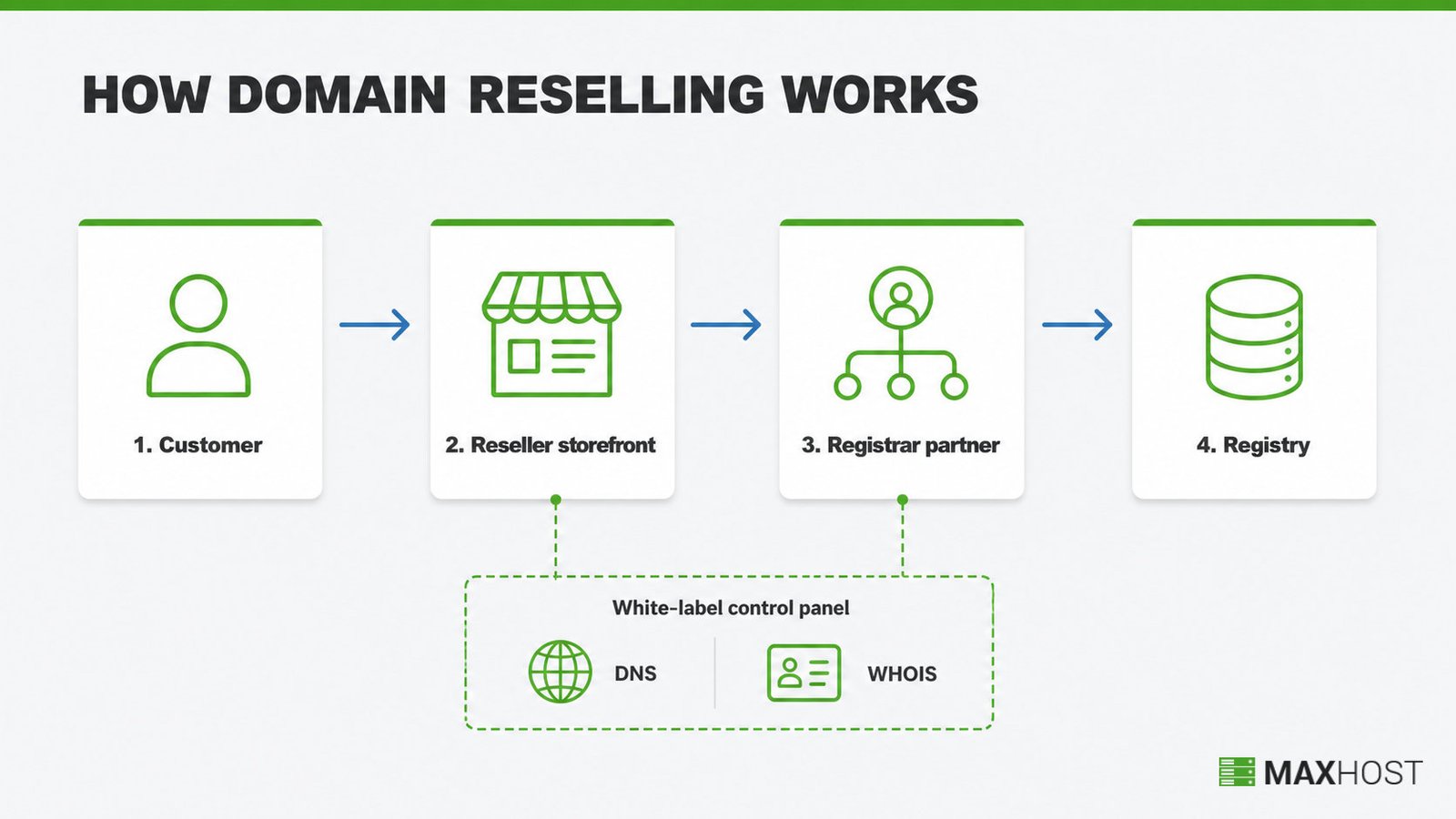
This private-label setup means a customer rarely sees the underlying registrar's name. Enom's reseller program stays invisible to a reseller's own customers, so the storefront, invoices, and support emails carry only the reseller's brand.
Reseller programs typically price registrations on a wholesale slab. The more domains a reseller sells, the deeper the discount on the next batch. Enom uses a four-tier structure, Silver through Platinum+, that rewards higher sales volume with a wider spread between wholesale and retail. GoDaddy's reseller program works the same way: a reseller sets its own markup above GoDaddy's wholesale rate for every domain sold through its storefront.
What Are the Benefits of Becoming a Domain Reseller?
Domain reselling's two headline benefits are recurring renewal revenue and low overhead. A domain a customer registers today typically renews every year, and reselling requires no servers, no accreditation, and little upfront cost.
Reselling domains offers five concrete advantages.
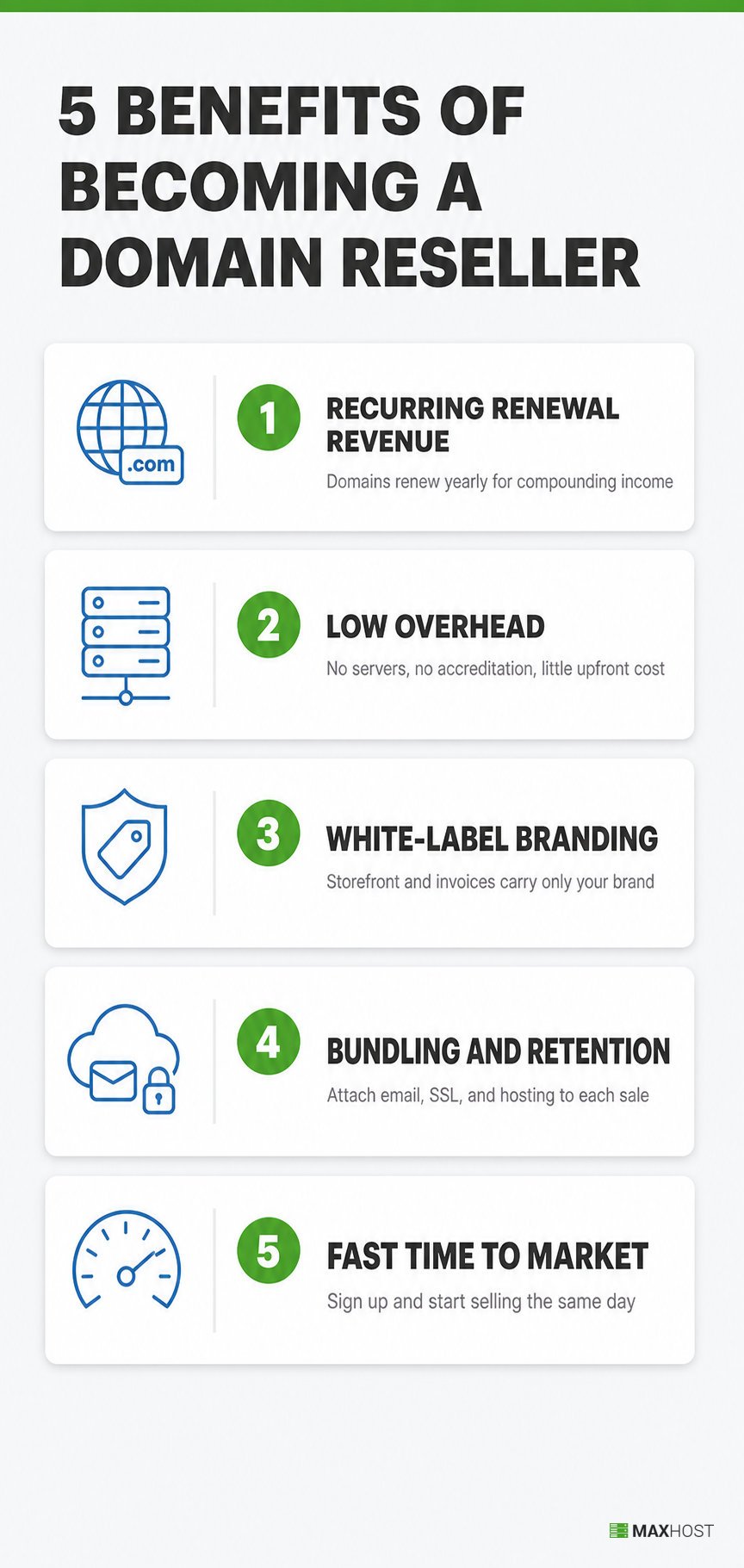
- Recurring renewal revenue. Every domain a reseller sells renews annually unless the customer switches providers, so a growing customer base compounds into predictable yearly revenue.
- Low overhead. A reseller needs no server hardware, no ICANN accreditation, and no registry connection of its own. The registrar handles that infrastructure.
- White-label branding. The reseller's storefront, invoices, and control panels carry only its own brand, so customers never see the underlying registrar.
- Bundling and retention. A reseller can pair every domain sale with email hosting, an SSL certificate, or web hosting. Those attached services also keep the customer inside its own ecosystem.
- Fast time to market. Signing up for a reseller account takes minutes, so a new business can start selling domains the same day it applies.
How Much Do Domain Resellers Actually Earn?
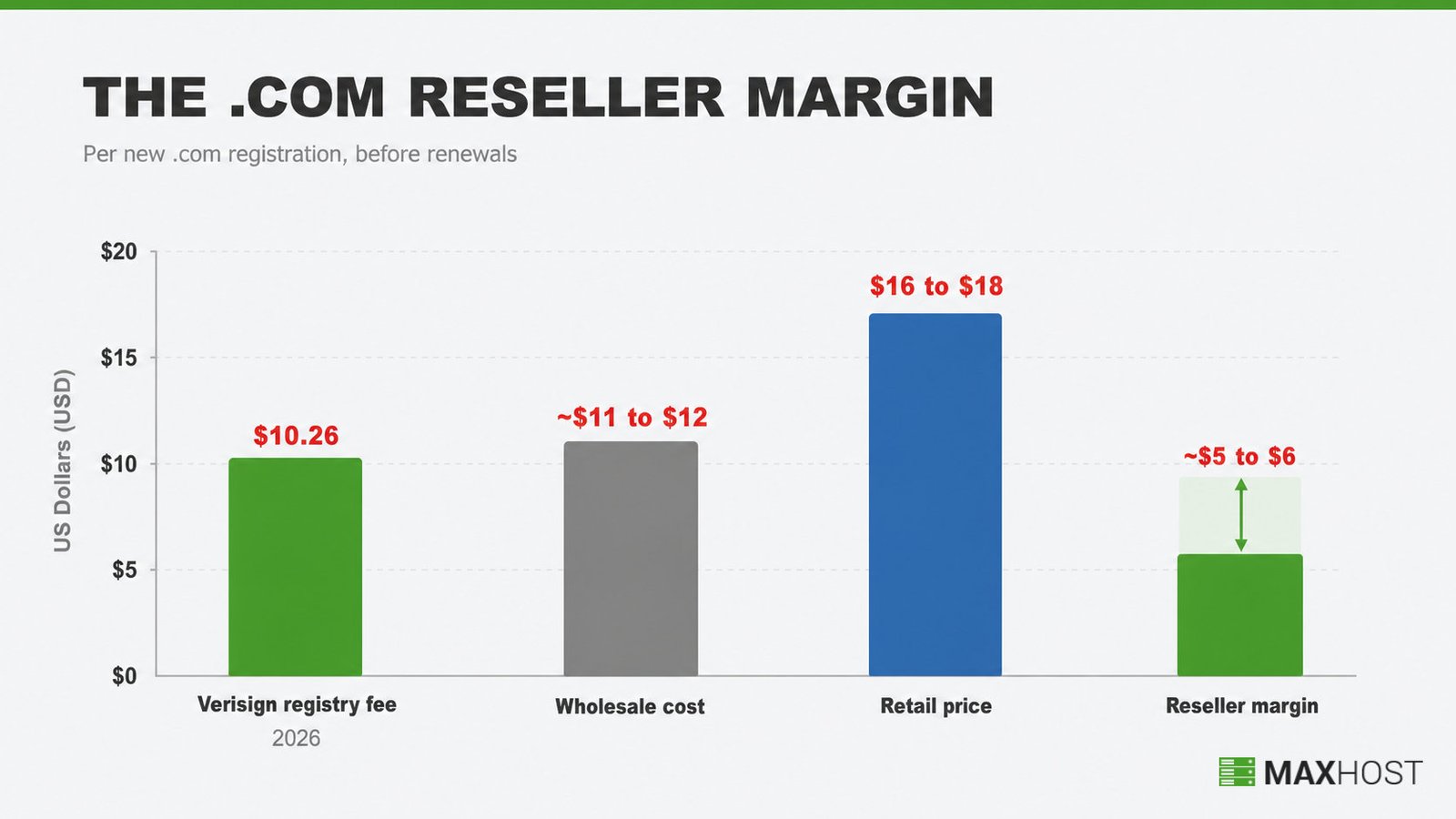
Domain reseller margins commonly run from about 10 to 50 percent per registration, with renewal revenue adding a second, more durable income stream on top. The exact spread depends on the reseller program's volume tier and the TLD sold.
The .com illustrates the real spread. A reseller program prices a .com wholesale near 11 to 12 dollars, since the Verisign registry fee alone is 10.26 dollars in 2026. Resellers commonly sell that same .com between 16 and 18 dollars retail. That leaves a spread of roughly 5 to 6 dollars per registration before renewals, inside the usual 10 to 50 percent range.
Four revenue levers combine to make domain reselling worthwhile past that first sale.
| Revenue lever | What it is | Why it compounds |
|---|---|---|
| Registration margin | The spread between wholesale cost and the reseller's retail price on a new domain | One-time per domain, but immediate |
| Renewal revenue | The same margin repeated every year a customer keeps the domain registered | Grows automatically as the customer base grows, with no new sale needed |
| Transfer and restore fees | Charges when a customer transfers a domain in or restores a lapsed one | Small, but recurring across an active customer base |
| Bundled attach | Hosting, email, and SSL sold alongside the domain | Multiplies revenue per customer without a second acquisition cost |
A reseller with 1,000 active domains at an average 6 dollar margin earns roughly 6,000 dollars a year from renewals alone. That figure excludes any bundled hosting, email, or SSL revenue.
Domain registration rarely stands as a profitable business on its own. Most resellers treat it as a low-margin anchor that pulls customers toward higher-margin hosting and services.
How Do You Become a Domain Reseller?
Becoming a domain reseller takes five steps, each building on the last.
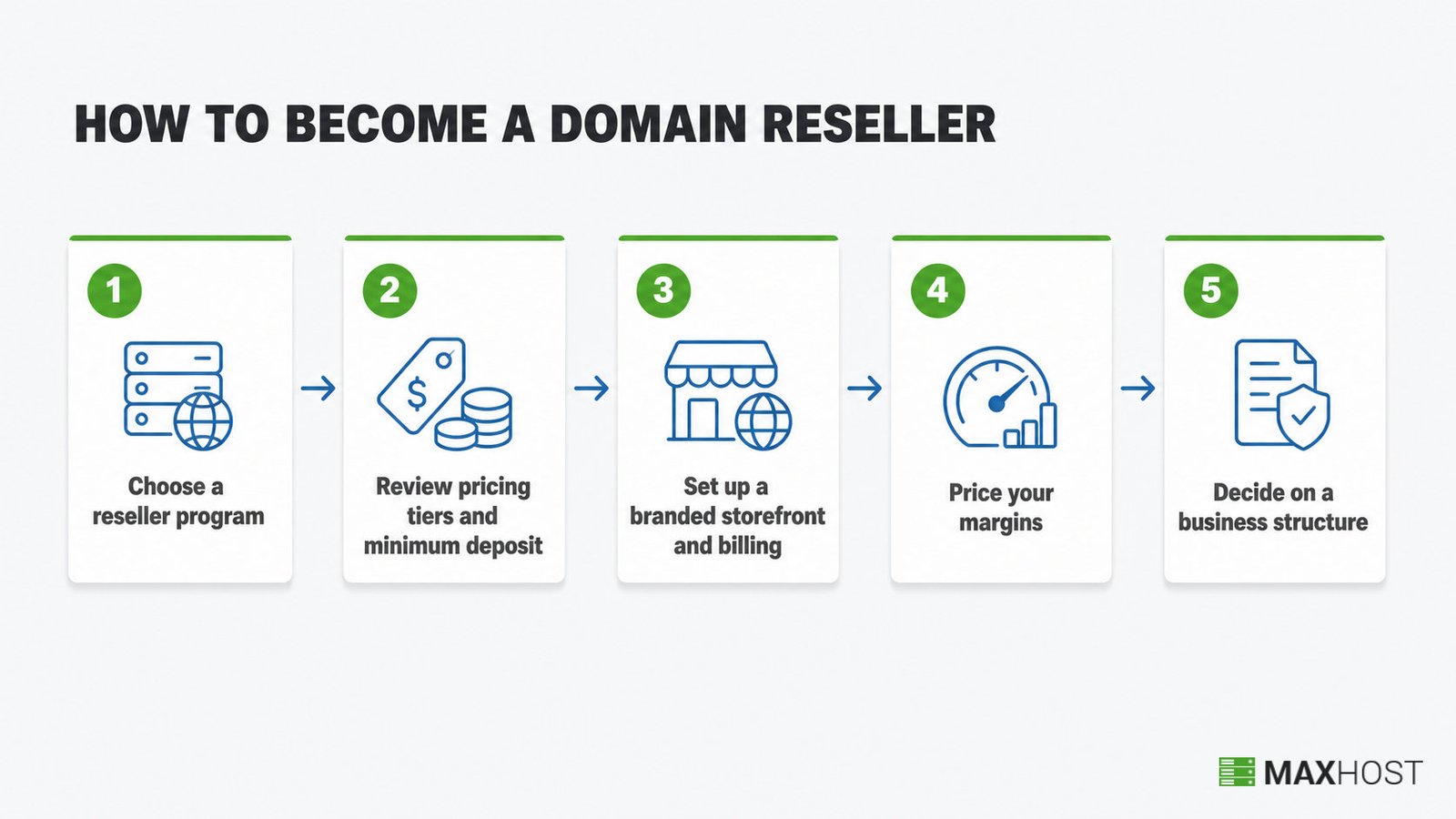
- Choose a reseller program or registrar, such as ResellerClub, Enom, GoDaddy Reseller, or CentralNic Reseller, based on its wholesale pricing and TLD coverage.
- Review the pricing tiers and minimum deposit, since most programs require a prepaid balance rather than a monthly fee.
- Set up a branded storefront with a domain search tool and a billing platform such as WHMCS, so orders, invoices, and renewals run without manual work.
- Price your margins across the TLDs you plan to sell, balancing competitiveness against your profit target.
- Decide on a business structure. Most resellers start as a sole proprietor and formalize later as volume grows.
No step here requires ICANN accreditation or server infrastructure of your own. Launching and marketing the storefront is the final step, covered in full in our guide to how to become a domain reseller.
Is a Domain Reseller the Same as a Hosting Reseller?
A domain reseller and a hosting reseller are not the same, though many businesses run both. A domain reseller resells domain name registrations; a hosting reseller resells server space under its own brand.
The two businesses often share the same storefront and billing setup, since both route through a reseller account and a platform like WHMCS. A business that bundles domains with reseller hosting or white label hosting creates a second recurring revenue stream from the same customer base. For the full comparison between those two hosting-resale models, see reseller hosting vs white label hosting.
How Is Domain Reselling Different From Domain Flipping?
Domain reselling is an ongoing service business that sells registrations to end customers under a reseller-program agreement. Domain flipping is a one-off investment: buying a domain to hold, then resell later for a profit.
Domain name speculation, commonly called domain flipping, is the practice of registering or acquiring generic domain names as an investment. The intent is to sell them later for a profit. A reseller earns from ongoing registrations and renewals across many customers. A flipper earns a one-time gain on a smaller number of domains it holds in its own portfolio.
The two roles can overlap. A domain reseller sometimes flips premium names from its own inventory alongside its regular reseller business. The core models stay distinct: recurring service revenue versus speculative investment gain.
How MaxHost Supports Domain Resellers
MaxHost does not operate a domain registry or reseller program itself. It is a WordPress and WHMCS theme that gives a domain reseller the storefront and billing front end a reseller program needs, without custom development.
A domain reseller running MaxHost gets an AJAX live domain search module built into the WordPress front end. A visitor can check availability before reaching checkout.
WHMCS order-form templates then carry that same branding into checkout and the client area. The reseller never loses a customer mid-purchase to a mismatched design.
MaxHost also ships GoDaddy Reseller Store plugin compatibility (version 2.2.6), for a reseller already running domains through a GoDaddy Reseller Plan. That plugin embeds a live domain-search widget directly into a WordPress page, so the storefront and the domain search sit on the same branded site.
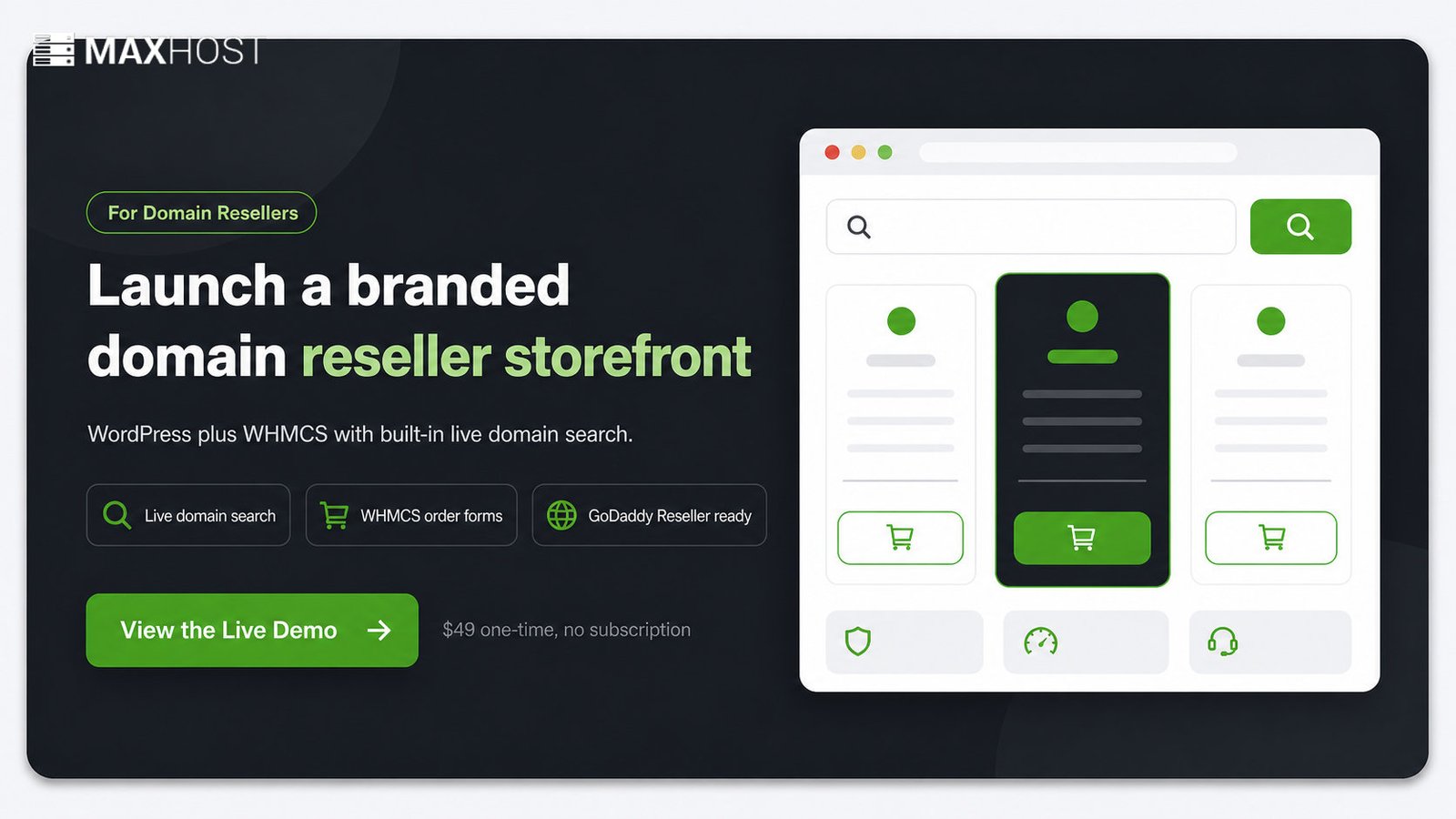
See the domain reseller website template built for exactly this storefront.
FAQs
What is a domain reseller?
A domain reseller is a company or person that sells domain name registrations through a registrar's reseller program. It buys wholesale and sets its own retail price. It typically runs alongside a hosting or web-services business.
Is domain flipping illegal?
No. Domain flipping, buying and reselling domains for profit, is legal. The exception is cybersquatting: registering a domain in bad faith to profit from someone else's trademark, which is illegal under the UDRP and the ACPA.
Do you need an LLC to become a domain reseller?
No ICANN rule requires a domain reseller to form an LLC. The accreditation requirement applies only to the underlying registrar. Forming an LLC is a general business-liability decision, not a domain-reseller-specific requirement.
How much can a domain reseller earn?
Earnings depend on volume and renewal retention, not one flat number. Registration margins commonly run 10 to 50 percent per domain, and renewal revenue from an existing customer base compounds every year a domain stays registered.
What's the difference between a registrar and a domain reseller?
A registrar holds direct ICANN accreditation and connects to the domain registry itself. A domain reseller sells registrations through an accredited registrar's program without holding that accreditation itself.
Can you resell domains without ICANN accreditation?
Yes. ICANN accreditation applies to registrars with direct registry access, not to resellers. A reseller operates under its registrar partner's agreement, and that registrar remains accountable for every domain the reseller sells.