A domain name is the human-readable address, such as wikipedia.org, that identifies a website or server on the internet. It replaces the numeric IP address the server actually uses, and the Domain Name System (DNS) translates one into the other.
What Are the Parts of a Domain Name?
A domain name has up to three parts, read right to left: the top-level domain (TLD), the second-level domain (SLD), and an optional subdomain. In blog.example.com, .com is the TLD, example is the SLD, and blog is the subdomain, each label separated by a dot.
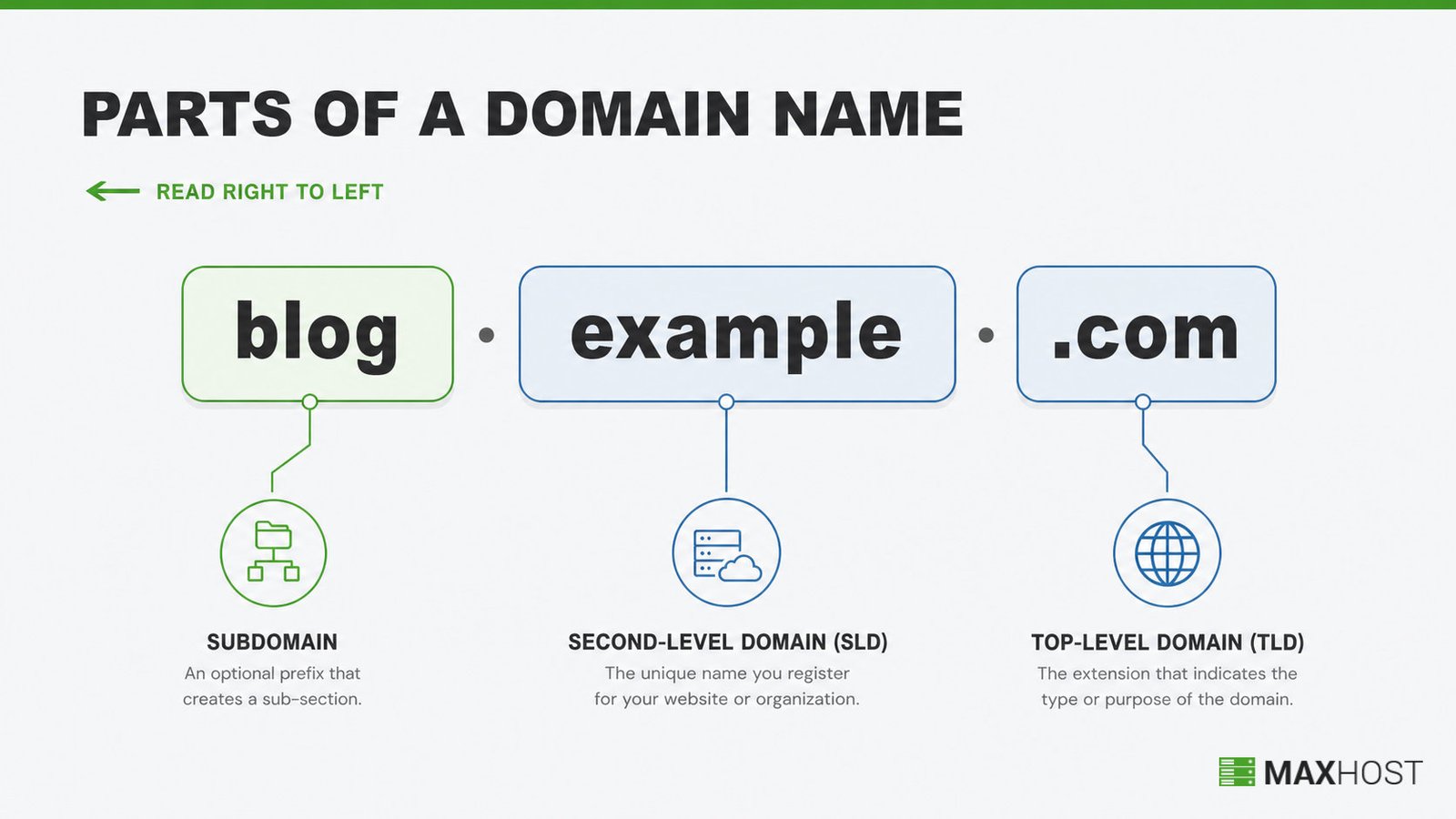
Each part plays a distinct role:
- Top-level domain (TLD): the suffix on the far right, such as .com, .org, or .uk, signaling the site's category or country.
- Second-level domain (SLD): the unique registered name directly left of the TLD, usually a brand or business, such as example.
- Subdomain: an optional prefix on the far left, such as blog or shop, that organizes a section of the site.
The country-code domain google.co.uk shows every layer at once. Here .uk is the country-code TLD, .co signals a commercial second-level category, and google is the registered name beneath it.
TLDs fall into three categories, and the category signals who can register under it.
| TLD type | What it signals | Example |
|---|---|---|
| Generic (gTLD) | Open registration, organized by theme | .com, .org, .net |
| Country code (ccTLD) | Tied to one country or territory | .uk, .ca, .fr |
| Sponsored (sTLD) | Restricted to an eligible community | .gov, .edu |
A subdomain extends a registered domain without a separate registration. Hosting companies use subdomains like cpanel.example.com or client.example.com to separate services under one root domain.
How Does a Domain Name Work?
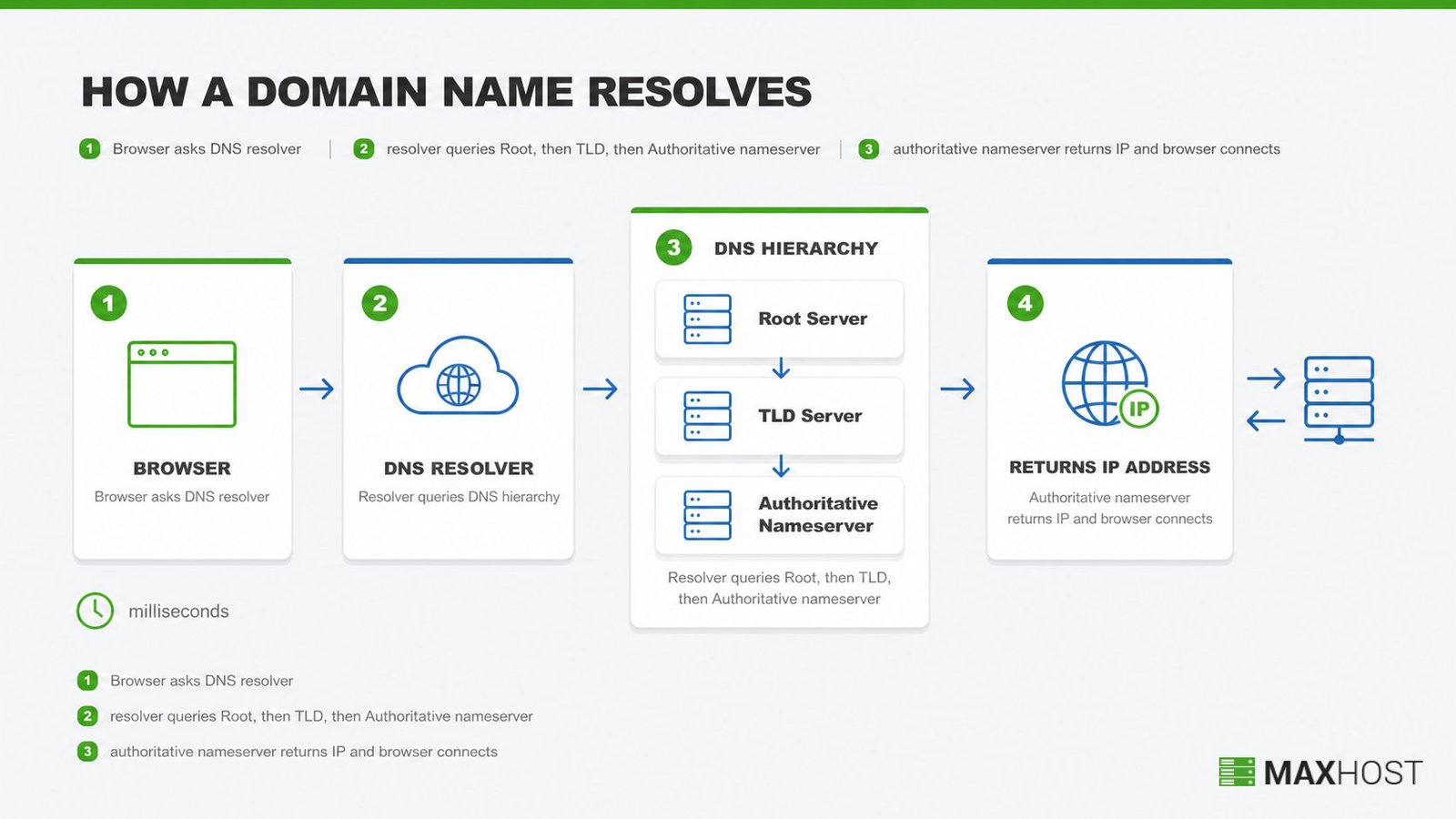
A domain name works by mapping to a numeric IP address through a DNS lookup. That lookup lets a browser locate and connect to the right server. Typing a domain triggers a chain of nameserver queries that resolves the name to that address, usually in milliseconds.
A domain name and the DNS server that resolves it are not the same thing. The domain is the address a person types; understanding what DNS does clarifies how that address turns into a location a browser can reach.
The resolution runs in three steps for any visit without a cached answer.
- The request: the browser asks a DNS resolver, usually the visitor's internet provider, to look up the domain.
- The hierarchy: the resolver queries the root server, then the TLD server, then the domain's authoritative nameserver, which holds the official records.
- The connection: the authoritative nameserver returns the IP address, and the browser connects to that server to load the site.
Resolvers cache each result for a set time, so repeat visits skip most of this chain and load faster.
How Is a Domain Name Different From a URL?
A domain name is only one piece of a URL. The full URL also carries the protocol, an optional subdomain, and the path to a specific page, while the domain alone just names the site.
| URL component | In https://blog.example.com/domain-name | What it does |
|---|---|---|
| Protocol | https:// | Sets the connection method between browser and server |
| Subdomain | blog. | Organizes an optional section of the site |
| Domain name | example.com | Identifies the site itself |
| Path | /domain-name | Points to one specific page on that site |
A domain name stays fixed for as long as its owner renews it. A URL changes constantly, since every new page, category, or query string produces a new one.
How Do You Register a Domain Name?
Registering a domain name means reserving it through an ICANN-accredited registrar, which submits the request to the TLD's registry and creates a WHOIS record.
The process takes five steps at any registrar:
- Pick a registrar: choose an ICANN-accredited registrar such as Namecheap, GoDaddy, or Cloudflare; you need not buy from the company that builds your site.
- Search availability: use the registrar's search box to check the name, and try another TLD like .net or .co if it is taken.
- Choose a term: register the name for one to ten years, since you are renting it rather than owning it outright.
- Add privacy: turn on WHOIS privacy protection so your contact details stay hidden from public lookups.
- Check out and auto-renew: enter your contact and payment details, then enable auto-renew so the domain does not lapse.
A registrar is the storefront: it checks availability, takes payment, and manages renewals on the owner's behalf. The registry runs the authoritative database for its TLD, and only accredited registrars can submit changes to it.
ICANN accredits registrars under a Registrar Accreditation Agreement, which sets the rules a registrar must follow to sell domains. Registration also creates a WHOIS record: the registrant's contact and technical details, filed with the registry. Privacy protection, sold by most registrars, often shields those details from public view.
Domain registration is not new. Symbolics.com became the first registered .com domain on March 15, 1985, according to Wikipedia's history of the domain name system.
Registrar choice matters beyond price. Auto-renew protects the name from lapsing, but some registrars renew at inflated rates or restrict transfers. Read the terms before buying. A domain reseller sells registrations under its own brand, while an accredited registrar or wholesale partner runs the backend. Many hosting businesses add reselling for recurring revenue.
Registering someone else's trademark in bad faith is domain squatting, a practice policies like the UDRP treat as a registration violation. Checking a name against existing trademarks before buying avoids that risk entirely.
What Else Does a Website Need Besides a Domain Name?
A domain name is only the address. A live, secure, fast, and reliable site also needs a few more pieces working together behind it.
- Web hosting stores the site's files and serves them to visitors whenever the domain resolves.
- An SSL certificate encrypts traffic between the visitor's browser and the server, so the address bar shows a padlock instead of a warning.
- A CDN caches the site's assets on servers near each visitor, cutting load times for people far from the origin server.
- Uptime measures how consistently the hosting stays reachable, and most hosts publish a monthly percentage guarantee.
- Email hosting runs a professional inbox at the domain, such as name@example.com, instead of a free generic address.
How MaxHost Supports Domain Names for Hosting Businesses
MaxHost bundles a live AJAX domain search module into its WHMCS-integrated WordPress theme. A hosting or reseller business can let visitors check domain availability without leaving its own site.
MaxHost is a WordPress theme built for web hosting companies, domain resellers, and corporate businesses that run WHMCS. It pairs hosting-focused marketing demos with matching WHMCS client-area templates, so the marketing site and the WHMCS checkout share one design.
The Domain Search and more module renders as an AJAX-driven search box, so availability results appear without a page reload. It hands off directly into WHMCS domain registration, transfer, and reseller flows. That keeps the buying path on the hosting company's own branded site, not a third-party lookup tool.
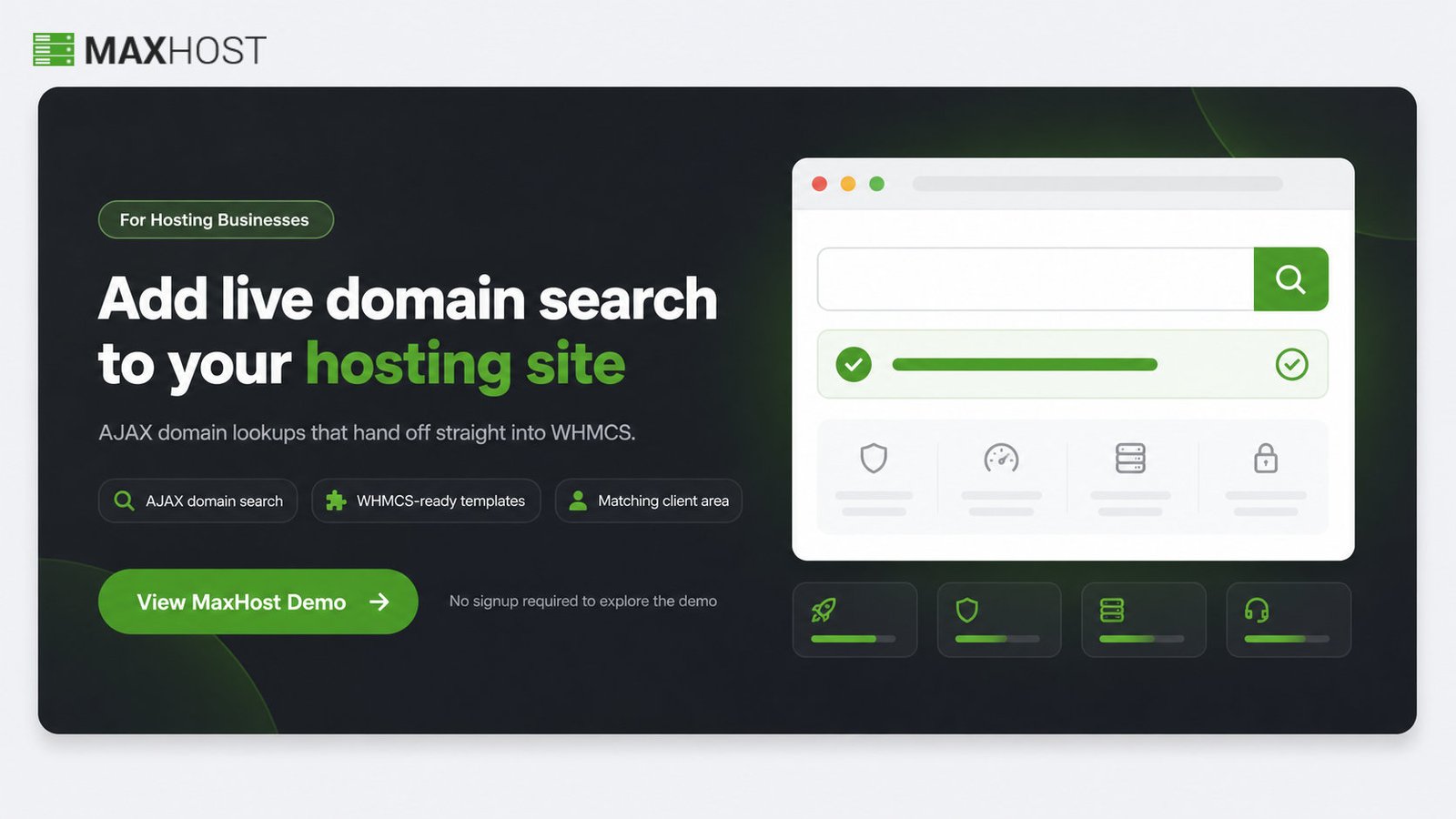
Hosting resellers already selling domains often want that search box on their own storefront instead of sending buyers elsewhere. See how to add a live domain search to your WordPress hosting site.
FAQs
What is a domain name?
A domain name is the readable text address, such as example.com, that identifies a website or server instead of its numeric IP address. DNS translates it into that address behind the scenes.
What is an example of a domain name?
wikipedia.org, google.com, and support.example.co.uk are all domain names. The last one shows every layer: a subdomain, a second-level domain, and a two-part country-code TLD.
Do you need a domain name for a website?
Yes, for any professional or owned site. The only common exception is a free platform subdomain, like a page hosted at yoursite.wordpress.com, which trades a custom address for zero setup cost.
How much does a domain name cost?
Standard TLDs like .com typically run about $10 to $25 a year through most registrars, with the first year sometimes discounted. Premium or highly sought names can cost far more, sometimes thousands of dollars.
What is the difference between a domain name and a website?
The domain name is the address; the website is the actual content and pages served at that address. A domain without hosting and files behind it resolves to nothing.