Reseller hosting is a business model where you buy server capacity wholesale from an upstream provider. You then repackage and resell it to your own clients under your own brand. It lets you launch a hosting business without buying, racking, or maintaining any servers yourself.
This guide covers how reseller hosting works, what a reseller actually does day to day, the benefits and realistic costs, and who it fits best. It also compares reseller hosting to shared hosting and white label hosting, then covers how to get started.
How Does Reseller Hosting Work?
Reseller hosting works by buying a wholesale, WHM-based reseller package from an upstream host. You then subdivide it into branded accounts for your own clients.
The reseller workflow runs in four steps.
- Buy a reseller package from an upstream host that includes WHM (Web Host Manager) access.
- Use WHM to create an individual cPanel account for each client site.
- Set your own branding, custom nameservers, plan names, and prices above your wholesale cost, so clients never see the upstream host.
- Bill and support clients directly, often automated through WHMCS.
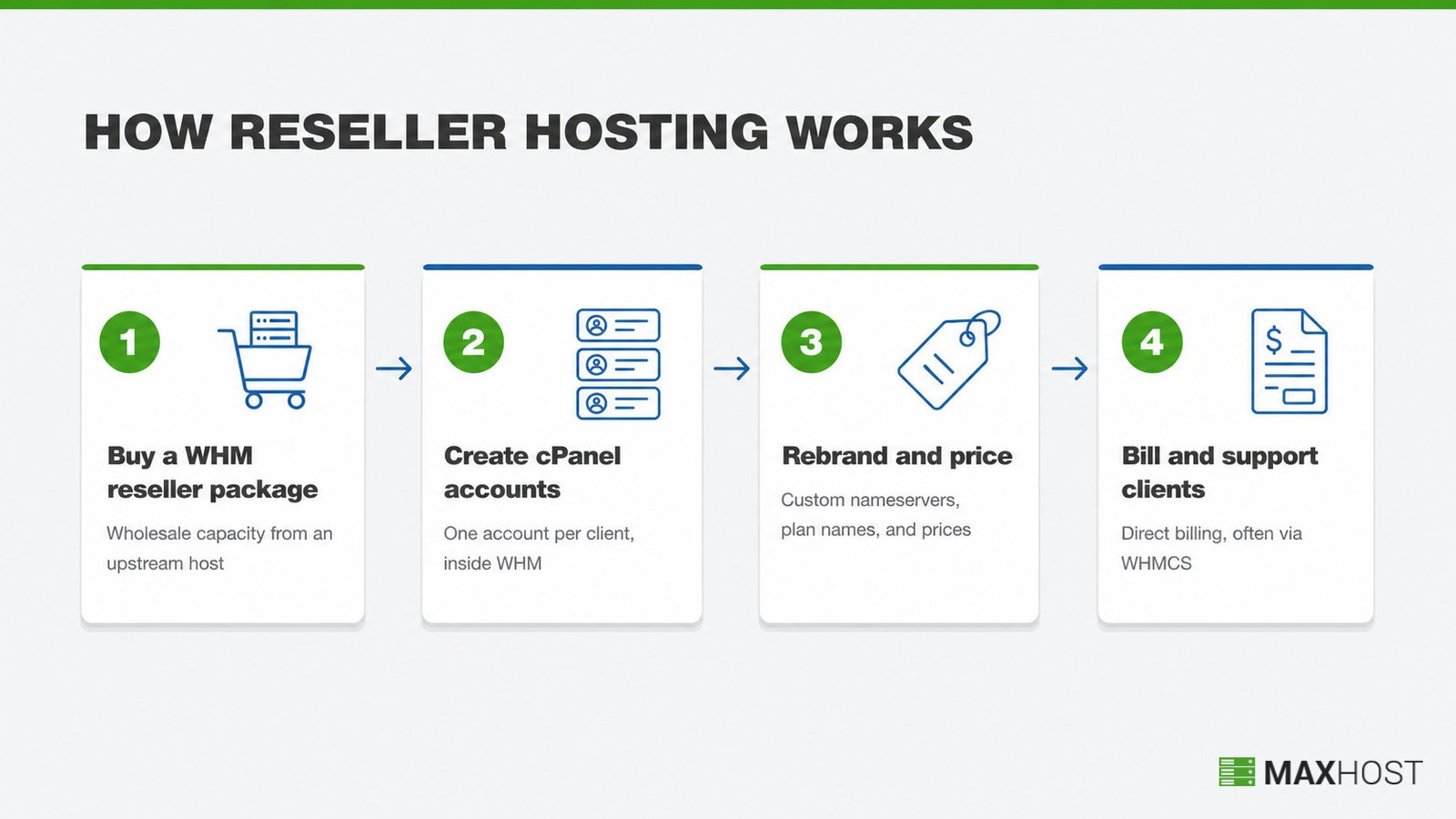
WHM's own product documentation confirms administrators can create cPanel accounts for customers, which is the exact provisioning step a reseller repeats for every new client.
Depending on the upstream provider, you can resell shared, VPS, dedicated, or cloud plans this way. That is the same mix covered in our guide to the types of web hosting. If you are deciding which plan type to resell, VPS vs cloud hosting breaks down the tradeoffs.
What Does a Web Hosting Reseller Actually Do?
A web hosting reseller brands hosting plans, sets prices and margins, provisions and manages client accounts through WHM, and runs billing and support. The job blends light server administration with real customer service and sales.
A reseller typically handles five responsibilities day to day.
- Branding and pricing plans under their own company name, not the upstream provider's.
- Provisioning, suspending, and managing client cPanel accounts inside WHM.
- Billing, invoicing, and renewals, usually automated through WHMCS. WHMCS's own product page promises to automate invoicing, recurring billing, and payment collection across a reseller's client base.
- Answering client support tickets for account, email, and website issues.
- Escalating server-level problems, such as hardware failures or network outages, to the upstream provider.
What Are the Benefits of Reseller Hosting?
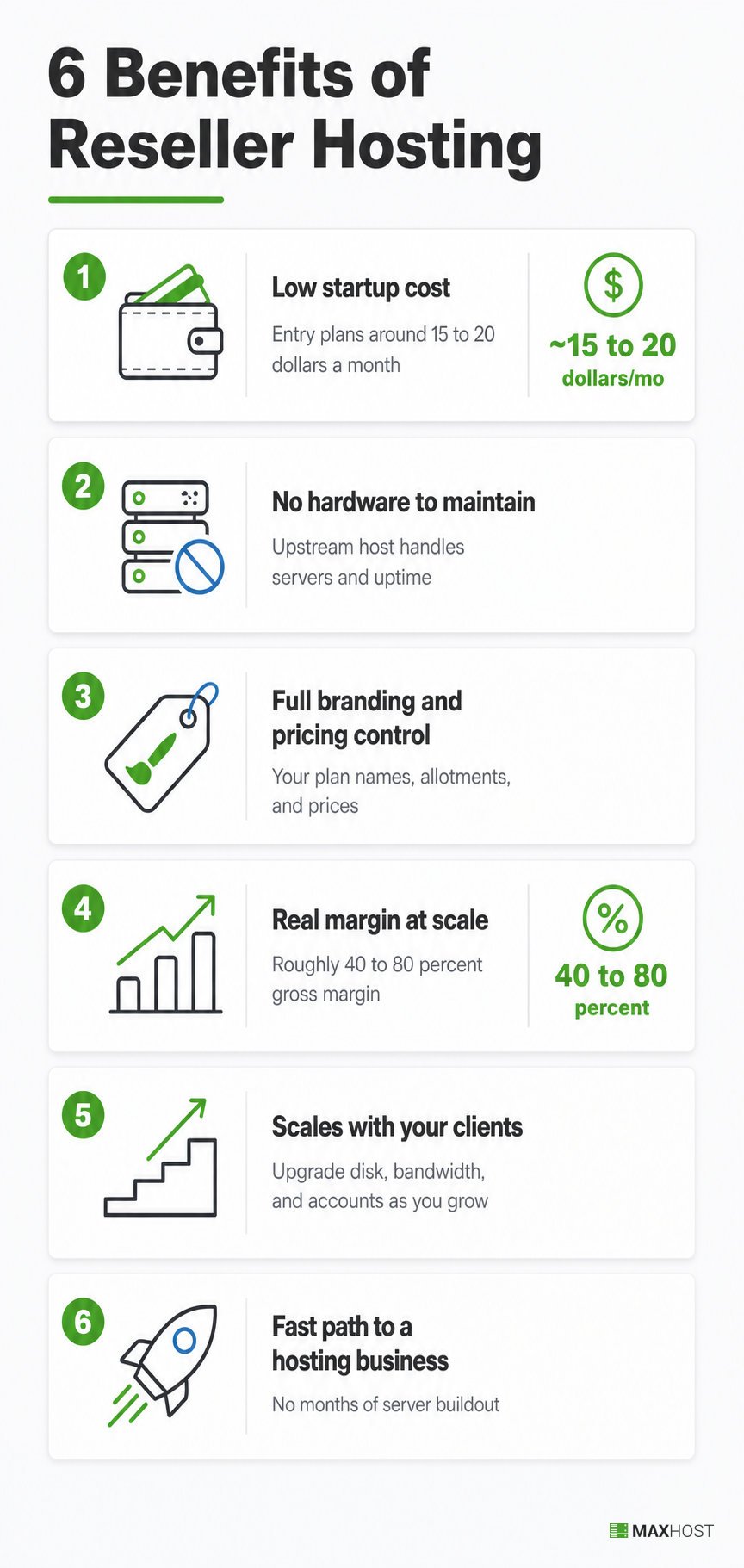
Reseller hosting's main benefits are a low startup cost and no server hardware to maintain. You also get full control over branding and pricing, plus a fast path into a hosting business. The specific benefits break down as follows.
- Low startup cost. Entry-level reseller plans commonly start around $15 to $20 a month. ScalaHosting's reseller plan currently starts at $14.95 a month during its introductory term.
- No server hardware or maintenance. The upstream provider handles hardware, network uptime, and OS patching, so you focus on clients instead of servers.
- Full control over branding and pricing. You set your own plan names, resource allotments, and prices instead of matching someone else's template. That spread above your wholesale cost is your margin.
- Real margin potential at scale. A June 2026 reseller hosting margin analysis puts new-reseller margins around 40 to 50 percent. That climbs toward 75 to 80 percent once a reseller manages 50 or more clients.
- Scales with your client base. You start on a small entry plan and upgrade disk, bandwidth, or accounts as clients grow. Your costs then track your revenue instead of leading it.
- A fast path into a hosting business. You skip months of building server infrastructure and start selling branded plans as soon as WHM and WHMCS are configured.
For the full playbook, see our guide to starting a reseller hosting business.
Who Should Use Reseller Hosting?
Reseller hosting fits anyone who wants to sell hosting under their own brand without running servers. Five groups get the most value from it.
- Web designers and developers who build client sites can bundle hosting into their existing service packages for recurring income.
- Digital agencies managing many client websites keep each site in a separate, isolated account while adding a monthly revenue line.
- Freelancers and IT consultants with existing client relationships add hosting as a natural upsell.
- New entrepreneurs can launch a web hosting company using white-label tools, without buying server hardware.
- Domain resellers layer reseller hosting onto an existing domain business for a second recurring revenue stream.
Agencies already building client sites are well placed to also stand up a web hosting company's website of their own. That pairs hosting with the design and development work they already sell.
How Is Reseller Hosting Different from Shared Hosting?
Shared hosting gives you one account for your own site. Reseller hosting gives you a wholesale package you subdivide into many branded accounts for your own clients.
| Aspect | Shared hosting | Reseller hosting |
|---|---|---|
| Accounts | One cPanel account, for your own site | 10 to 250 cPanel accounts, managed under WHM |
| Reselling | Not permitted on the plan | The entire point of the plan |
| Control panel | cPanel only | WHM for you, a separate cPanel account per client |
| Typical cost | Roughly $3 to $10 a month | Roughly $15 to $50 a month |
| Best for | One owner with a single website | Agencies, freelancers, and resellers managing many client sites |
Reseller hosting is sometimes called white label hosting, but the two are not identical. White label hosting hides the upstream provider's brand completely, while traditional reseller hosting may still show it in places. For the full breakdown, see reseller hosting vs white label hosting, or read our dedicated guide to white label hosting.
How MaxHost Supports Reseller Hosting Businesses
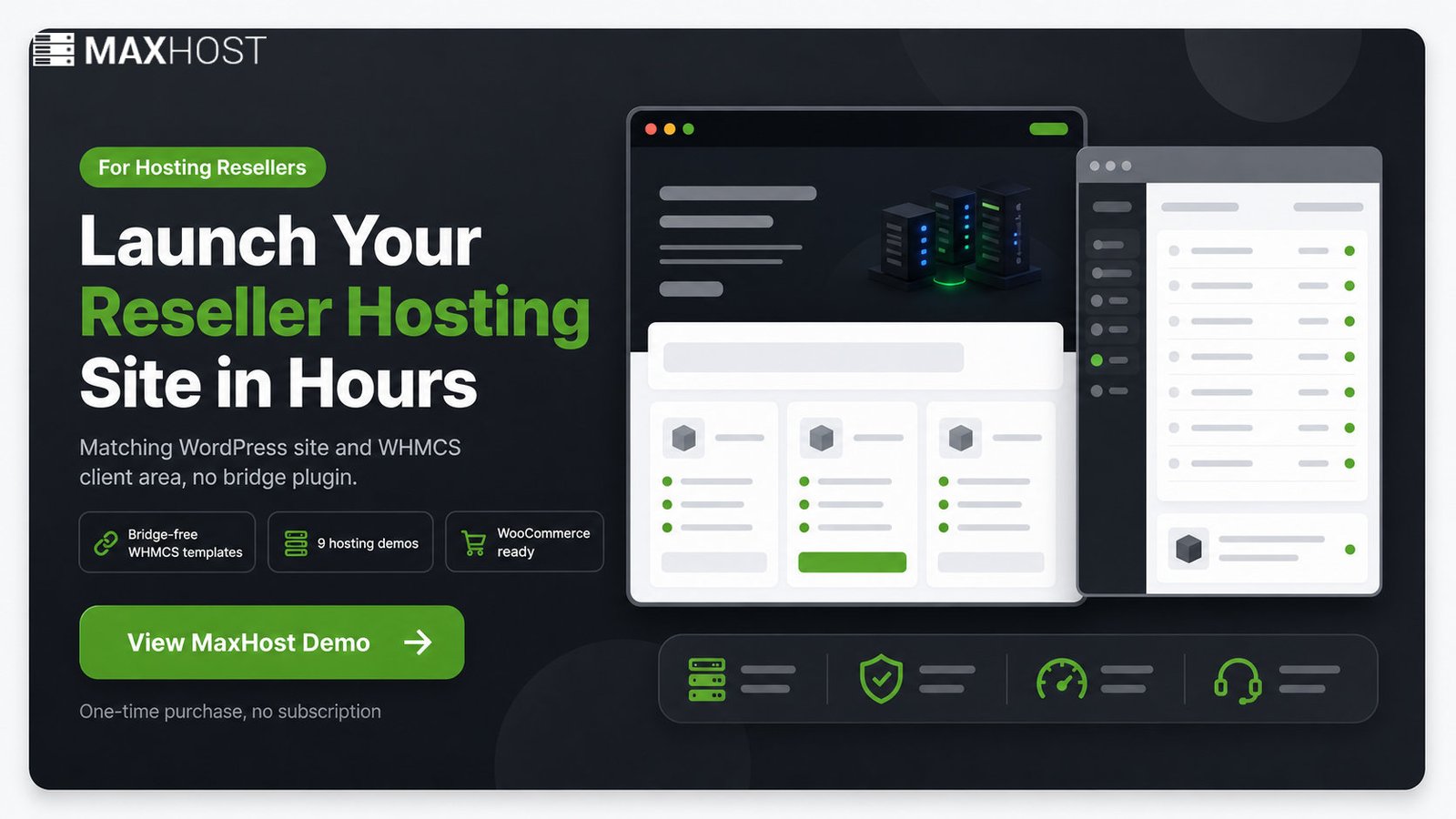
MaxHost is a WordPress and WHMCS theme built for reseller hosting businesses. It ships a branded marketing site and a design-matched WHMCS client area, without a bridge plugin, the moment you start reselling.
A new reseller needs two things live fast: a professional marketing site and a WHMCS client area that looks like the same brand. MaxHost bundles both, so moving from your marketing pages into checkout never feels like a different company mid-purchase.
MaxHost ships WHMCS templates that install directly into WHMCS. That skips the bridge plugin many hosting themes depend on, and that plugin can break on updates. It also includes nine importable hosting demos, from shared and VPS to cloud and CyberPanel layouts. You can launch a matching front end in hours.
See the demo library inside MaxHost's reseller hosting WordPress theme, built for exactly this launch moment.
FAQs
What is reseller hosting?
Reseller hosting is a business model where you buy hosting capacity wholesale from an upstream provider. You then repackage and resell it to your own clients under your own brand. It requires no server hardware of your own.
How does reseller hosting work?
You buy a WHM-based reseller package from an upstream host, then use WHM to create a cPanel account for each client. You set your own prices and bill clients directly, often through WHMCS.
Is reseller hosting a good business to start?
Reseller hosting can be a good business to start because it needs a low upfront investment and lets you set your own margins. Its profitability depends on client acquisition and retention, not the hosting itself, so results vary by how well you sell and support clients.
What's the difference between reseller hosting and white label hosting?
Reseller hosting lets you rebrand hosting plans, though the upstream provider's name may still surface occasionally. White label hosting hides the upstream provider completely, so every touchpoint, from the client area to support emails, carries only your brand.
Do I need technical skills to run a reseller hosting business?
Basic familiarity with WHM and cPanel helps, since you provision and troubleshoot client accounts there. WHMCS automates most of the technical overhead, like billing, provisioning, and account suspension, so deep server administration knowledge is not required to start.
How much does it cost to start reseller hosting?
Entry-level reseller hosting plans commonly start around $15 to $20 a month, plus optional WHMCS licensing and a hosting-company website. Costs scale up with disk space, bandwidth, and the number of client accounts your plan supports.