White-label hosting is reselling another provider's hosting under your own brand, fully rebranded so the upstream provider stays invisible to your customers. It gives a reseller full control over nameservers, the control panel, and billing, unlike plain reseller hosting, which often still shows the original host's branding.
This guide covers how the rebranding mechanism works, the real benefits, and how white-label hosting differs from reseller hosting and private-label hosting. It also covers real start-up costs and how MaxHost supports a white-label hosting storefront.
How Does White Label Hosting Work?
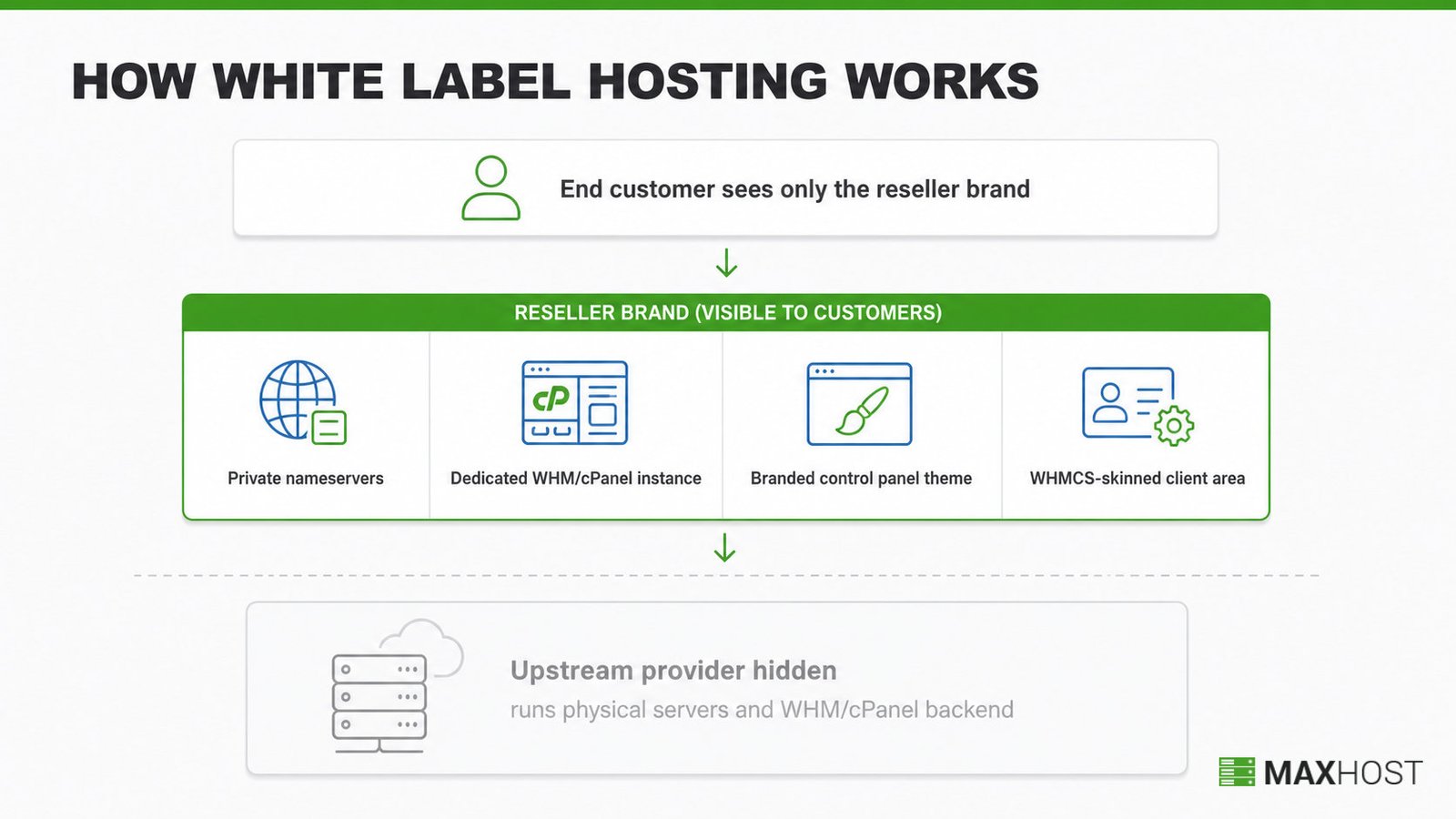
White-label hosting works by rebranding an upstream provider's infrastructure so completely that the end customer never sees the original host. The reseller controls the domain, nameservers, and the WHMCS-skinned client area. The upstream provider still runs the physical servers and the WHM or cPanel backend behind the scenes.
White-label hosting sits inside the broader landscape of types of web hosting, one branding layer a reseller adds on top of an upstream plan.
Four components make the rebrand work:
- Private nameservers point domain lookups to the reseller's own brand instead of the upstream host's, per cPanel's WHM Resellers documentation.
- A dedicated WHM or cPanel instance gives each reseller account its own control panel, separate from other resellers on the same server.
- A branded control panel theme replaces the upstream provider's logo and colors with the reseller's own, using WHM's Theme Manager.
- A WHMCS-skinned client area handles cart, invoicing, and support under the reseller's brand, per WHMCS's reseller program.
Most white-label resellers start on a shared or VPS tier before growing into higher capacity. For a full breakdown of that entry tier, see what is shared hosting.
The billing layer runs on WHMCS, the platform white-label resellers use to automate invoicing, provisioning, and support tickets under their own brand.
What Are the Benefits of White Label Hosting?
White-label hosting delivers recurring monthly revenue, higher profit margins, and full brand control. You buy at wholesale, resell under your own name at a markup, and keep the client while the provider runs the servers.
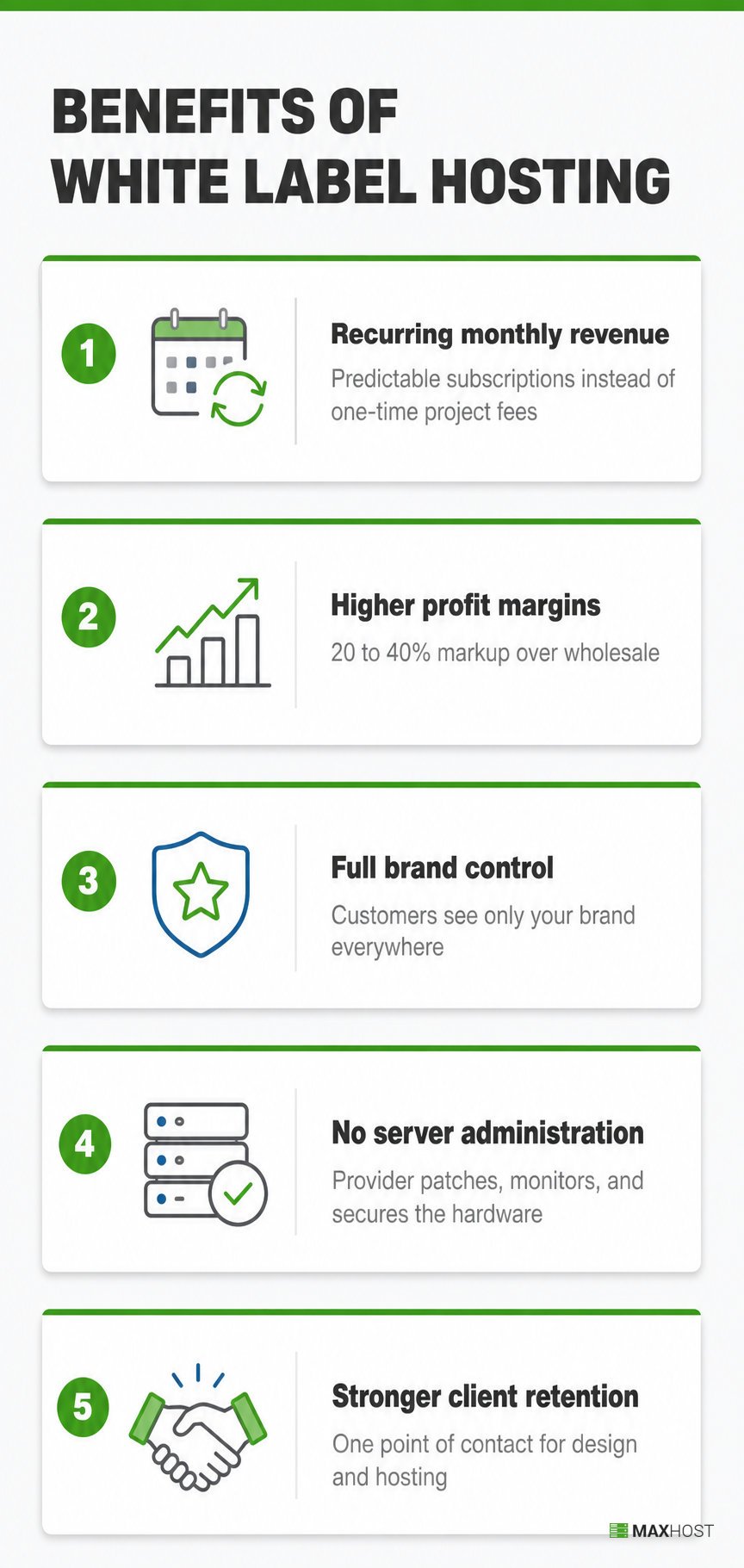
- Recurring monthly revenue. Hosting bills every month, so you earn predictable recurring revenue instead of one-time project fees. That turns a design or development client into a subscription that renews on its own.
- Higher profit margins. You buy hosting at wholesale and set your own retail price, so the markup is yours to keep. Resellers commonly add 20% to 40% above the wholesale cost.
- Full brand control. Your customers see only your company on the nameservers, control panel, and invoices. The upstream provider stays completely hidden, so every interaction builds your brand, not someone else's.
- No server administration. The upstream provider patches the operating system, monitors uptime, and secures the physical hardware. You never touch a data center, so a non-technical reseller can run the business.
- Stronger client retention. You stay the client's single point of contact for design, development, and hosting together. That all-in-one relationship makes customers far less likely to leave for another provider.
A reseller weighing VPS vs cloud hosting picks the underlying capacity first. Then a structured how to choose a web host framework helps vet the upstream provider itself. Many white-label resellers also sell domains alongside hosting plans, a role explained in what is a domain reseller.
How Is White Label Hosting Different from Reseller Hosting?
White-label hosting fully rebrands reseller hosting, and private-label hosting fully customizes it: the three sit on a spectrum from provider-branded to reseller-exclusive.
| Attribute | Reseller Hosting | White-Label Hosting | Private-Label Hosting |
|---|---|---|---|
| Brand visibility | Often shows the upstream provider on the panel or nameservers | Upstream provider fully hidden | Upstream provider fully hidden |
| Product | Standard packages resold as is | Standard packages, rebranded | Custom-built plans for one reseller |
| Control panel | Shared or manually configured | Private nameservers, branded theme | Private nameservers, branded theme, reseller-defined structure |
| Best for | A small, hands-on customer base | A reseller launching a branded hosting business | A reseller wanting a distinct product line |
Private-label hosting works like white-label hosting, but it skips the generic plan. The upstream provider builds pricing tiers and features to the reseller's own spec, not a shared template every reseller resells identically.
For the full side-by-side breakdown, see the reseller vs white-label comparison.
How MaxHost Supports White Label Hosting Businesses
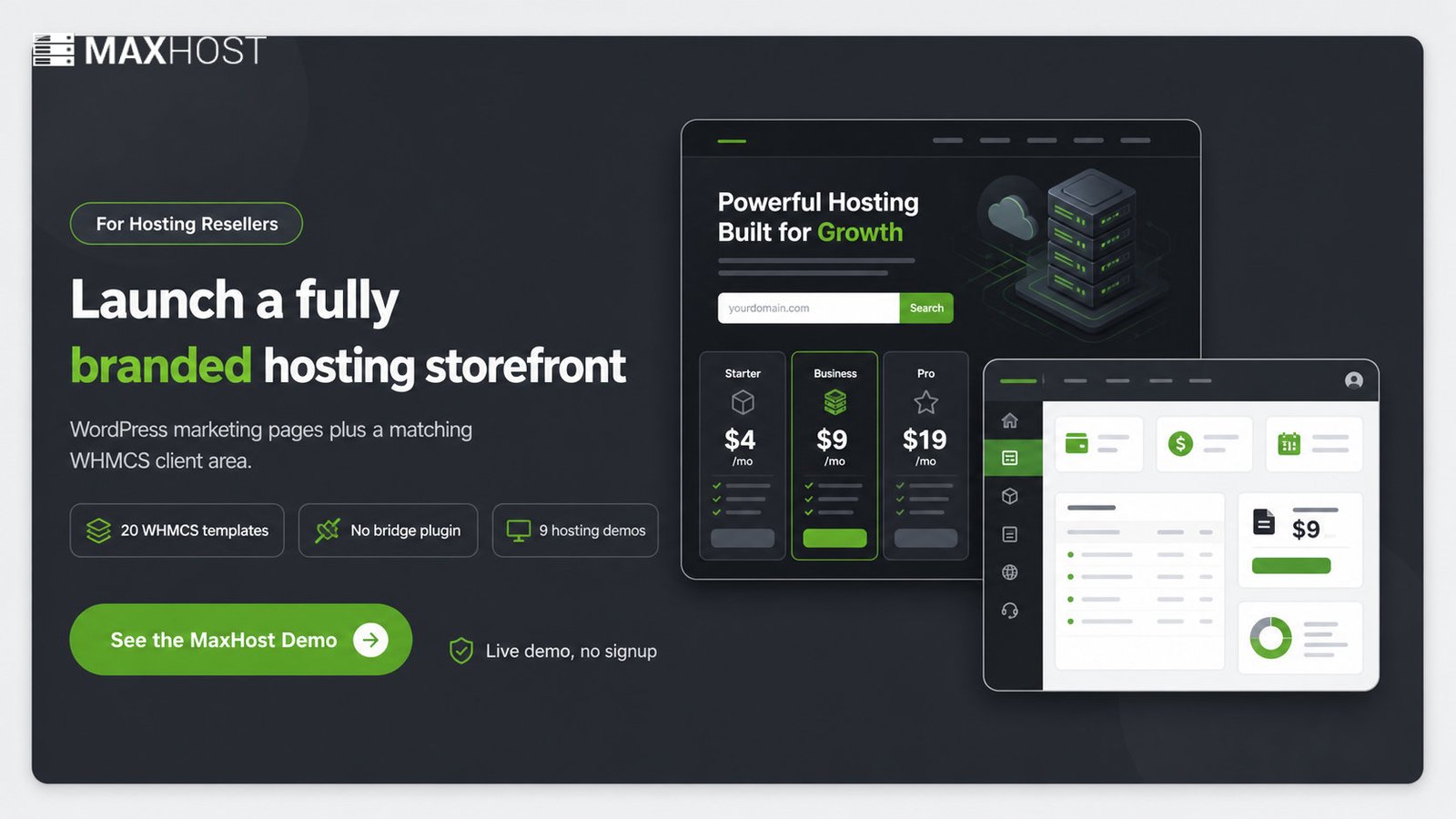
MaxHost gives a white-label hosting reseller a fully branded storefront. It pairs importable hosting-themed WordPress marketing pages with a WHMCS client area skinned to match, installed directly with no bridge plugin.
A white-label operator needs the marketing site and the billing storefront to look like one business, not two bolted together. MaxHost bundles 20 WHMCS client-area templates that install directly into WHMCS, so checkout, invoices, and support tickets carry the reseller's own branding throughout. The theme has shipped updates from 2016 through 2026, with roughly 1,250 sales and a 4.69 out of 5 rating across 48 reviews on ThemeForest.
Nine hosting-focused WordPress demos give a white-label reseller shared, VPS, cloud, and dedicated plan pages without a custom design project. The reseller hosting WordPress theme pairs those demos with GoDaddy Reseller Store plugin support. A reseller who also sells domains can add that storefront to the same branded site.
See the MaxHost demo to view the hosting and WHMCS templates a white-label reseller can launch on.
FAQs
What is white label hosting?
White label hosting is reselling another provider's hosting under your own brand, with the upstream provider fully hidden from your customers. You control the nameservers, the control panel branding, and the WHMCS-skinned billing experience.
Do I need to run my own servers for white label hosting?
No, the upstream provider owns and runs the physical servers. You manage branding, billing, and customer support while the provider handles hosting infrastructure, security patching, and uptime.
Do I need technical hosting skills to offer white label hosting?
No more than plain reseller hosting requires. The upstream provider handles server administration, so you focus on sales, support, and keeping the brand experience consistent.
How much does white label hosting typically cost to start?
Entry white-label reseller plans generally run from about $10 to $50 a month, depending on the upstream provider and included capacity. Markup on top of that wholesale cost typically runs 20 to 40%. For the fuller launch picture, see how to start a reseller hosting business.