Shared hosting is a web hosting model where many websites run on one physical server and split its CPU, RAM, and storage. It costs less than any other hosting tier because the server's expense spreads across every site on it.
How Does Shared Hosting Work?
Shared hosting places hundreds or thousands of websites on one physical server, each drawing from the same pool of CPU, RAM, and storage. A control panel, most often cPanel, gives each site owner a browser-based dashboard for files, email, and databases. Providers price shared plans low by oversubscribing that shared pool.
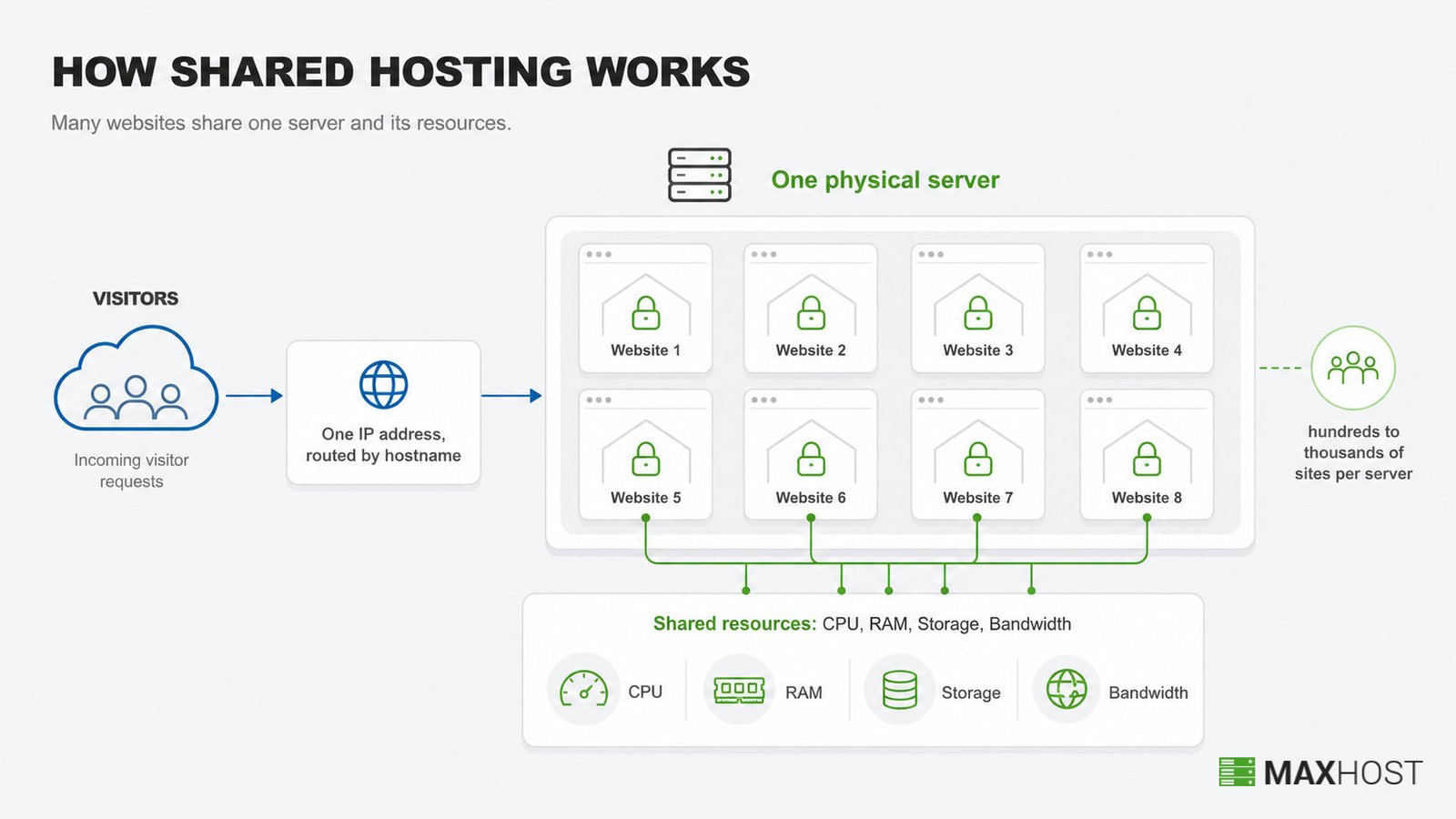
Shared hosting works like an apartment building. Each site keeps its own locked unit for its files and databases. Every tenant shares the building's plumbing and power, meaning the server's CPU, RAM, and bandwidth.
Most shared servers run name-based hosting. One IP address serves every site on the box, and the server reads each request's hostname to route it correctly. This is what makes packing hundreds of sites onto one machine possible without hundreds of IP addresses, according to Wikipedia's shared web hosting overview.
Oversubscription is the pricing mechanism behind shared hosting's low cost. A server with 256 GB of RAM and 32 CPU cores could support roughly 256 accounts at 1 GB each. A provider selling $10-a-month plans often sells 1,000 accounts on that same box, a near four-times oversell ratio. The bet works because most sites never use their full allotment at the same time.
Providers cap usage instead of guaranteeing dedicated capacity. Typical limits include CPU seconds per process, RAM per account, and inode counts, the number of files and folders a filesystem can index. A 1 KB text file and a 1 GB video file each use one inode, so file-heavy sites can hit inode caps before storage caps.
Shared hosting is one of several types of web hosting a new site owner can choose from, alongside VPS, dedicated, and cloud hosting.
What Are the Benefits of Shared Hosting?
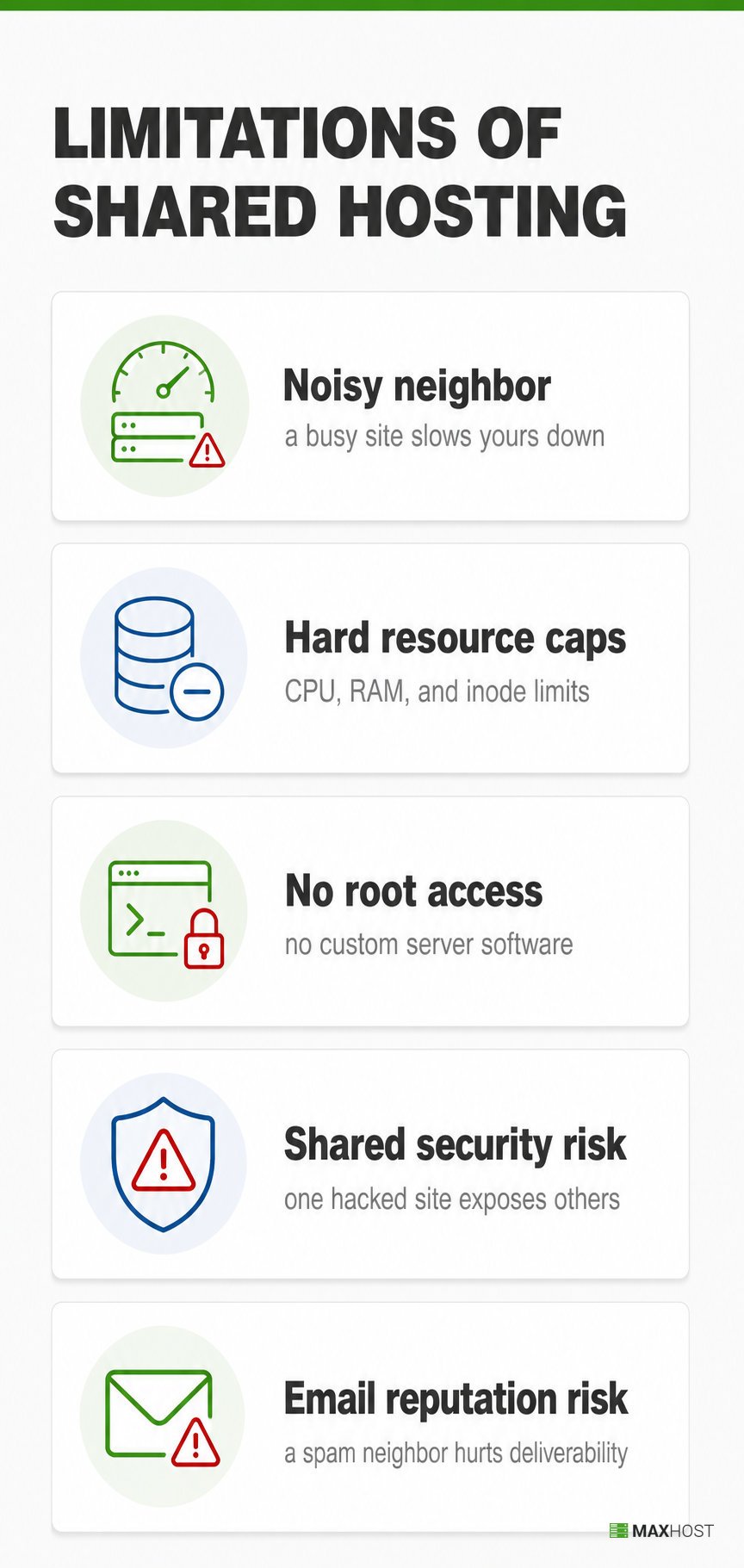
Shared hosting's core benefits are low cost, provider-managed maintenance, a beginner-friendly setup, and bundled starter extras.
- Costs less than any other tier. Entry plans run $2 to $15 a month, cheaper than VPS, dedicated, or cloud hosting at any comparable spec, per Hostinger's shared hosting breakdown.
- Removes server administration from your plate. The provider patches the operating system, monitors uptime, and secures the physical server, so you never touch server-level maintenance.
- Runs on a point-and-click control panel. cPanel handles file uploads, email accounts, and database creation without command-line skills.
- Bundles the extras a new site needs. Most plans include a free SSL certificate, business email, and one-click WordPress installation, so you launch without buying add-ons.
- Scales without a same-day migration. Most providers let you move to a higher shared tier first, then to VPS, as traffic grows.
What Are the Limitations of Shared Hosting?
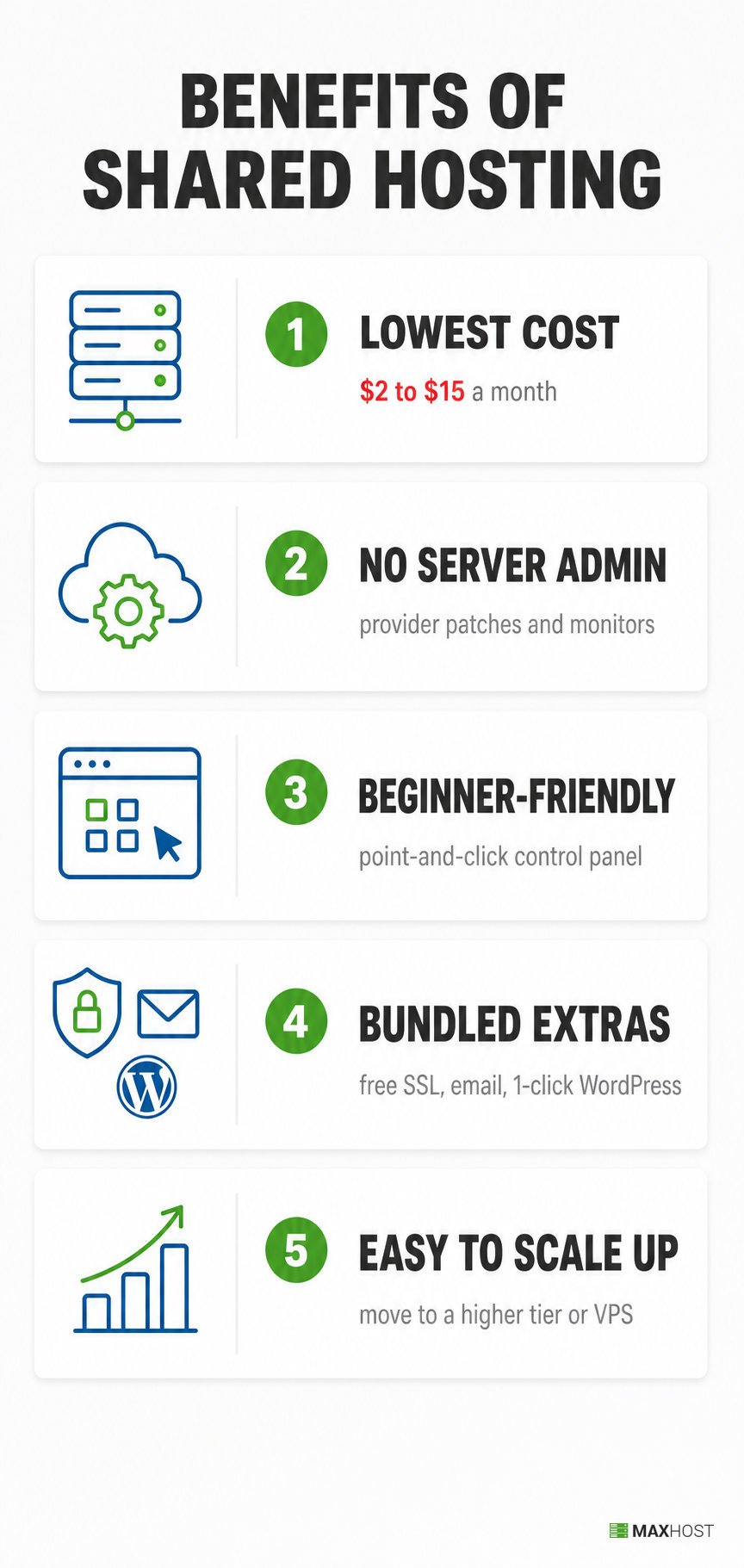
Shared hosting's limitations are the noisy neighbor effect, hard resource caps, and limited server-level control.
- Neighboring sites can slow yours down. A traffic spike on another account competing for the same CPU and RAM can drag down your site's response time, an effect hosts call the noisy neighbor problem.
- Resource caps hit before storage does. CPU seconds, RAM per process, and inode counts throttle busy sites long before the storage quota fills.
- No root access. You cannot install custom software, change server-level PHP configuration, or choose your own operating system.
- One compromised neighbor raises everyone's risk. A shared file system and a shared IP address mean a hacked site on the same server can expose others on it.
- A spam-flagged neighbor can hurt your email. Every site on the server shares one IP address, so a neighbor flagged for spam can drag down your sender reputation and email deliverability.
Is Shared Hosting Good for Your Website?
Shared hosting fits new sites, low-to-moderate-traffic blogs, and cost-sensitive budgets. It stops fitting once your site outgrows its resource caps.
Shared hosting fits these situations.
- You are launching a new site with no established traffic yet.
- Your monthly visitors stay under roughly 10,000.
- Budget matters more to you than guaranteed peak performance.
Shared hosting stops fitting in these situations.
- Your site already hits a shared account's CPU or RAM caps.
- You run an online store, membership site, or app that cannot tolerate a slowdown from a neighboring site.
- You need root access or custom server software.
For a full weighted checklist that applies at any hosting tier, see how to choose a web host.
How Does Shared Hosting Compare to VPS, Dedicated, and Cloud Hosting?
Shared hosting is the cheapest of the four main hosting types because it packs the most sites onto one server. VPS, dedicated, and cloud hosting each trade that low cost for more reserved capacity.
| Hosting type | Resource model | Typical monthly cost | Best for |
|---|---|---|---|
| Shared hosting | Many sites split one server's CPU, RAM, and storage | $2 to $15 | New sites, blogs, cost-sensitive budgets |
| VPS hosting | A reserved, isolated virtual slice of a shared physical server | $20 to $100 or more | Sites that outgrow shared resource caps |
| Dedicated hosting | One entire physical server for a single account | $80 to $500 or more | High-traffic sites needing full server control |
| Cloud hosting | Resources drawn dynamically from a network of servers | $10 to $200 or more | Traffic that spikes unpredictably |
Figures reflect blended 2026 market ranges, not one provider's list price. Sources: Bluehost's VPS-versus-shared pricing breakdown, Bluehost's dedicated server pricing guide, and Bluehost's cloud server pricing guide.
The upgrade trigger is the same across every step up: shared hosting's shared, capped resources stop being enough. VPS hosting reserves CPU and RAM to your account alone, so performance stays consistent regardless of what other accounts on the physical server are doing. For the full four-way breakdown with feature-by-feature detail, see shared vs. VPS vs. dedicated vs. cloud hosting.
How MaxHost Helps Hosting Companies Sell Shared Hosting Plans
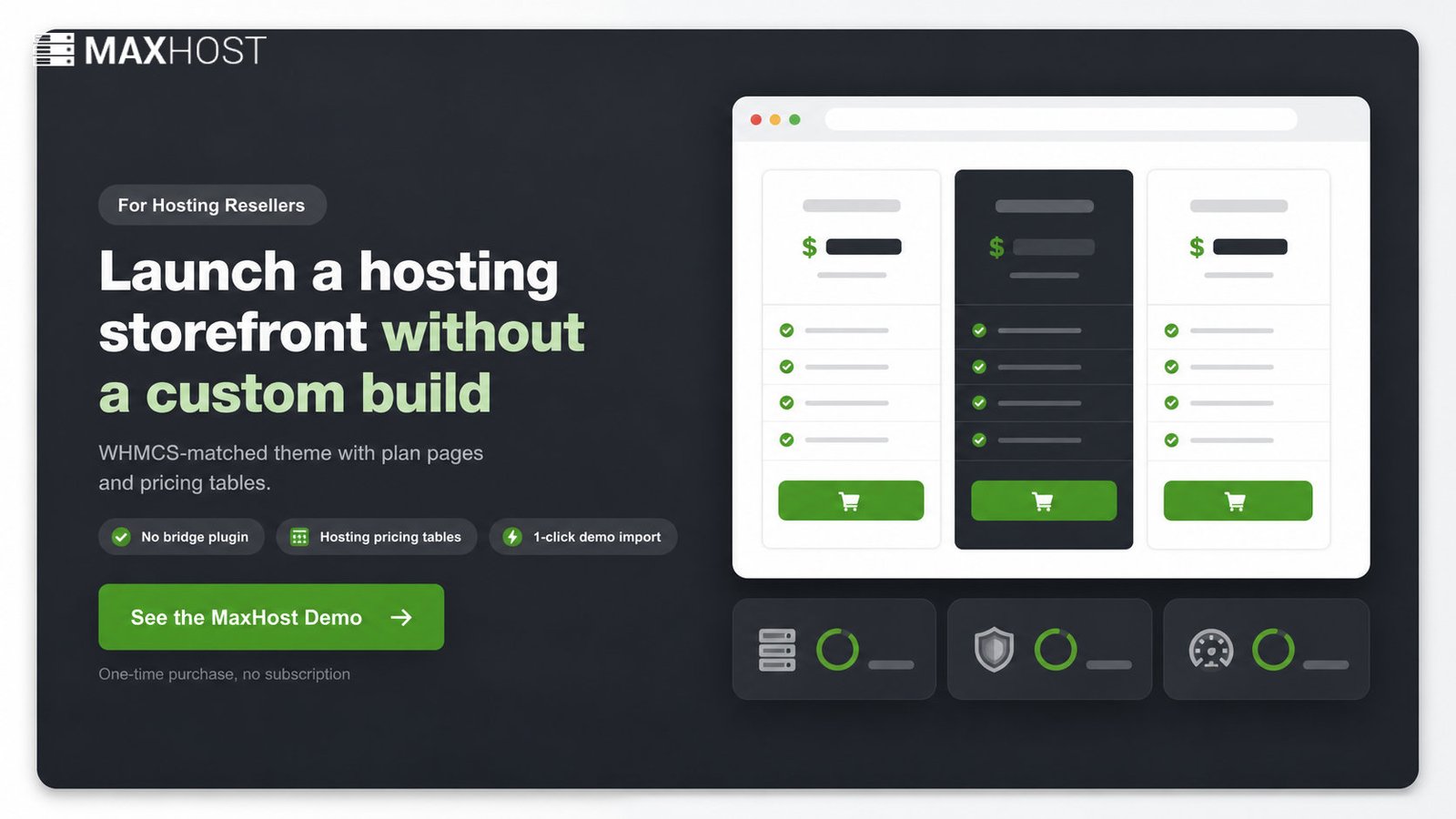
A hosting business that resells shared hosting plans still needs a storefront. That means a site to present plans, take orders, and match checkout to the brand. A WHMCS-matched WordPress theme like MaxHost gives a reseller that storefront without a custom build.
See the MaxHost demo to view its hosting plan pages and pricing tables.
FAQs
What is shared hosting?
Shared hosting is a web hosting model where many websites run on one physical server and split its CPU, RAM, and storage. It is the cheapest hosting tier because the server's cost spreads across every site on it.
When should I use shared hosting?
Use shared hosting for a new site, a low-to-moderate-traffic blog, or any project where budget matters more than guaranteed peak performance. Move up once your site outgrows its resource caps.
What are the disadvantages of shared hosting?
Shared hosting's main disadvantages are the noisy neighbor effect, hard CPU and RAM caps, and no root access. A compromised site on the same server can also expose others.
Is shared hosting good for a small business?
Yes, shared hosting is good for a small business launching its first site. Reassess as traffic grows past roughly 10,000 monthly visitors or the plan's resource caps.
Is shared hosting free?
No, shared hosting is not free, but it is the cheapest paid tier at $2 to $15 a month. Truly free hosting exists, yet it usually forces ads, weak performance, and a subdomain instead of your own domain.
What is the difference between shared hosting and virtual hosting?
Virtual hosting, specifically name-based virtual hosting, is the technical method that lets one server route many sites on a single IP. Shared hosting is the commercial service built on that method, so the two describe the same setup at different levels.
What are the 4 types of web hosting?
The four types of web hosting are shared, VPS, dedicated, and cloud hosting. See what is web hosting for the full breakdown of each.