Reseller hosting is the business model of buying wholesale hosting capacity and reselling it under your own brand. White label hosting is the fully rebranded subset of it, where the upstream provider stays completely invisible to your customers.
Every white label setup is reseller hosting, but not every reseller setup goes fully white label. This guide compares both models side by side, covers the branding and billing mechanics behind each, and shows which one fits your business.
Reseller Hosting vs White Label Hosting at a Glance
Reseller hosting and white label hosting both resell capacity from the broader types of web hosting a provider sells. They diverge on how visible that provider stays to your customers.
| Attribute | Reseller Hosting | White Label Hosting |
|---|---|---|
| What it is | Reselling wholesale hosting under your own brand | The fully rebranded subset of reseller hosting |
| Upstream provider visible to customers | Sometimes, in nameservers or fine print | Never |
| Nameservers | Often the provider's shared nameservers | Private nameservers registered in your name |
| Control panel branding | Frequently the provider's default theme | A fully rebranded control panel theme |
| WHMCS billing setup | Same platform, often the default client area theme | Same platform, skinned to match your brand |
| Customer support handling | You answer every client support ticket yourself | Optional white labeled support, so the upstream team can answer under your brand |
| Typical cost and setup effort | Standard monthly plan, minimal extra setup | Same plan tier, plus a one-time branding setup |
| Who it fits | A first hosting side business testing demand | A credibility-driven hosting brand |
What Is Reseller Hosting?
A hosting reseller buys server capacity wholesale from an upstream provider, then resells it to their own customers under a new brand. Wikipedia's hosting overview confirms this exact mechanism: resellers buy hosting and resell it to their own customers, often offering shared, VPS, or dedicated plans.
That WHM-based package gets subdivided into branded cPanel plans for individual clients. You set the prices and handle support, while the upstream provider still runs the actual servers behind the scenes.
For the full picture on how reseller hosting works and who it fits, see what is reseller hosting.
What Is White Label Hosting?
A white label reseller rebrands an upstream provider's hosting so completely that customers never see the original host's name. Every touchpoint, from the nameservers to the support inbox, carries only your brand.
A white label operator controls the domain, the nameservers, and a WHMCS skinned client area. The upstream provider still runs the physical servers and the WHM or cPanel backend out of sight.
For the full breakdown of the mechanism and benefits, see what is white label hosting.
Is White Label Hosting Just a More Branded Form of Reseller Hosting?
Yes, structurally. Every white label setup is a reseller arrangement underneath, but not every reseller setup goes fully white label.
Three concrete steps push a plain reseller arrangement into full white label territory.
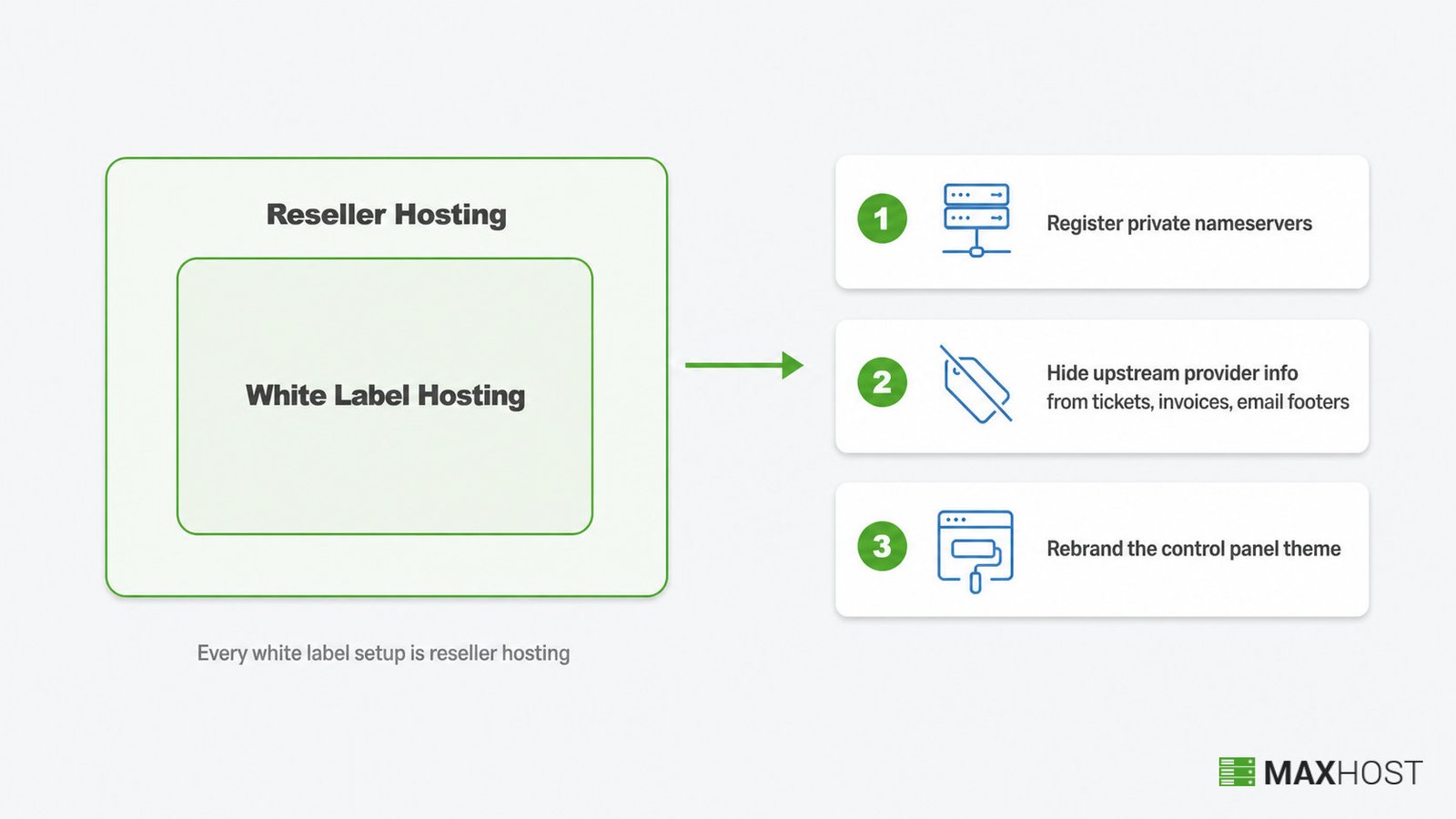
- Register private nameservers in your own name, not the upstream provider's.
- Hide upstream company information from support tickets, invoices, and email footers.
- Rebrand the control panel theme so it carries zero trace of the provider.
A reseller who skips those three steps still resells hosting. Customers may still spot the upstream provider's name in a nameserver lookup, an email footer, or a support ticket.
Branding and Nameserver Differences
Branding splits on two mechanics: private nameservers registered in your own name, and a control panel theme rebrand that removes the provider's logo. Standard reseller plans often skip both and run on the provider's shared nameservers instead.
WHM's own documentation confirms both mechanisms exist at the platform level.
- Private nameservers: WHM's Resellers tools include "Edit Reseller Nameservers and Privileges," letting a reseller point domain lookups to their own name. This means registering glue records at your registrar so ns1 and ns2 resolve to your own IP addresses.
- Control panel theme: WHM's Theme Manager lets a reseller replace the default panel branding with their own logo and colors.
Either mechanic wraps around any resold plan tier. You can apply the same branding to a shared plan or a resold dedicated hosting plan. It works the same way on a resold cloud hosting plan, without changing how nameservers or theming function underneath.
WHMCS Billing Differences
The WHMCS billing layer itself does not change between reseller hosting and white label hosting. Both models run the same invoicing, recurring billing, and client area automation.
WHMCS's own site describes its reseller program as delivering branded experiences with automated tracking and easy onboarding. Both models run on that same automated invoicing, recurring billing, and payment collection layer.
What changes is only the branding configured on top of that shared platform. A plain reseller may leave the default client area theme in place. A fully white label operation skins that same client area to match their own site.
Who Handles Customer Support?
A plain reseller answers every client support ticket directly, with no upstream help desk behind them. Some white label plans add white labeled support, where the upstream provider resolves client tickets under your brand.
This is the one difference that is operational rather than cosmetic. White labeled support removes the technical support burden. A plain reseller trades that convenience for a lower price and full control of the client relationship.
Cost and Setup Differences
Reseller packages sell as a standard monthly plan, and white label branding sits on top of that same plan. Typical 2026 market pricing splits into three capacity tiers, whichever path you take.
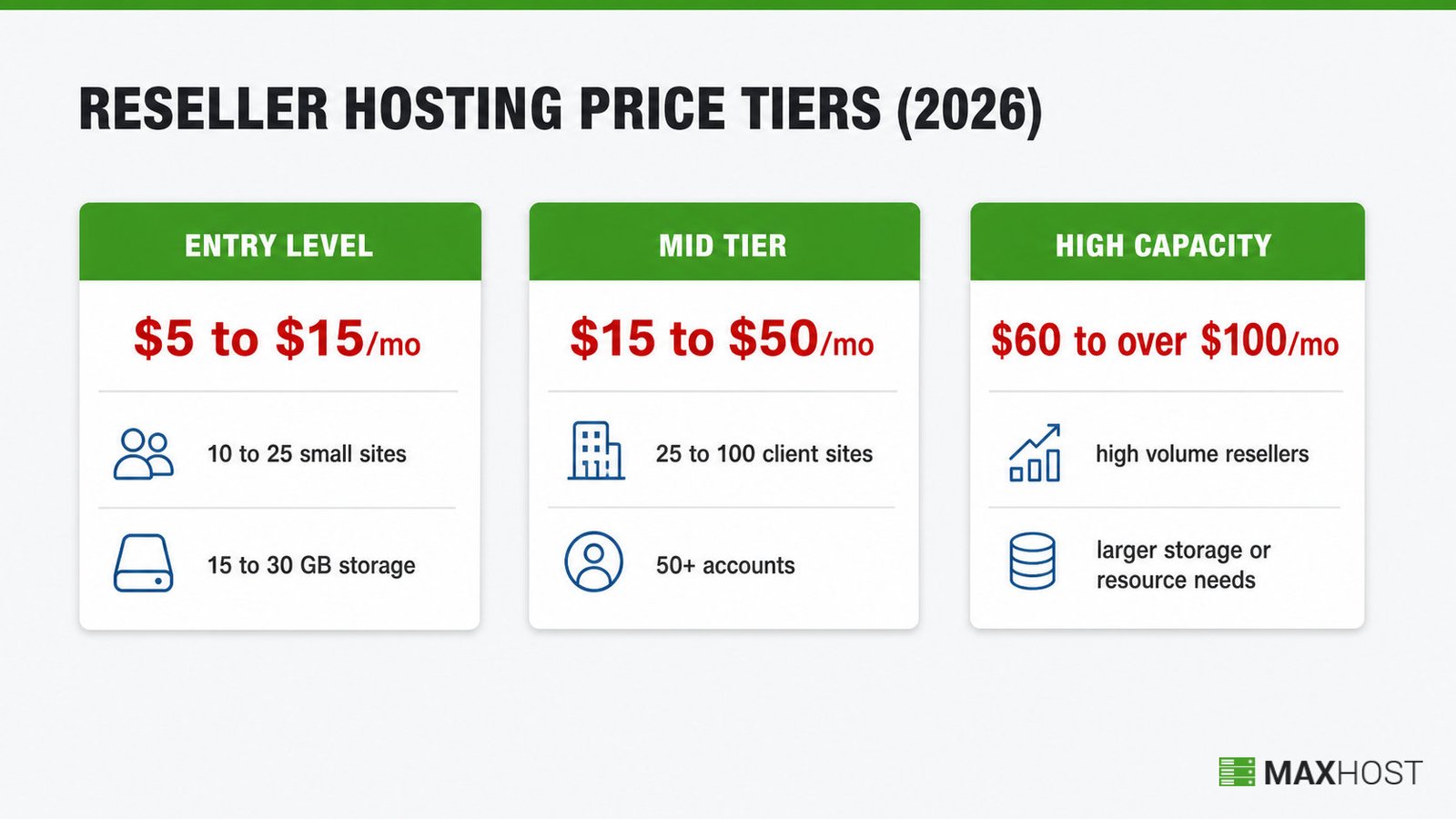
- Entry level ($5 to $15 per month): hosts 10 to 25 small sites, with 15 to 30 GB of storage and basic branding.
- Mid tier ($15 to $50 per month): suits agencies running 25 to 100 client sites, with 50 or more accounts.
- High capacity ($60 to over $100 per month): covers high volume resellers and larger storage or resource needs.
Going fully white label sometimes costs extra and sometimes comes included, depending entirely on the provider's packaging. Private nameservers or a branding tier can appear as a paid add-on, while other providers bundle both into every reseller plan. Many hosts also bundle a free or discounted WHMCS license with reseller plans.
Setup effort runs similar either way. Both models provision through WHM or cPanel and bill through WHMCS. The extra white label steps, nameserver registration and control panel rebranding, are one-time setup tasks, not ongoing overhead.
Which Model Fits Your Business?
White label hosting is the stronger long-term brand play, while plain reseller hosting is the cheaper, faster way to start.
Plain reseller hosting fits a first hosting side business or a low-budget operation comfortable with some upstream visibility in the fine print. Full white label hosting fits a business that needs a completely hidden third-party brand.
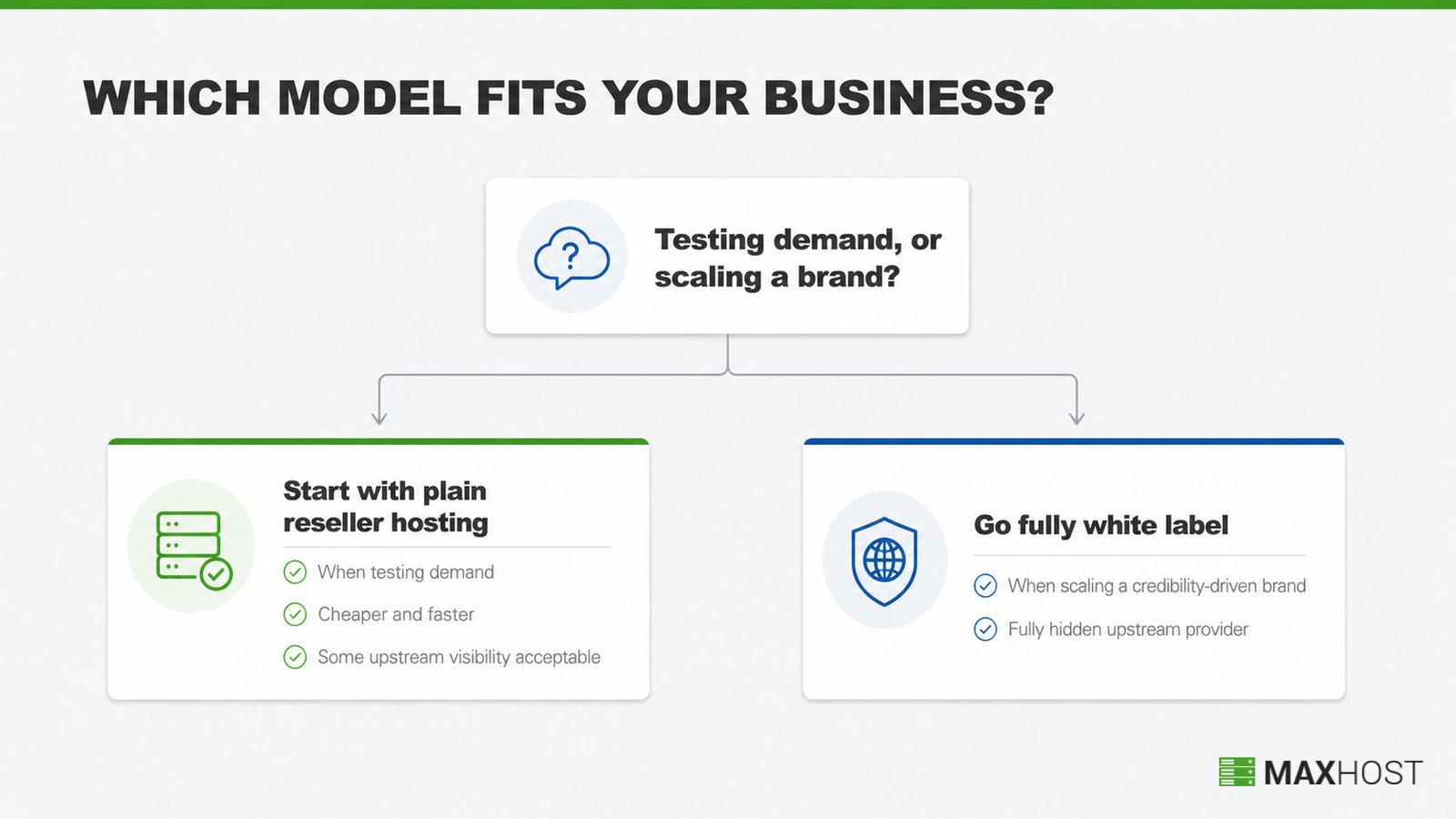
- Start with plain reseller hosting if you are testing demand before investing in a fully hidden identity. Our guide to starting a reseller hosting business walks through the setup.
- Go fully white label if you are scaling into a credibility-driven hosting company identity. See our guide to a WordPress theme for a web hosting company for the public-facing site that pairs with it.
How MaxHost Supports Reseller and White Label Hosting Businesses
MaxHost is a WordPress and WHMCS theme that ships a matching marketing site and client area. It works whichever path you take, with no bridge plugin required.
MaxHost bundles WHMCS templates that install directly into WHMCS, avoiding the bridge plugin many hosting themes depend on. That matters equally for both models.
A plain reseller gets a consistent look between the marketing site and checkout. A white label operator gets a client area with zero trace of the upstream provider.
The theme also includes GoDaddy Reseller Store plugin compatibility, giving a domain reseller a matching storefront for domain sales alongside hosting plans. Nine importable hosting demos, from shared and VPS to cloud and CyberPanel layouts, cover either business without a custom design project.
See the reseller hosting WordPress theme for the full demo library MaxHost ships for either path.
FAQs
What's the difference between reseller hosting and white label hosting?
Reseller hosting is buying wholesale hosting and reselling it under your own brand. White label hosting is the fully rebranded subset where the upstream provider stays completely invisible to your customers.
Is white label hosting a type of reseller hosting?
Yes. Every white label setup is a reseller arrangement underneath, since the upstream provider still delivers the actual hosting capacity. Not every reseller setup goes fully white label, since some still show provider branding.
Do I need to run my own servers for either model?
No. The upstream provider owns and runs the physical servers for both reseller hosting and white label hosting. You manage branding, pricing, and support while the provider handles the infrastructure.
Which costs less to start, reseller hosting or white label hosting?
Plain reseller hosting is often the lower entry point, since it skips any private nameserver or branding add-on. The exact gap depends entirely on the upstream provider's own packaging, not a fixed industry rule.
Can I upgrade from reseller hosting to white label hosting later?
Yes, typically. Most upstream providers let an existing reseller add private nameservers and a rebranded control panel theme later. Switching providers or rebuilding the hosting side of the business is not required.