VPS hosting runs your site on one physical server split into isolated virtual slices, with fixed resources and a flat monthly fee. Cloud hosting spreads your site across a network of servers with elastic, pay-as-you-go capacity. The core difference is architecture: one server versus many.
This guide compares VPS and cloud hosting on scalability, pricing, control, and reliability. It then covers where each model wins and how to choose between them.
VPS vs Cloud Hosting at a Glance
VPS and cloud hosting diverge across six dimensions, summarized below.
| Hosting Type | Architecture | Scalability | Performance | Reliability | Pricing Model | Best For |
|---|---|---|---|---|---|---|
| VPS Hosting | One physical server partitioned into isolated virtual slices | Vertical upgrades only, usually a resize or migration | Dedicated, isolated resources with predictable output | Single point of failure if the host server goes down | Fixed monthly fee regardless of usage | Fixed-budget, predictable workloads that want hands-on control |
| Cloud Hosting | A distributed pool of interconnected servers | Scales in minutes with no downtime | Load balanced across multiple servers and data centers | Automatic failover, commonly marketed near 99.99 percent uptime | Pay-as-you-go, based on resources actually consumed | Traffic-variable workloads and growth-stage sites |
One row often surprises buyers. VPS hosting is not automatically the cheaper option: the pricing model, fixed versus usage-based, decides which one costs less for a given workload. The two sections below walk through why.
Is VPS Actually a Form of Cloud Hosting?
Yes, a VPS is a form of cloud hosting when it runs on clustered infrastructure. A traditional VPS on one physical server is not. Both models use virtualization; the real split is whether the virtual server draws from one machine or a shared pool.
IBM calls a VPS a form of multitenant cloud hosting, where virtualized server resources reach a user over the internet. AWS defines a VPS as a machine that operates virtually, using only a portion of one physical server's hardware. That shared virtualization layer is why buyers conflate the two.
The split shows up as two products. A traditional VPS carves one physical server into isolated slices, so it fails if that host fails. A cloud VPS pulls resources from a network of servers, so it keeps running when one machine breaks.
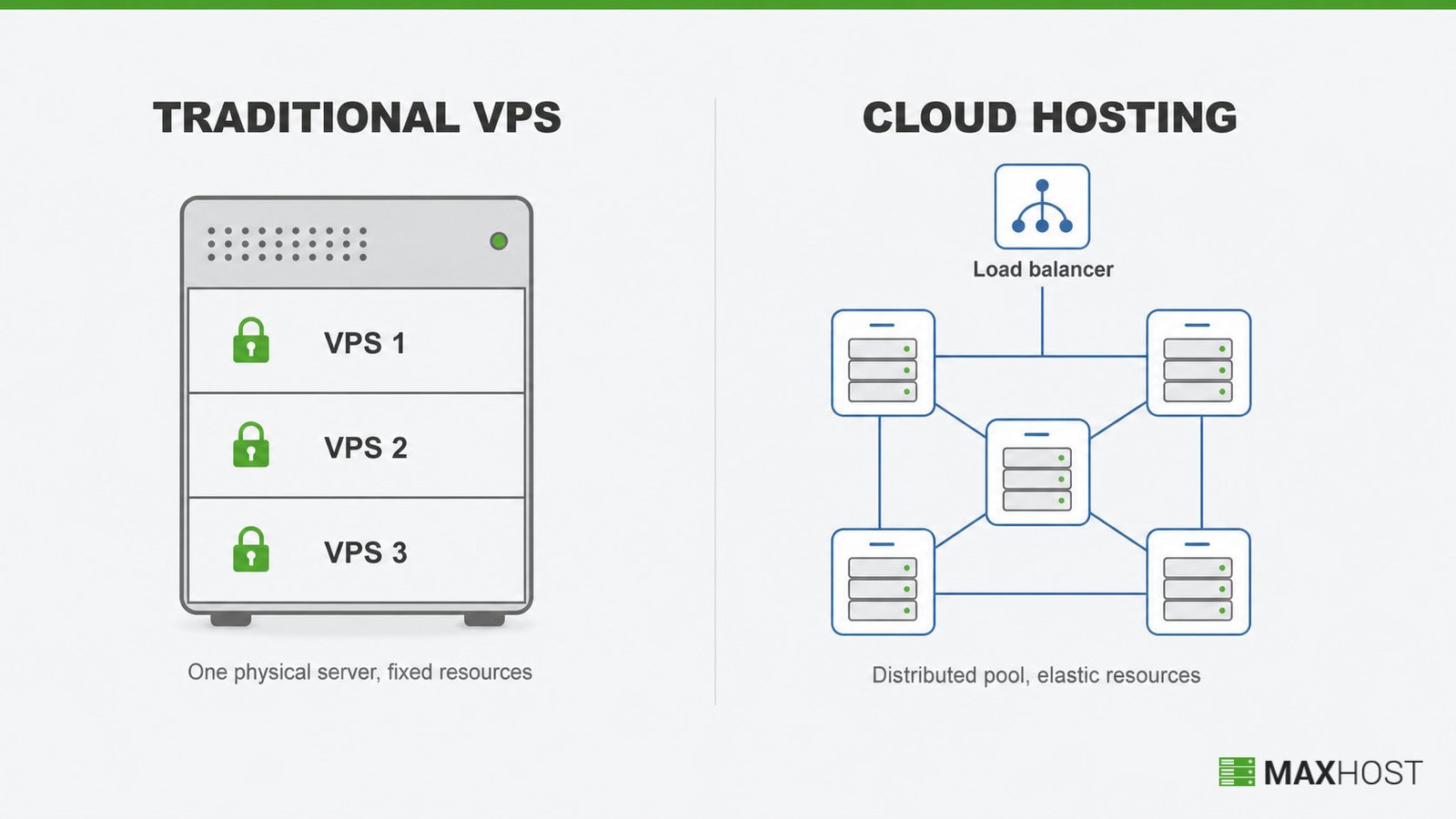
AWS describes cloud hosting as virtual servers drawn from a pooled network across many machines. IONOS treats VPS and cloud hosting as distinct architectures despite the shared technique. Treat "VPS is basically cloud hosting" as a half-truth: a VPS is a unit of cloud virtualization, not a distributed cloud on its own.
Where Cloud Hosting Wins
Cloud hosting outperforms VPS hosting on scalability, reliability, and maintenance burden.
- Scales in minutes: capacity increases on demand without taking the site offline for a manual upgrade.
- Fails over automatically: if one server in the pool goes down, traffic reroutes to another, protecting uptime.
- Distributes load across servers: no single machine becomes a bottleneck during a traffic spike.
- Reduces maintenance work: the provider handles most server-side operations instead of leaving patching to you.
Cloudways documents the same asymmetry from the pros-and-cons side. Cloud hosting adds resources within minutes and markets guaranteed uptime near 99.99 percent. A VPS typically has to come down briefly for a resource upgrade.
These same points explain VPS hosting's disadvantages from the inverse angle. A VPS scales slower and fails as a single unit. Patching and configuration fall on you, not the provider. For the full mechanism, benefits, and limitations, see what is cloud hosting.
Where VPS Hosting Wins
VPS hosting wins on pricing predictability, hands-on control, and tenant isolation.
- Charges a fixed fee: the same monthly price whether you use 10 percent or 100 percent of your allocated resources.
- Grants full root access: install any software, operating system, or configuration without a provider's package limits.
- Costs less at equal resource levels: without cloud's usage-based markup, a comparable VPS plan often runs cheaper.
- Delivers predictable performance: your CPU, RAM, and storage stay reserved, not pooled with other tenants.
- Isolates your environment: a VPS walls your resources off from other tenants, which Google Cloud lists as a security benefit of the model.
That predictability carries a trade-off. A VPS lives on one physical server. A hardware failure on that server takes your site down until you or the provider fix it.
There is no automatic backup capacity to fall back on. For the full mechanism, root access details, and support models, see what is vps hosting.
Which Should You Choose?
Choose VPS hosting if your traffic is stable and you want a fixed monthly bill with full control. Choose cloud hosting if traffic varies, or you expect rapid growth and want the server to scale itself.
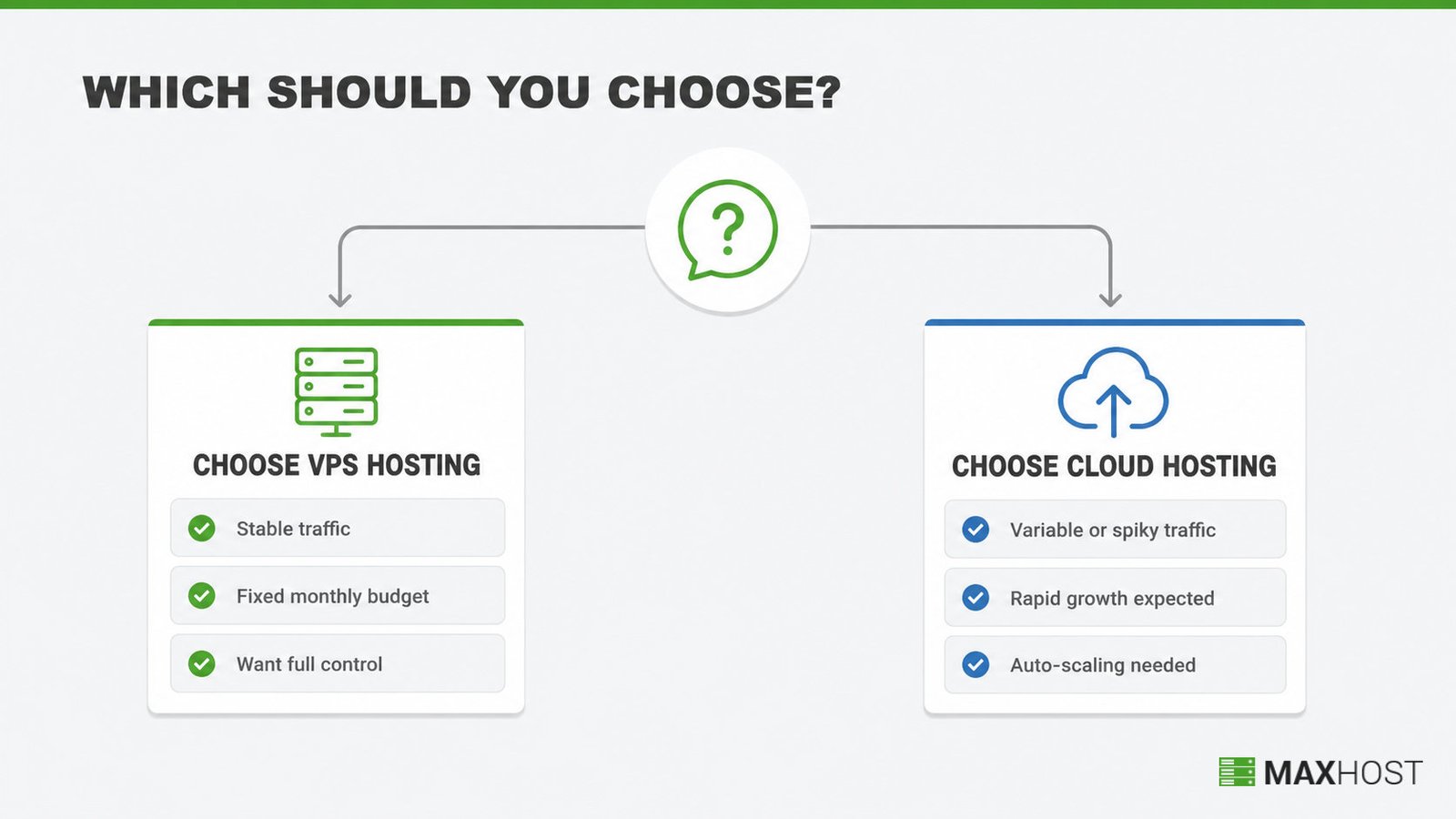
A hosting reseller or agency running a fixed set of client sites benefits most from VPS hosting's flat pricing and predictable bill. A site expecting seasonal spikes, like an ecommerce store during a sale, benefits more from cloud hosting's elastic capacity and automatic failover.
Resellers building plans on either model should also read what is reseller hosting and what is white label hosting. Both explain a matching business structure.
Neither VPS nor cloud always fits. If you need an entire physical server with no sharing at all, see what is dedicated hosting instead. For shared and dedicated hosting added to this comparison, see shared vs vps vs dedicated vs cloud hosting. For a broader framework across every hosting type and budget, see how to choose a web host.
How MaxHost Supports VPS and Cloud Hosting Businesses
MaxHost is a WordPress and WHMCS theme built for hosting resellers selling VPS or cloud plans. It ships dedicated Server Hosting and Cloud Hosting demos, plus WHMCS-matched pricing and comparison tables that present both models to your own visitors.
MaxHost does not sell VPS or cloud hosting itself. It is the WordPress and WHMCS theme a hosting company selling either model uses to launch a matching marketing site and billing client area.
The theme ships a dedicated Server Hosting demo and a Cloud Hosting demo, tagged HOT on the demo hub. Twenty WHMCS client-area templates skin checkout and billing to match whichever model you sell. Built-in pricing tables and plan-comparison blocks let your own visitors compare VPS and cloud plans the same way this article just did.
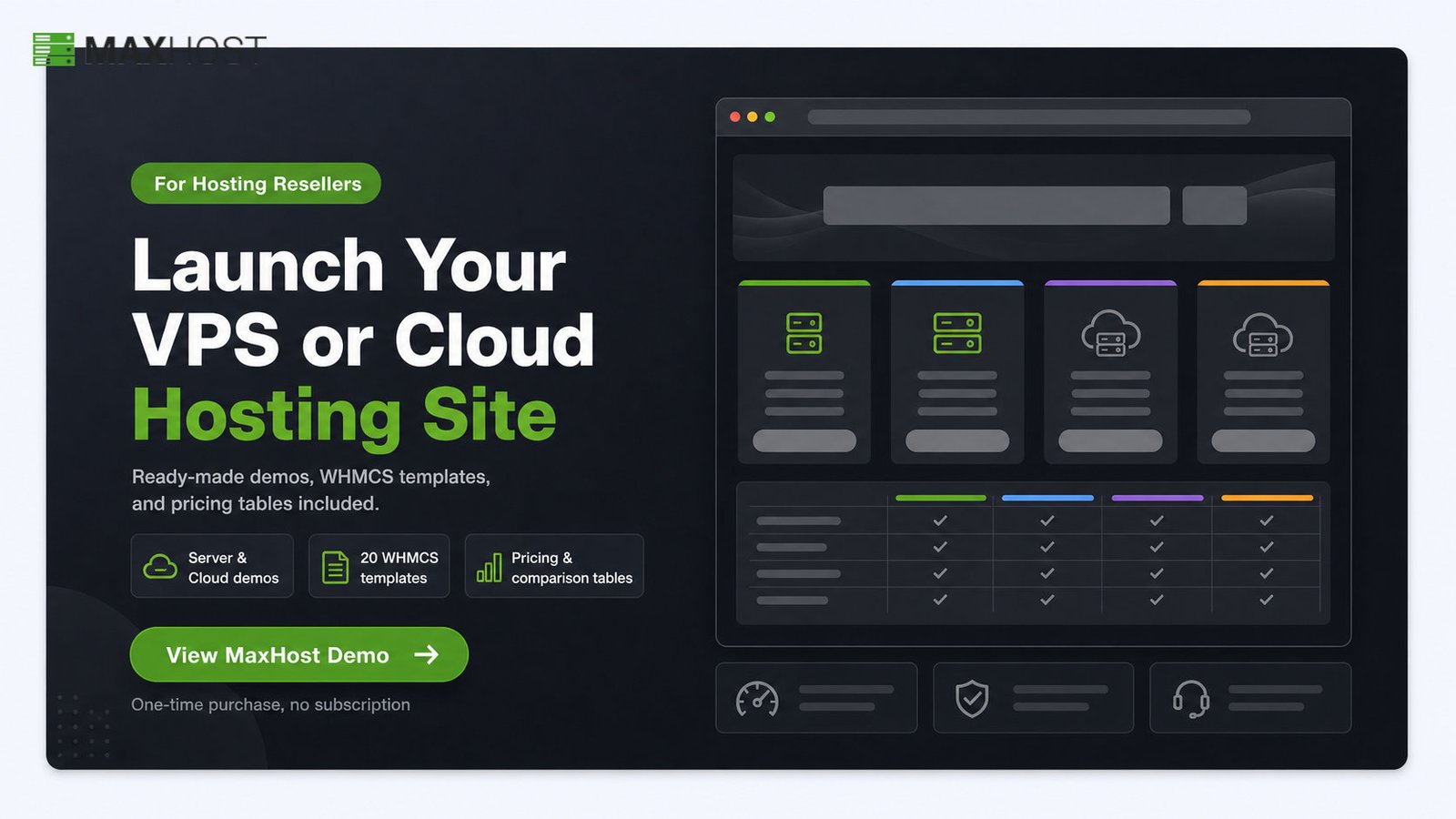
See the VPS, Dedicated, and Cloud Server Hosting theme, or view the Cloud Hosting demo directly.
FAQs
What's the difference between VPS and cloud hosting?
VPS hosting runs your site on one physical server split into fixed virtual slices with a flat monthly fee. Cloud hosting spreads your site across many servers with elastic, pay-as-you-go capacity. VPS suits stable traffic; cloud suits spikes and growth.
What are the disadvantages of VPS hosting?
VPS hosting costs more than shared hosting and requires server-management knowledge you handle yourself. It scales slower than cloud hosting and needs a manual resize for more resources. It also depends on one physical server, so a hardware failure can take your site down.
Is cloud hosting cheaper than VPS hosting?
Not always. VPS hosting is usually cheaper for stable, predictable traffic because of its flat fee. Cloud hosting can cost less for variable traffic, since pay-as-you-go billing only charges for the resources you actually use.
Is VPS better than cloud hosting?
Neither is universally better. VPS hosting wins for stable traffic, fixed budgets, and hands-on control. Cloud hosting wins for variable traffic, rapid growth, and automatic failover. The better choice depends on your workload, not on one model being superior.
What are the 4 main types of web hosting?
The four main types of web hosting are shared, VPS, cloud, and dedicated hosting. Each trades cost for control differently. See what is web hosting for the full breakdown of all four.
Can a VPS scale like cloud hosting?
Not automatically. A VPS can add CPU or RAM, but the upgrade usually means a resize or migration that can take the site offline briefly. Cloud hosting scales in minutes, drawing from a shared pool of servers, with no downtime.
Is VPS hosting a type of cloud hosting?
Sometimes. A VPS on clustered infrastructure, called a cloud VPS, is a form of cloud hosting. A traditional VPS on one physical server is not. Both use virtualization, but only the pooled version delivers cloud scaling and failover.