Cloud hosting runs a website or application on a network of virtual servers pooled across many physical servers and data centers. It replaces one dedicated machine with that shared, distributed pool. Providers bill per resource used and scale capacity automatically, an infrastructure as a service (IaaS) model built for unpredictable traffic.
This guide explains how cloud hosting works, its core benefits and limitations, and how it compares to shared, VPS, dedicated, and self-hosting. It also covers typical costs and how MaxHost fits hosting businesses built on cloud infrastructure.
How Does Cloud Hosting Work?
Cloud hosting works by running virtual servers on a shared pool of physical hardware spread across multiple data centers. A hypervisor divides each physical server into several virtual machines. The provider then pulls extra CPU, RAM, or storage from that shared pool whenever one site needs more.
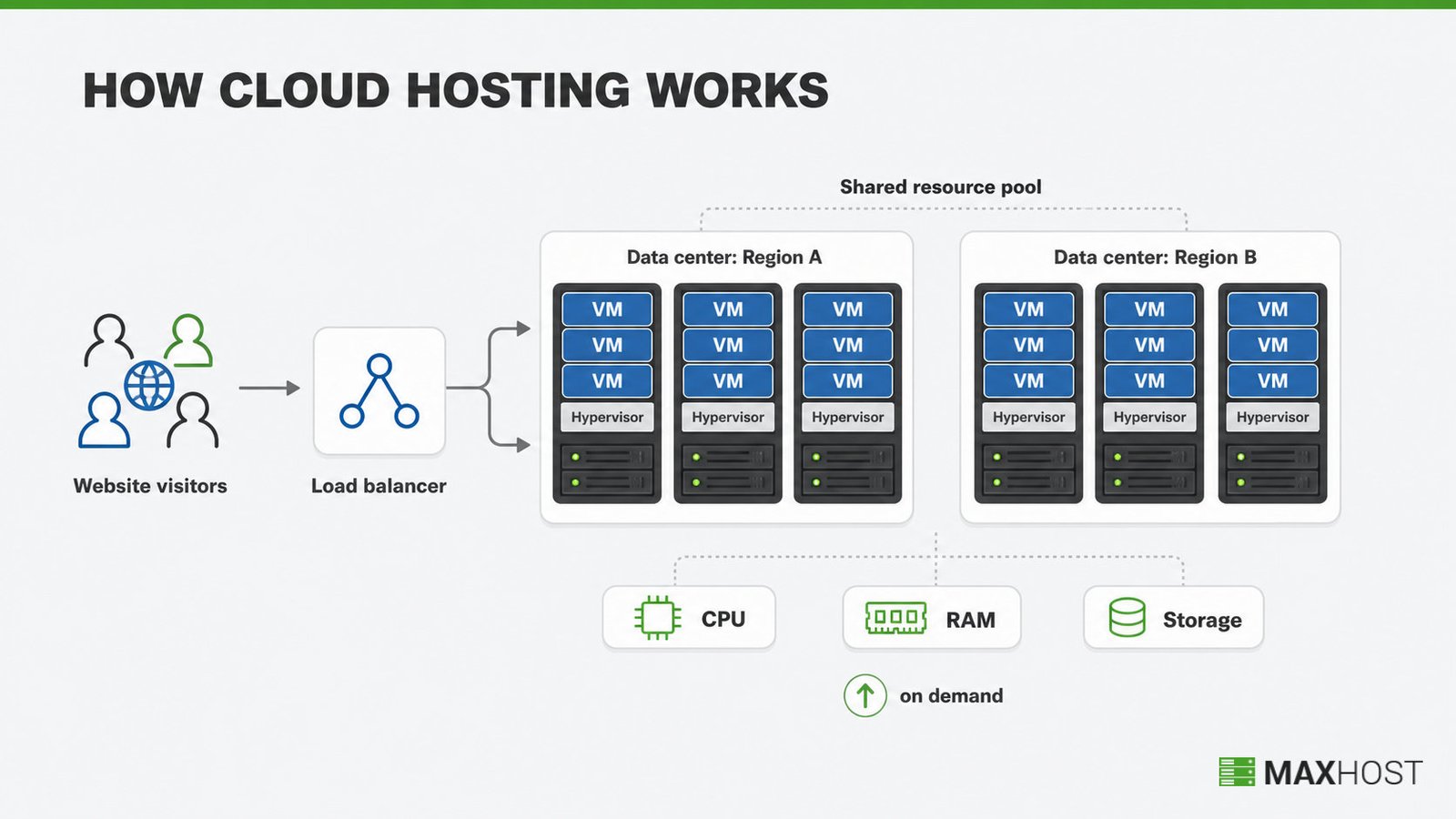
Load balancers spread incoming requests across available servers, so no single machine becomes a bottleneck. Data centers sit in multiple regions, cutting latency for visitors far from any one location. This distributed-resource model is what separates cloud hosting from the broader types of web hosting category it belongs to.
Major providers, including AWS, Google Cloud, Azure, and DigitalOcean, sell this infrastructure as public cloud capacity. Some organizations run a private cloud on dedicated hardware, or mix public and private in a hybrid setup. Most small hosting businesses buy public cloud capacity directly.
Reseller and white label hosting businesses often build their own plans on top of a cloud provider's infrastructure instead of owning physical servers. See reseller hosting vs white label hosting for how that model works.
What Are the Benefits of Cloud Hosting?
Cloud hosting's core benefits come from pooling resources across many servers instead of relying on one.
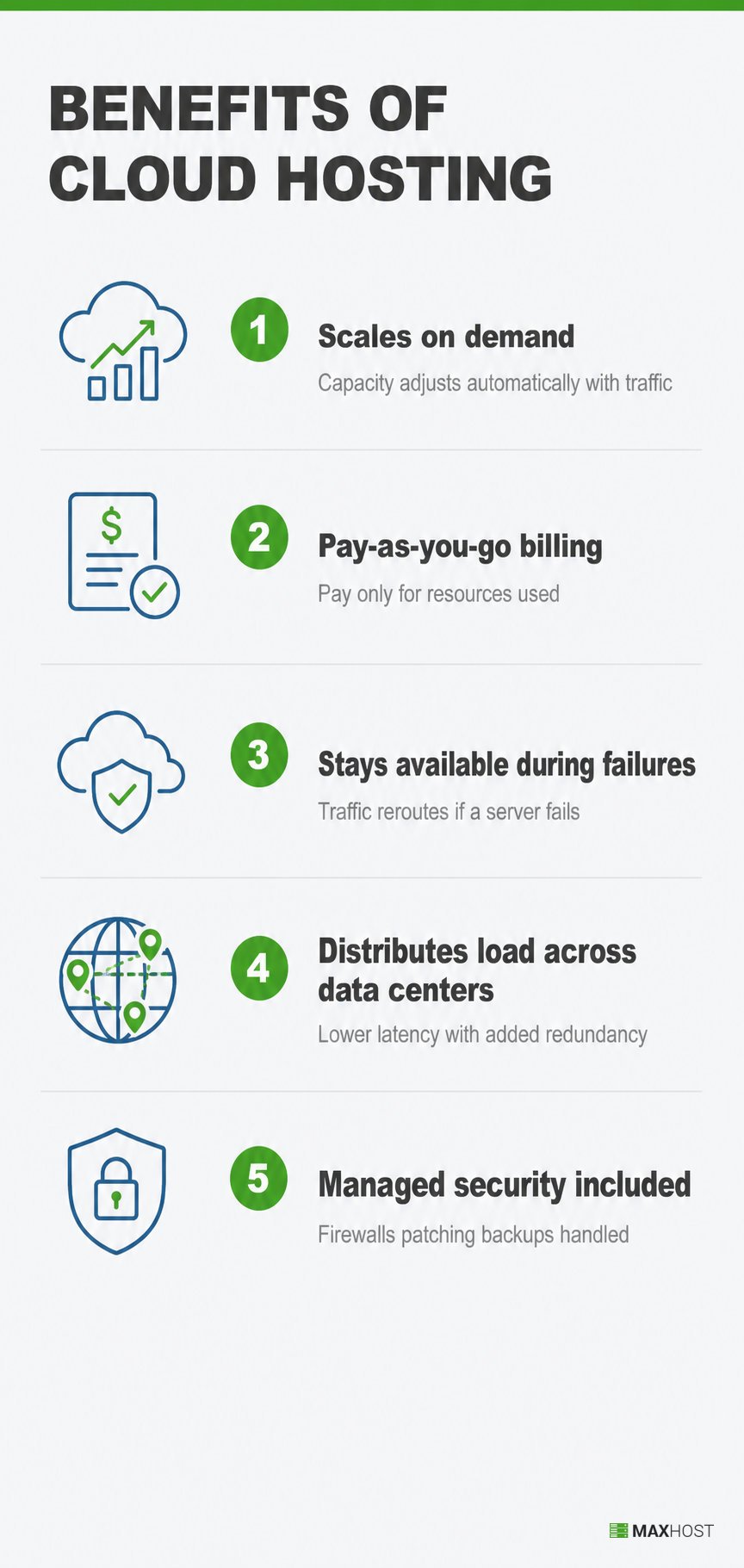
- Scales on demand: capacity increases or decreases automatically when traffic spikes or drops, without a manual server upgrade.
- Bills pay-as-you-go: you pay for the CPU, RAM, storage, and bandwidth actually used, with no large upfront hardware cost.
- Stays available during failures: if one physical server fails, traffic reroutes to another server in the pool, protecting uptime.
- Distributes load across data centers: providers run facilities in multiple regions, which lowers latency and adds redundancy.
- Includes managed security: the provider handles firewalls, automatic patching, and data backups, which lowers the security burden on you.
Most cloud providers guarantee at least 99.9 percent uptime, which allows for under nine hours of downtime a year. That reliability comes directly from the distributed, pooled-resource design described above.
What Are the Limitations of Cloud Hosting?
Cloud hosting's trade-offs mirror its benefits: what makes it flexible also makes it harder to predict.
- Costs fluctuate with usage: a pay-as-you-go bill can spike during a traffic surge, unlike a flat-rate plan.
- Offers less low-level control than a dedicated server: you cannot access or tune the underlying physical hardware directly.
- Depends on the provider's own reliability: an outage in the provider's network or data center still affects your site.
- Requires comfort with cloud consoles and billing dashboards: monitoring resource use and spend takes more technical familiarity than a flat-rate shared plan.
- Can create vendor lock-in: moving a site between cloud providers is harder because each one uses its own tools and configuration.
How Does Cloud Hosting Differ From Shared, VPS, Dedicated, and Self-Hosting?
Cloud hosting is one of five common resource models, and each trades control for convenience differently.
| Hosting Type | Control | Scalability | Cost Predictability | Best For |
|---|---|---|---|---|
| Shared Hosting | Lowest, the provider manages everything | Limited, capped by the shared plan | High, flat monthly rate | New, low-traffic sites |
| VPS Hosting | High, root access to a virtual slice | Limited, fixed to the plan size | High, flat monthly rate | Growing sites that need guaranteed resources |
| Dedicated Hosting | Highest, one full physical server | None, fixed to the hardware | High, flat monthly rate | High-traffic sites that need full control |
| Self-Hosting | Highest, your own hardware | None, fixed to owned equipment | Highest, no recurring provider bill | Businesses with in-house IT and compliance needs |
| Cloud Hosting | Moderate, managed shared infrastructure | Highest, scales on demand | Lower, usage-based billing | Sites with variable or spiking traffic |
VPS vs cloud hosting breaks down the VPS-to-cloud decision in more depth. Shared vs vps vs dedicated vs cloud hosting compares all four resource-sharing models side by side. Once you know which model fits, how to choose a web host walks through picking an actual provider and plan.
How MaxHost Supports Cloud Hosting Businesses
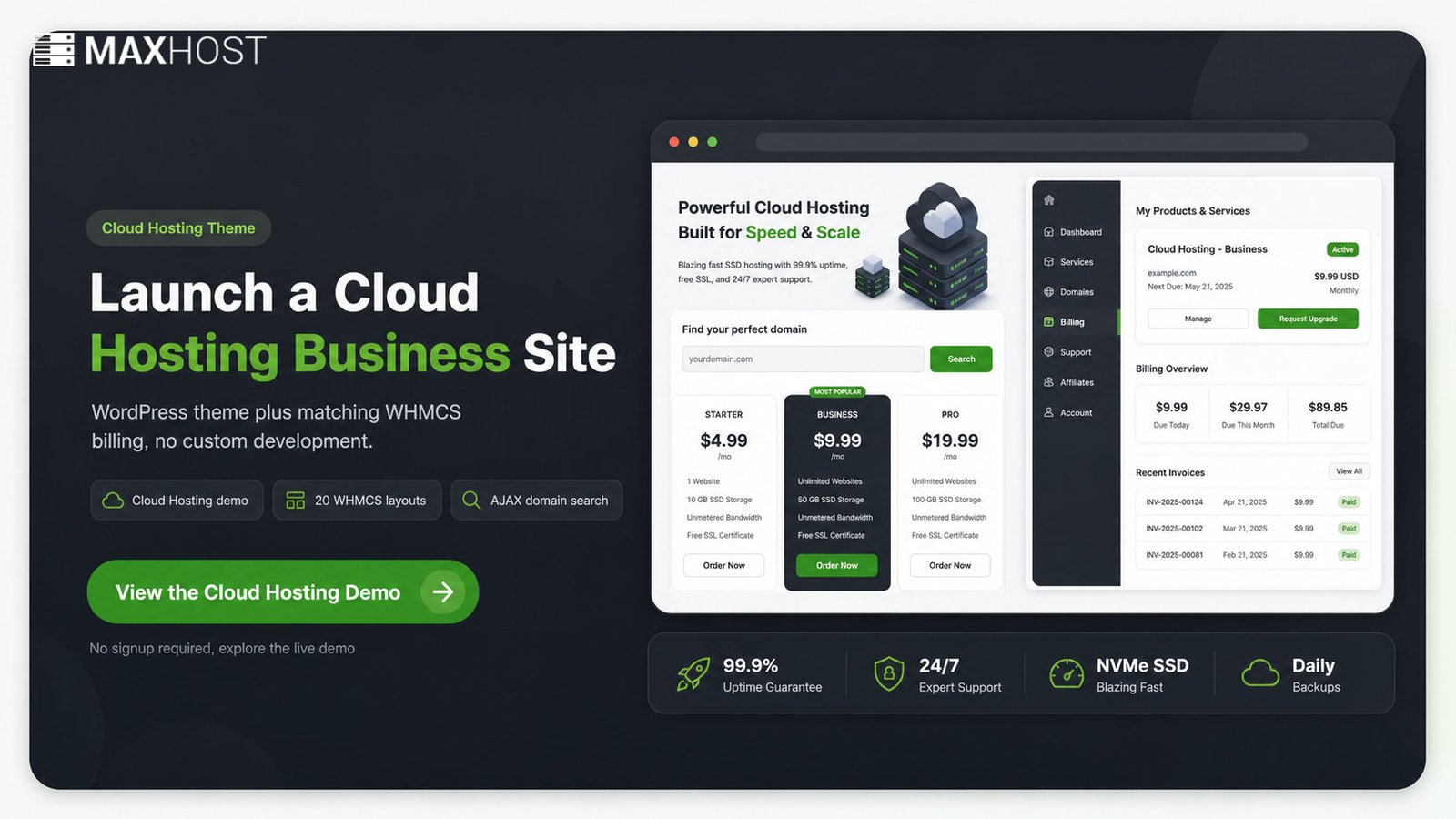
MaxHost is a WordPress and WHMCS theme built for cloud hosting resellers and IT services businesses. It launches a matching marketing site and WHMCS billing client area without custom development.
MaxHost does not provide cloud hosting itself. It is the WordPress theme a cloud hosting reseller, freelance developer, or IT services business uses to launch its own site. The theme also builds the matching WHMCS billing area.
The theme ships a dedicated Cloud Hosting homepage demo built for exactly this use case. Twenty WHMCS client-area templates skin checkout and billing to match the marketing site. Built-in pricing tables and an AJAX domain search module let a reseller display cloud plans and check domain availability without extra plugins.
Resellers who also sell VPS or dedicated plans can start from the server hosting WordPress theme page for the full demo library. View the Cloud Hosting demo to see the layout live.
FAQs
What is cloud hosting?
Cloud hosting runs a website on a network of virtual servers pooled across many physical machines instead of one dedicated server. Providers bill per resource used and scale capacity automatically, making it suited to sites with unpredictable or spiking traffic.
Is cloud hosting the same as VPS hosting?
No, cloud hosting is not the same as VPS hosting. VPS hosting partitions one physical server into fixed virtual slices, while cloud hosting pools resources across many physical servers and scales them on demand.
How much does cloud hosting cost per month?
Cloud hosting typically costs $5 to $500 or more per month, based on the CPU, storage, and bandwidth used. Small sites often run under $20 a month, while high-traffic applications can climb into the hundreds.
Is cloud hosting better than shared hosting?
Cloud hosting outperforms shared hosting on reliability and scalability but costs more and requires more setup comfort. Shared hosting suits small, low-traffic sites on a flat budget, and cloud hosting suits sites that need to handle traffic spikes without downtime.
Can I self-host instead of using cloud hosting?
Yes, self-hosting runs your site on hardware you own and control instead of a provider's servers. It gives full control and keeps data off third-party infrastructure, but you handle all maintenance, security patching, and uptime yourself.
Do I need cloud hosting for a small website?
Not necessarily. A small, low-traffic site runs fine on cheaper shared hosting. Cloud hosting becomes worthwhile once you expect traffic spikes, plan to add more tools, or need reliability that a shared plan cannot guarantee.