Dedicated hosting is a hosting model where a business rents an entire physical server for its exclusive use, not shared with any other customer. It delivers the highest performance, security, and control of the standard tiers, at the highest cost, for high traffic or compliance heavy sites.
This guide covers how dedicated servers work, the difference between managed and unmanaged plans, and the real benefits and limitations. It also compares the tier to VPS hosting and covers cost expectations and when a business genuinely needs one.
How Does Dedicated Hosting Work?
A dedicated server works because a provider owns and racks a physical machine in a data center, then leases the whole machine to one customer. The customer gets exclusive use of the server's CPU, RAM, storage, and bandwidth, plus administrative control over the operating system, hardware, and software. You manage it remotely over the internet, through SSH or a control panel, since the hardware sits in the provider's data center.
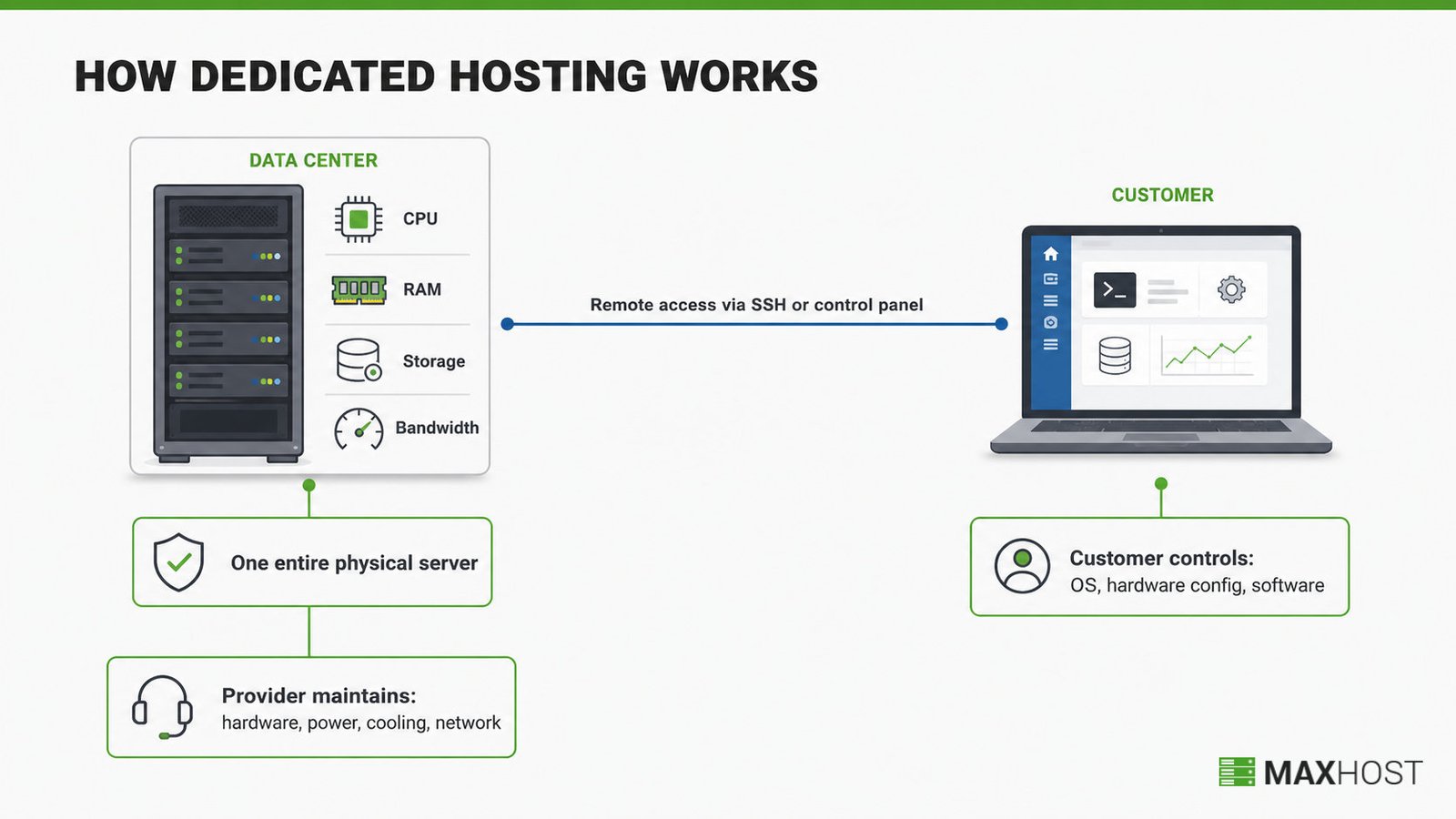
The provider maintains the physical hardware and the data center's power, cooling, and network connections. Per Wikipedia's dedicated hosting overview, the customer controls the operating system, hardware configuration, and software above that layer. Root access is common on both managed and unmanaged plans, though a managed provider handles most day to day changes on the customer's behalf.
Managed vs. Unmanaged Dedicated Hosting: What's the Difference?
The core difference is who does the technical work. On a managed plan the provider handles maintenance, updates, security, and support; on an unmanaged plan you do it all yourself. Dedicated hosting actually spans four tiers between those two poles, each shifting more upkeep onto the provider.
| Support Tier | Who Handles Maintenance | Support Level | Typical Cost | Best For |
|---|---|---|---|---|
| Fully managed | Provider: monitoring, patches, backups, OS upgrades | 24/7 expert help | Highest | Businesses with no in-house server admin |
| Managed | Provider, with some customer input | Guided support | High | Teams wanting oversight without daily upkeep |
| Self-managed | Customer maintains, provider monitors | Hardware plus limited software | Mid | Teams with some server administration skill |
| Unmanaged | Customer handles everything | Hardware replacement only | Lowest | Experienced sysadmins who want full control |
Most buyers choose managed or fully managed plans, since unmanaged servers demand ongoing sysadmin work. A fully managed plan includes monitoring, automated backups, software updates, reboots, security patches, and operating system upgrades, so the customer stays completely hands off. Unmanaged hosting trades that convenience for a lower price, but the customer provides all maintenance, patches, and security.
Price tracks the support level. Unmanaged plans start around 40 USD a month, while managed plans typically begin near 100 to 150 USD a month.
What Are the Benefits of Dedicated Hosting?
Dedicated hosting delivers five concrete benefits over shared and VPS hosting tiers.
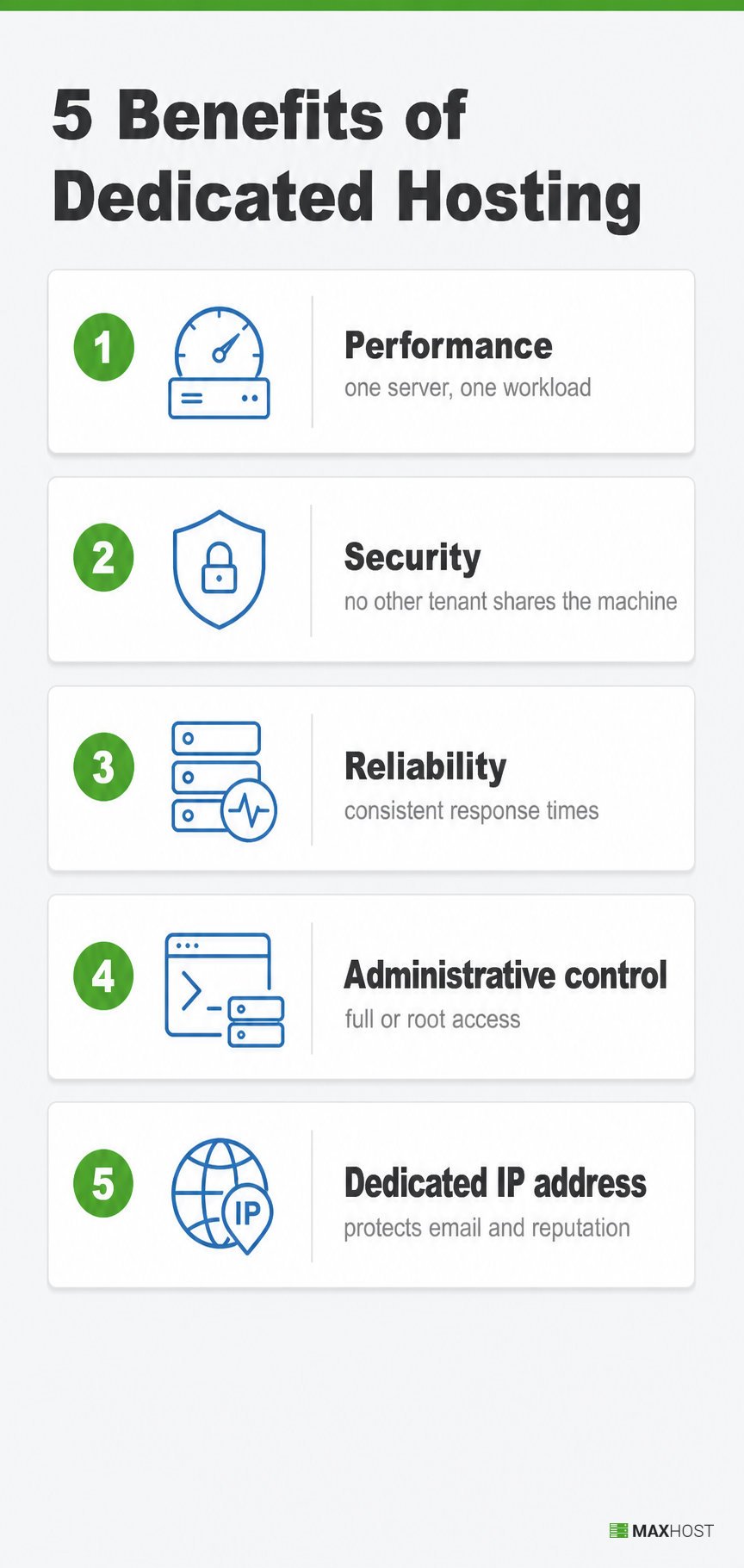
- Performance: the entire server's CPU, RAM, and storage serve one workload, so traffic spikes on other sites never slow your pages.
- Security: no other tenant shares the machine, unlike shared hosting, where a breach on one account can expose its neighbors.
- Reliability: dedicated resources produce consistent response times, without the noisy neighbor slowdowns virtualized tiers can cause.
- Administrative control: full or root access lets you install custom software, tune server settings, and meet specific compliance requirements.
- Dedicated IP address: the server carries its own IP, so another tenant's spam or blocklisting cannot drag down your email deliverability or search reputation.
What Are the Limitations of Dedicated Hosting?
Dedicated hosting carries four real tradeoffs against its cost and complexity.
- Cost: a dedicated server costs far more than shared or VPS plans, since you pay for an entire machine instead of a shared slice.
- Technical expertise: unmanaged plans put patching, monitoring, and security fully on you, and mistakes here cause outages or breaches.
- Fixed capacity: scaling up means new hardware or a migration, not a few clicks, unlike cloud hosting, which adds resources in minutes.
- Single point of failure: one physical server has no built-in redundancy, so a hardware fault can take your site down, unlike cloud hosting.
Do You Need Dedicated Hosting?
Most websites do not need dedicated hosting, since shared or VPS hosting handles typical traffic and workloads fine. You genuinely need it in four specific situations, not just above a general traffic threshold.
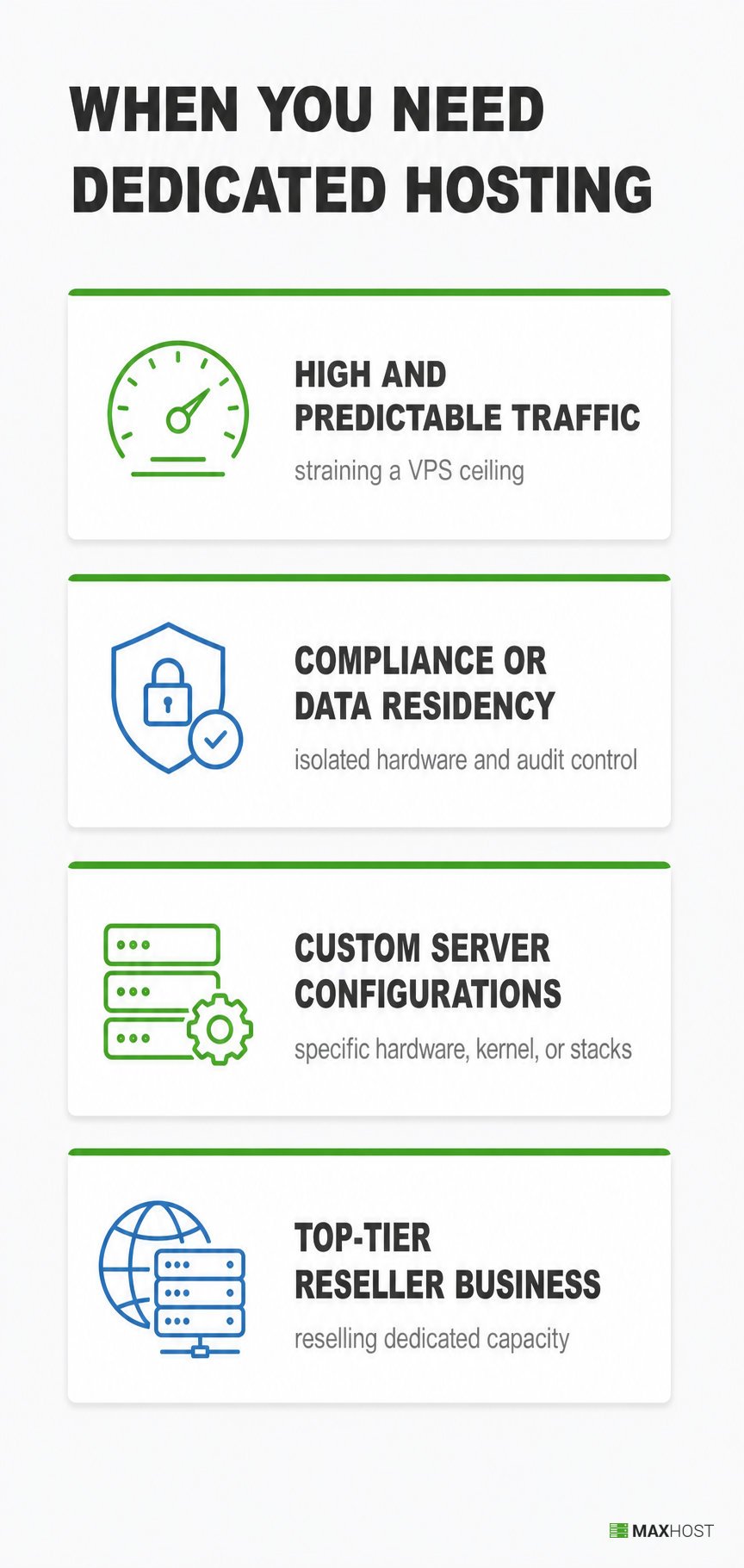
- High and predictable traffic: sites already straining a VPS plan's CPU or RAM ceiling during normal, not just peak, hours.
- Compliance or data residency requirements: industries like healthcare, finance, or government that need isolated hardware and audit control.
- Custom server configurations: workloads needing specific hardware, kernel settings, or software stacks a shared environment cannot support.
- A reseller business at the top tier: hosting companies reselling dedicated capacity to their own high demand clients.
You can skip it if you run a standard blog, portfolio, or small store, where a shared or VPS plan is the better call. The same holds on a tight budget or without server administration skills. Once you have decided dedicated hosting fits, how to choose a web host walks through comparing providers on uptime, support, and price.
How Does Dedicated Hosting Differ from VPS Hosting?
Dedicated hosting and VPS hosting both give you isolated resources, but at very different scales.
| Attribute | Dedicated Hosting | VPS Hosting |
|---|---|---|
| Hardware | One entire physical machine | A virtualized slice of a shared physical machine |
| Resource sharing | None, fully exclusive | Isolated, but the physical host is shared |
| Scalability | Fixed capacity, scaling needs new hardware | Fast, adjust virtual resources on the fly |
| Typical cost | Around 100 USD a month and up | Roughly 5 to 80 USD a month |
| Best for | Maximum control and performance | Growing sites that outgrow shared hosting |
For the full breakdown across all four hosting types, see shared vs vps vs dedicated vs cloud hosting.
How MaxHost Supports Dedicated Hosting Providers
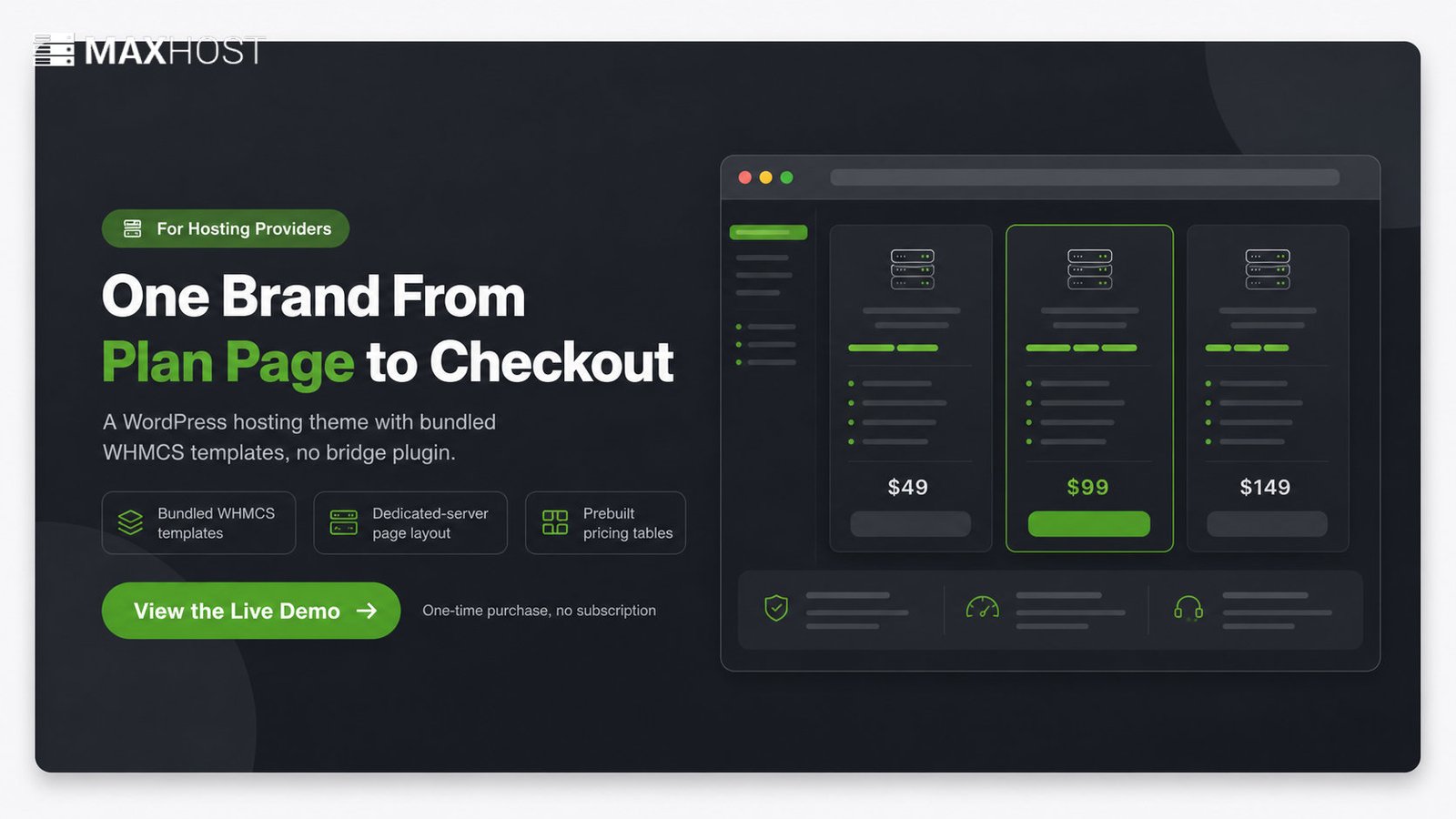
MaxHost does not sell dedicated hosting itself. It gives hosting companies and resellers that already sell dedicated-server plans a matching WordPress marketing site and WHMCS-templated checkout. The plan pages and the billing area then look like one brand.
The Server Hosting demo includes a dedicated-server page layout with pricing tables built in. See the live demo to browse it.
FAQs
What is dedicated hosting?
Dedicated hosting is a hosting model where one customer rents an entire physical server, not shared with anyone else. It costs more than shared or VPS hosting, but gives the most performance, security, and control.
How much does dedicated hosting cost?
Dedicated hosting typically runs from around 40 USD a month for a bare unmanaged plan to 250 USD for mid-tier plans. Premium, high-core builds cost 300 USD or more a month. Managed plans cost more than unmanaged ones, since the provider absorbs the maintenance work.
What are the 4 types of web hosting?
The four main types of web hosting are shared, VPS, dedicated, and cloud hosting, each trading cost against control and performance. See what is web hosting for the full breakdown of all eight hosting types.
Is dedicated hosting the same as colocation?
No, dedicated hosting and colocation are not the same. With dedicated hosting, the provider owns the physical server and leases it to you. With colocation, you own the hardware, and the provider only supplies power, cooling, and connectivity.
Can you upgrade from VPS hosting to dedicated hosting?
Yes, moving from VPS to dedicated hosting is a common growth path. Sites usually make the switch once sustained CPU or memory pressure, rising traffic, or new compliance needs outgrow what a VPS plan can absorb.
What's the difference between free hosting and dedicated hosting?
Free hosting costs nothing but caps storage, bandwidth, and support, and often shares a server among many sites. Dedicated hosting costs the most of the standard tiers, but gives one customer an entire server with full control.
Is dedicated hosting secure?
Yes, dedicated hosting is the most secure standard hosting tier by default, since no other customer shares the same machine. Actual security still depends on the management tier: unmanaged plans leave patching and hardening entirely to the customer.