A web hosting or reseller hosting business is genuinely profitable, but only under conditions most "yes, go for it" articles skip. It rewards operators who run it as a recurring-revenue service business with a support plan and a non-commodity angle. It punishes anyone chasing fast lump-sum profit or competing purely on price. Below I run the real numbers. That means honest margins, stacked startup and monthly costs, the client count where you break even, and the risks that sink small hosts.
Is a Web Hosting Business Profitable?
Yes, conditionally. A hosting business profits when you treat it as a recurring-revenue service, price above the commodity floor, and can cover client support. It stays thin or unprofitable if you chase quick money, sell only bare hosting, or try to undercut $1 hosts. Startup capital is low, and margins compound as clients stack up, but the early months run lean and the support load is real.
Here is the honest picture at a glance, before the detailed sections.
| Pros at a glance | Cons at a glance |
|---|---|
| Low startup cost and a low barrier to entry | "$1 hosting" price competition squeezes margin at the bottom |
| Recurring revenue that compounds client by client | You are the first line of client support, 24/7 |
| No server hardware to own or maintain | Thin or negative margin until you clear a client-count threshold |
| A large, still-growing market | Your uptime depends on an upstream provider you do not control |
| Real upsell and add-on revenue | A client's abuse or a security breach can get your whole account suspended |
What Are the Benefits of Starting a Web Hosting Business?
The category's real strengths are low startup capital, recurring monthly revenue that compounds, and no hardware to own if you resell. These are structural advantages, not marketing gloss. They also explain why the model attracts so many first-time operators. If you are still unsure what reseller hosting is or how it differs from running your own servers, start there first.
Low Startup Cost and a Low Barrier to Entry
You can start for well under $100 a month, which is the model's biggest draw. The recurring floor is a wholesale reseller plan plus billing software. A reseller hosting plan runs about $19.88 to $58.88 a month and includes free cPanel and WHM. Billing software adds the rest. There is no server to buy, no datacenter contract, and no staff on day one. That low entry point is exactly why solo operators can run near-zero marginal cost once the plan is paid.
Recurring Revenue That Compounds
Hosting is a subscription, so revenue stacks instead of resetting each month. Every client you keep is monthly recurring revenue (MRR) that carries into the next month automatically. Add ten clients this quarter and next quarter starts from that base, not from zero. That compounding is the real engine, not any single sale.
Switching costs make hosting stickier than most subscriptions. Clients rarely move a live site and its email to a new host, so churn stays low once the account is set up. White-label branding deepens that lock-in, because the client sees your brand, not the upstream provider's.
No Server Infrastructure to Own or Maintain
Reselling means your upstream provider owns and maintains the hardware, not you. You rent server capacity wholesale, then carve it into branded plans through WHM and cPanel. The provider handles the servers, network, uptime, and physical maintenance. You handle branding, billing, and clients. This is the difference between reselling and running your own datacenter or VPS fleet. There, hardware, redundancy, and on-call engineering become your problem and your capital cost.
A Large, Still-Growing Market
Demand keeps expanding because a web presence is now near-universal for businesses. Independent research sizes the global web hosting market in the hundreds of billions of dollars, with a double-digit annual growth rate. Exact totals vary by firm and definition. The practical takeaway is a durable tailwind, not a single reliable number. Every new small business that needs a site is a potential hosting customer.
Real Upsell and Add-On Revenue
The margin above bare hosting comes from add-ons attached to each client. Concrete upsell categories lift revenue per client without new client acquisition.
- SSL certificates, sold at a markup on the wholesale cost.
- Domain registration and renewals bundled with the plan.
- Managed maintenance retainers: updates, backups, and security monitoring.
- Priority support or premium caching tiers.
A single client on a maintenance retainer can add $30 to $50 a month on top of the hosting fee, and that revenue recurs.
What Are the Drawbacks of Starting a Web Hosting Business?
The genuine limitations are commodity price competition, a constant support burden, thin early margins, upstream dependency, and shared-infrastructure security risk. These are real obstacles, not hypotheticals, and each one is condition-specific. Most failed small hosts trace back to one of them. Here is exactly who each drawback hits and when.
"$1 Hosting" Price Competition Squeezes Margin at the Bottom
At the commodity shared tier, competitors underprice you through overselling. Large budget hosts pack far more accounts onto a server than resources truly support, betting most stay idle. That lets them advertise $1 to $5 plans you cannot match on a small reseller allocation. This squeeze is specific to the price-competitive bottom of the market, not the category as a whole. Compete there and margins collapse toward zero. The escape is to sell service, speed, and support rather than the cheapest gigabyte. That is a positioning choice, not a pricing war you can win.
You Are the First Line of Client Support, 24/7
When a client's site goes down at 2 a.m., they contact you, not your upstream host. Support is the single largest recurring cost in a small hosting business, and it is your time. This burden is acute for solo operators with no staff and no ticket automation. It eases once you automate provisioning and billing through WHMCS, set clear support-hours expectations, or hire help. Underestimate it and you burn out, or worse, respond slowly and lose the trust the whole model depends on.
Industry estimates put the share of clients who need active technical support around 20 percent. That minority still sets your response burden, because you cannot predict which client will break next, or when.
Thin or Negative Margin Until You Clear a Client-Count Threshold
The fixed tooling cost is the same whether you have three clients or thirty. That reseller plan plus billing software is roughly a fixed $75 a month floor. Spread across two or three clients, it eats most of your revenue or runs you at a loss. The math only turns comfortably positive once you clear a client-count threshold, which I work out in full in the cost section below. Early months are an investment, not income, and operators who expect immediate profit quit before the compounding starts.
Your Uptime Depends on an Upstream Provider You Don't Control
As a reseller, you cannot fix a hardware or network fault yourself. If your upstream provider's server fails, you wait for their engineers while your clients wait for you. Your brand absorbs the outage even though the cause sits one layer up. Choosing a reliable provider with a real uptime guarantee is the only meaningful defense, and it is a decision you make once, at the start. This dependency also feeds churn. Repeated downtime is one of the fastest ways to lose clients. Lost clients are expensive, because acquiring a new one costs several times more than keeping an existing one.
A Client's Abuse or a Breach Can Suspend Your Whole Account
On shared reseller infrastructure, one bad client can cost you every client. A hacked site, a spam-blasting script, or a malware host can get the shared server IP blacklisted, so legitimate clients' email starts bouncing. In the worst case, the upstream provider suspends your entire reseller account over one account's abuse.
This risk is specific to shared allocations, where you do not control what your neighbors run. The defense is an enforced acceptable-use policy, a provider that isolates accounts, and security add-ons like malware scanning you can also sell.
How Much Does It Cost to Start, and What Margin Can You Expect?
Startup cost is low and recurring, but the margin depends entirely on your client count and pricing. The recurring floor is a wholesale reseller plan plus billing software, with a small one-time cost for your site. The table below shows session-current pricing for the two main recurring line items.
Startup and Monthly Costs
Your real recurring floor is the reseller plan. Many providers, including Namecheap, bundle WHMCS billing free, so a starter can launch on the plan alone. Run a separate self-hosted WHMCS license for more control or scale and it adds the second line below. Here are current published prices for both.
| Line item | Entry tier | Mid tier | Higher tier |
|---|---|---|---|
| Reseller hosting plan (Namecheap) | $19.88/mo, 25 cPanel accounts | $39.88/mo, 100 accounts | $58.88/mo, 150 accounts |
| WHMCS billing (self-hosted, optional) | $34.95/mo, up to 250 clients | $54.95/mo, up to 500 | $84.95/mo, up to 1,000 |
| Combined floor with self-hosted WHMCS | around $55/mo | around $75 to $95/mo | around $115 to $145/mo |
If your provider bundles WHMCS free, your true floor is just the reseller-plan row, about $20 to $59 a month. On top of that sit small one-time costs: a domain (roughly $10 to $15 a year) and a website or storefront build.
A few recurring costs hide outside this table. Payment processors take about 2.9 percent plus $0.30 per transaction, and some upstream hosts pass through per-account cPanel license fees. If you buy traffic through ads, client acquisition can run 15 to 20 percent of revenue, so a referral or agency channel protects your margin.
Realistic Profit Margins by Tier
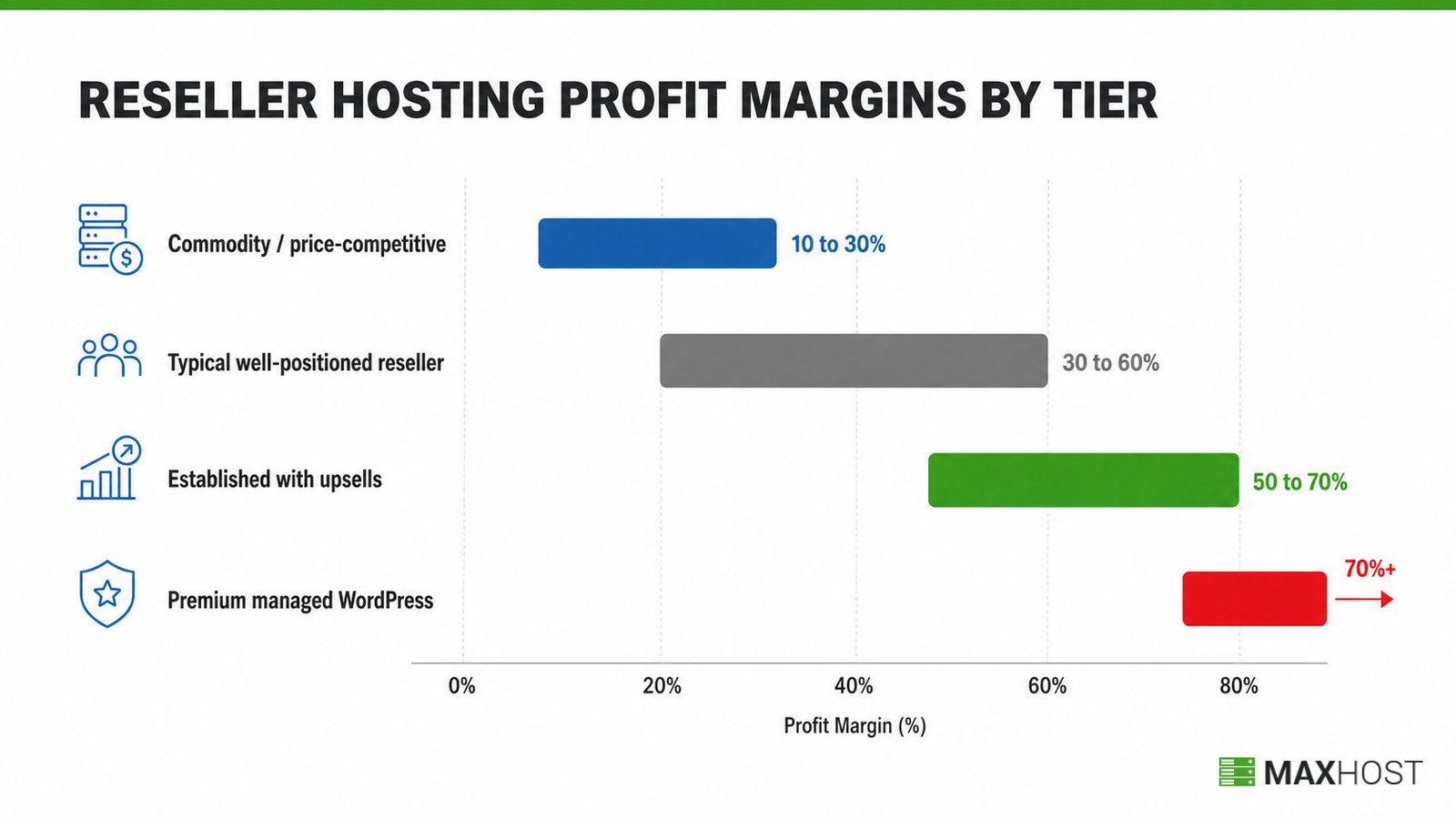
Margins are wide, and honesty means quoting a range by tier, not a single flattering number. At the commodity, price-competitive shared tier, expect roughly 10 to 30 percent, because overselling rivals cap what you can charge. A typical, well-positioned reseller runs about 30 to 60 percent. Established operators with real service and upsells reach 50 to 70 percent, and a premium managed-WordPress positioning can push gross margin past 70 percent. Hosting-community forums have long put solo, low-overhead margins at 80 percent or more. That thread predates current pricing and counts none of your own labor. Treat the higher figures as achievable, not automatic.
Sample Math at 10, 50, and 100 Clients
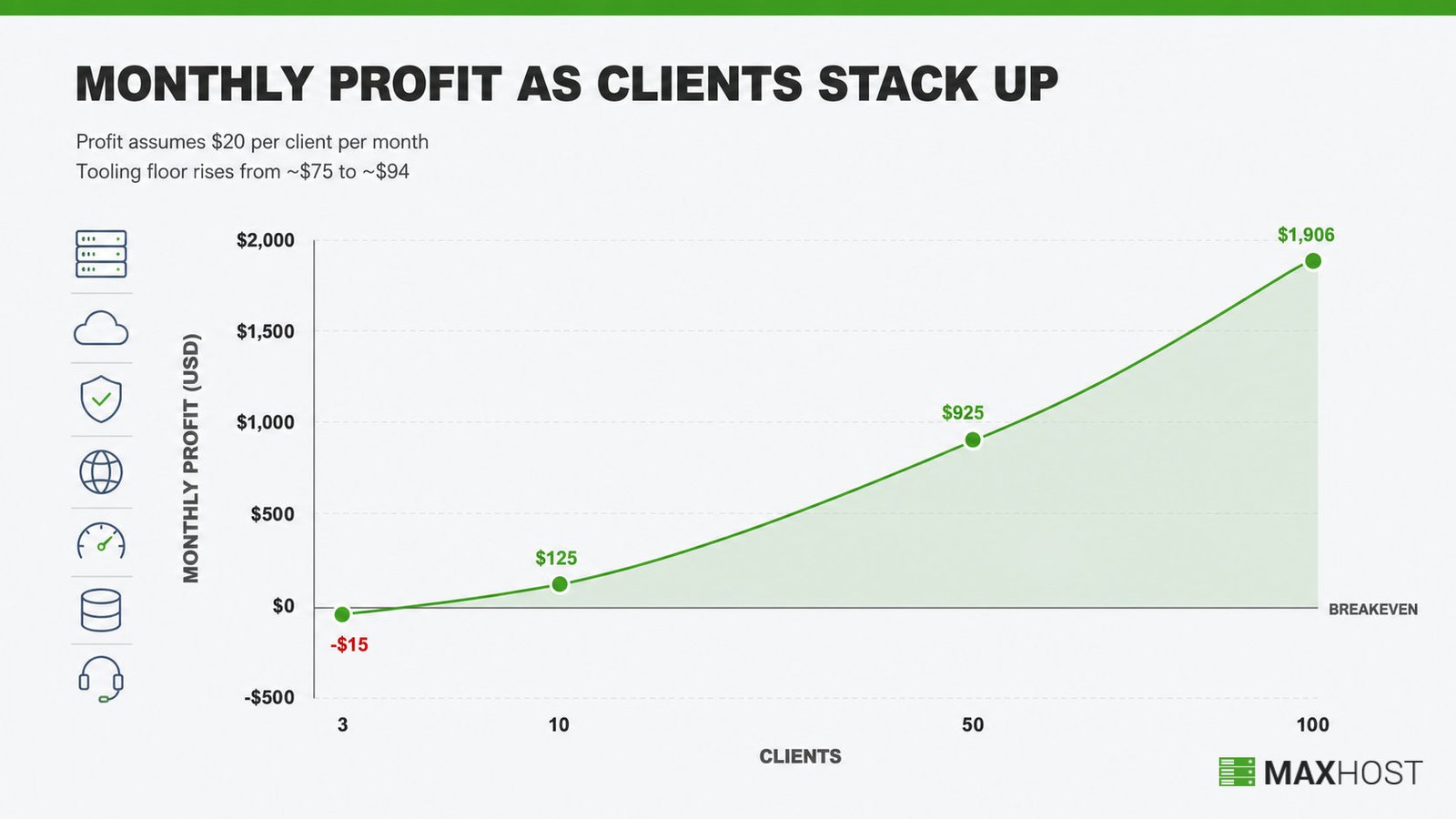
Here is an illustrative model, not a guarantee, using a mid-tier reseller plan plus a self-hosted WHMCS license at a roughly $75 fixed monthly floor. Assume a conservative $20 per client per month. On a bundled-free billing floor near $40, breakeven falls to two or three clients and every profit line below improves.
| Clients | Monthly revenue | Fixed tooling cost | Monthly profit (before your time) |
|---|---|---|---|
| 3 (breakeven zone) | $60 | ~$75 | about -$15 (a loss) |
| 10 | $200 | ~$75 | about $125 (~$1,500/yr) |
| 50 | $1,000 | ~$75 | about $925 (~$11,100/yr) |
| 100 | $2,000 | ~$94 (capacity upgrade) | about $1,906 (~$22,900/yr) |
Two things stand out. Below roughly four or five clients you run at a loss on tooling alone. Above that, margin expands fast, because the fixed floor barely moves as clients stack up, until you hit a plan-capacity tier upgrade. That is the compounding effect working in your favor.
Do You Need to Start a Web Hosting Business?
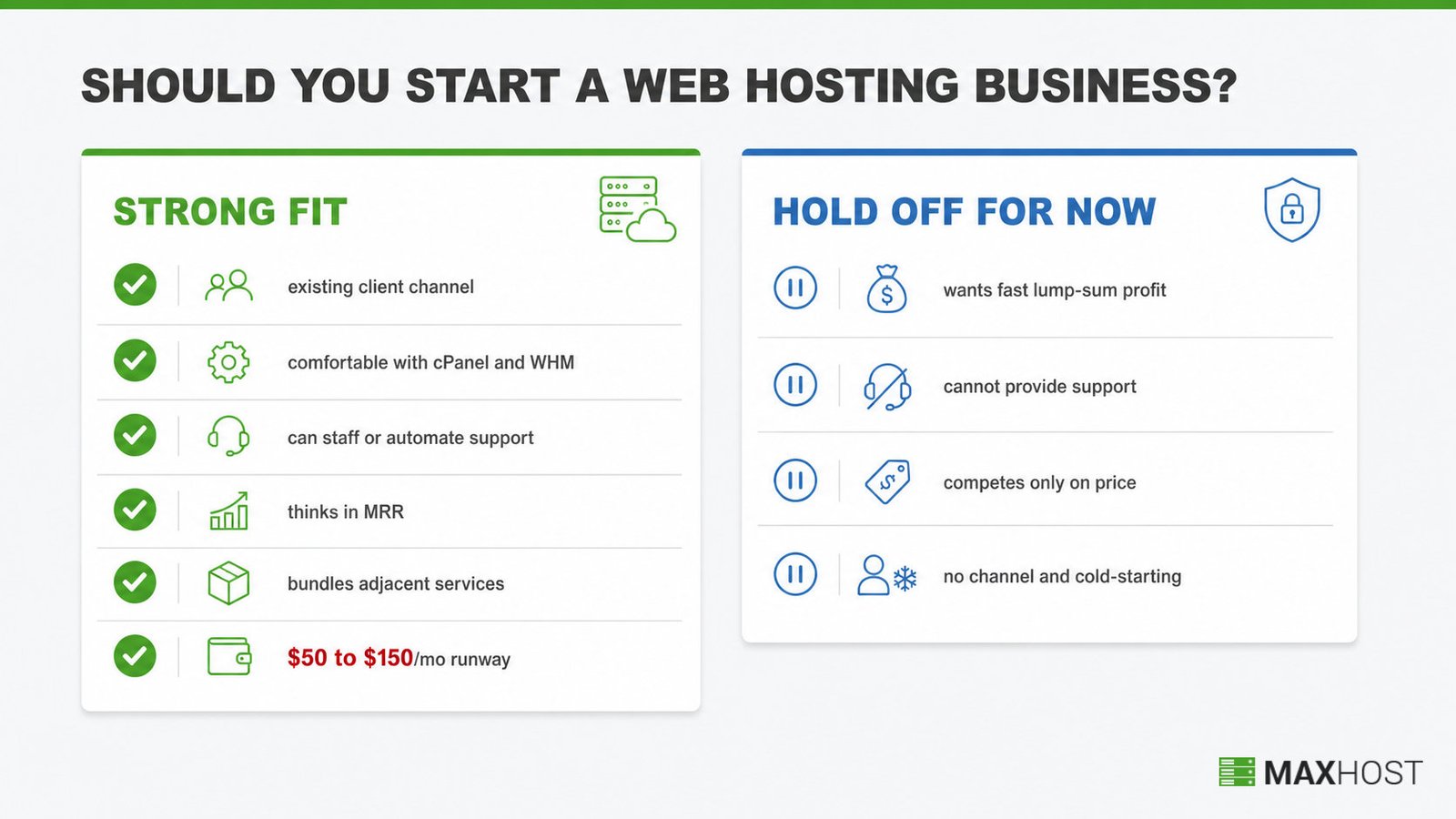
You are a strong fit if you already have a client channel, can cover support, and think in recurring revenue. You should hold off if you want fast money, cannot provide any support, or plan to win purely on price. Both answers are below, and neither is softened.
Signs You're a Strong Fit
You are well positioned to make this profitable if several of these describe you.
- You already have a client channel, such as web-design clients, agency relationships, or local-business contacts you can sell hosting into.
- You are comfortable with cPanel and WHM-level administration, or willing to learn it.
- You can staff or automate support coverage, rather than leaving tickets unanswered for days.
- You think in monthly recurring revenue, not one-time payouts, and can wait out the thin early months.
- You plan to bundle hosting with adjacent services like design, domains, or maintenance, instead of selling commodity hosting alone.
- You have $50 to $150 a month of recurring runway plus a few hundred dollars of one-time setup capital.
When It's Not the Right Move Yet
Some readers should genuinely stop here, and this section is meant to route them out honestly. Hold off if any of these are true.
- You want fast or lump-sum profit. Hosting pays through slow-compounding MRR, and the first months run at or near a loss.
- You cannot provide any support coverage, with no time, no staff, and no automation budget. Unanswered tickets kill retention faster than any competitor.
- You plan to compete purely on price against $1 to $5 commodity hosts. You cannot win that race on a small reseller allocation.
- You have no existing channel to sell into and would be cold-starting client acquisition in a saturated market, with no differentiation and no audience.
If two or more of those describe you, build the channel or the support plan first, then revisit the math.
What to Build First If You Decide to Move Forward
If the numbers work for you, the next step is to pick a track and stand up a professional storefront. Your path depends on the model you want:
- For the full launch sequence from niche to live site, follow how to start a web hosting business.
- If reselling under an upstream provider with no servers of your own is the model, the narrower setup is covered in how to start a reseller hosting business.
- To pair hosting with domain sales for extra recurring revenue, see how to become a domain reseller.
- Before committing capital, put the numbers above into a proper web hosting business plan.
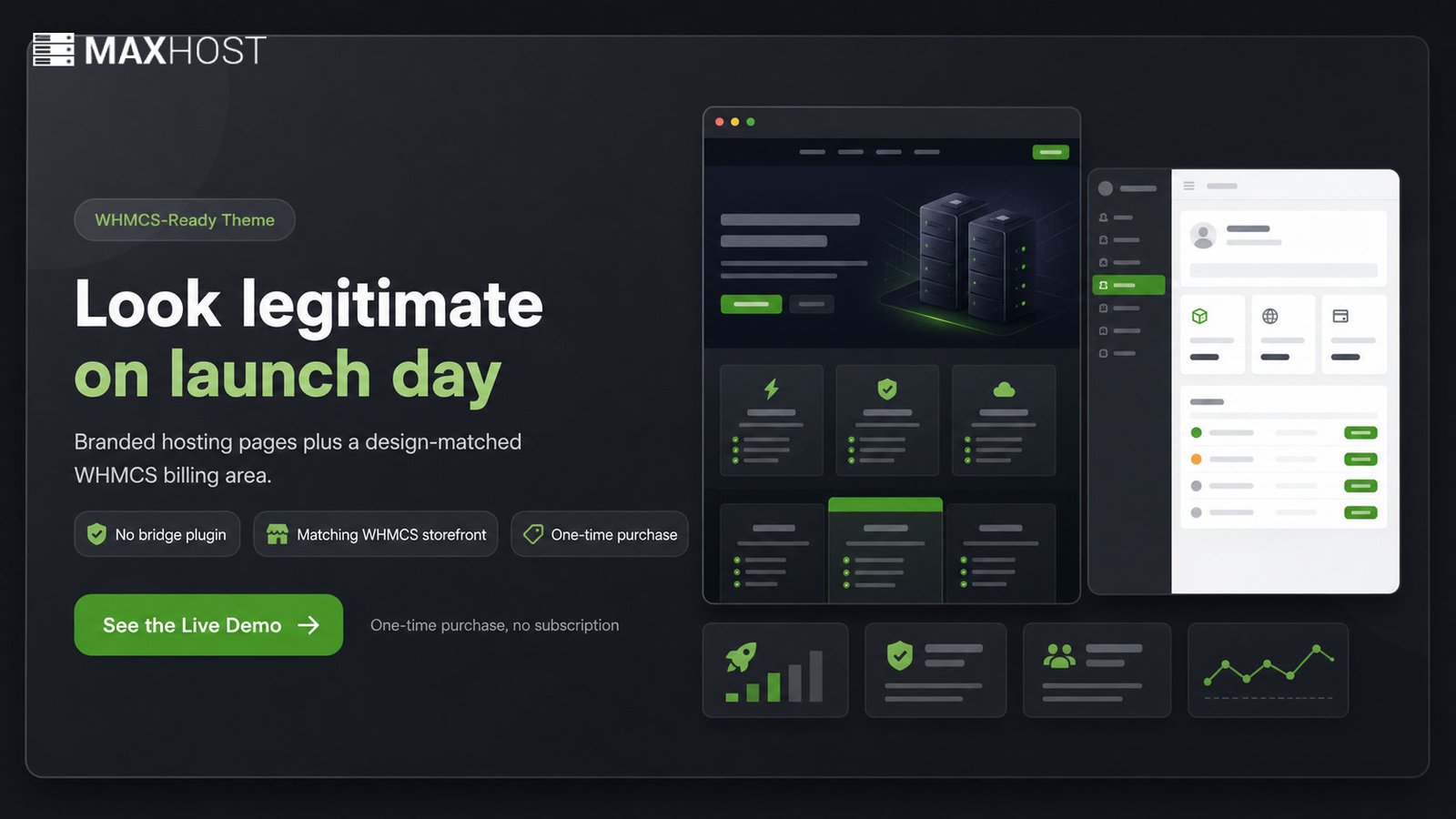
The one input cost you can responsibly shrink is the site build. Hosting buyers judge trust by your storefront, so a bare or unbranded site undercuts the exact signal they check. A WordPress theme built for a hosting company like MaxHost replaces a custom marketing-site build and a bridge-plugin-dependent WHMCS skin for a one-time cost. You get branded hosting pages plus a design-matched WHMCS billing area. It does not change your margin, churn, or support load, those depend on how you run the business. It only lowers the one-time cost of looking legitimate on day one. You can see the hosting site and matching WHMCS storefront in the live demo before you commit.
FAQs
Is a web hosting business profitable in 2026?
Yes, for operators who run it as a recurring-revenue service business. Profit comes from stacking clients on monthly billing, pricing above the commodity floor, and adding upsells like domains, SSL, and maintenance. It is not fast money. The first months run thin while your fixed tooling cost is spread across few clients, and margins only compound once you clear the breakeven threshold.
Is reseller hosting more profitable than starting a hosting company from scratch?
For most people starting out, yes. Reseller hosting skips the capital cost and engineering burden of owning servers, since your upstream provider handles hardware, uptime, and maintenance. You reach positive margin faster because your only recurring costs are the reseller plan and billing software. Building your own infrastructure can earn more per client at large scale, but it demands far more capital, expertise, and operational risk upfront.
What is a good profit margin for reseller hosting?
A well-positioned reseller typically runs 30 to 60 percent, and established operators with upsells reach 50 to 70 percent or higher. The commodity, price-competitive tier is much thinner, often 10 to 30 percent. Your margin is set mostly by pricing and packaging, not the wholesale cost. For how to actually set that price point, see how to price your hosting plans.
How many clients do you need to break even on a reseller hosting business?
Roughly four to five clients at $20 a month to cover the fixed tooling floor of about $75. Below that, the reseller plan plus billing software runs you at a loss. That covers only tooling, not your own time, so a realistic "worth it" threshold is closer to ten or more clients. After that, each new client is nearly pure margin until you hit a plan-capacity upgrade.
What's the biggest expense in running a small hosting business?
Client support is the biggest real cost, measured in your time rather than dollars. You are the first line of response 24/7, and unanswered tickets drive churn. The next-largest cost is the fixed tooling floor: the reseller plan plus WHMCS billing, roughly $75 a month combined. Automation through WHMCS reduces the support and admin load, which is why it is standard for serious operators.
Can you start a web hosting business with no technical skills?
Partly. Reseller hosting removes server administration, since the upstream provider maintains the hardware. You still need to handle cPanel and WHM account management, WHMCS billing setup, and client support, which are learnable but not zero-skill. Freelancers, web designers, and agency owners tend to fit best. They already have the adjacent technical comfort and, crucially, a client channel to sell into.
Is domain reselling more profitable than hosting reselling?
Usually no on its own, but it is a strong add-on. Domain margins per sale are thin compared to recurring hosting fees, because registration is a low-markup commodity. Its value is bundling. Attaching domains to a hosting plan raises revenue per client and boosts retention, since clients rarely move a site and its domain separately. Treat it as a margin booster on top of hosting, not a standalone business. The domain reseller setup guide linked above covers the specifics.
Do I need a business plan before I start reselling hosting?
You do not need a formal document, but you do need the numbers. Know your fixed tooling floor, your per-client price, your breakeven client count, and your support capacity before you spend a dollar. Writing it down forces you to confront the thin early months honestly. If you would rather start from a structure than a blank page, a business plan template does the section-by-section work for you.