Uptime is the percentage of time a server or website stays online and reachable, measured against total expected operating time. Hosts publish it as a reliability signal, usually inside a service level agreement (SLA), because brief outages still cost visitors and revenue.
Why Does Uptime Matter for Hosting Customers?
Uptime is the trust signal hosting buyers check before anything breaks, and visible downtime costs signups, rankings, and confidence at once.
Every layer of a hosting stack carries its own uptime expectation. Web hosting keeps the site itself online, and email hosting keeps inboxes reachable. A weak link in either one undermines the whole business.
An outage does more than inconvenience visitors. A prospect who lands on a broken site during evaluation reads it as proof the host cannot be trusted with revenue-critical infrastructure. That impression carries into every renewal decision afterward.
How Is Uptime Calculated?
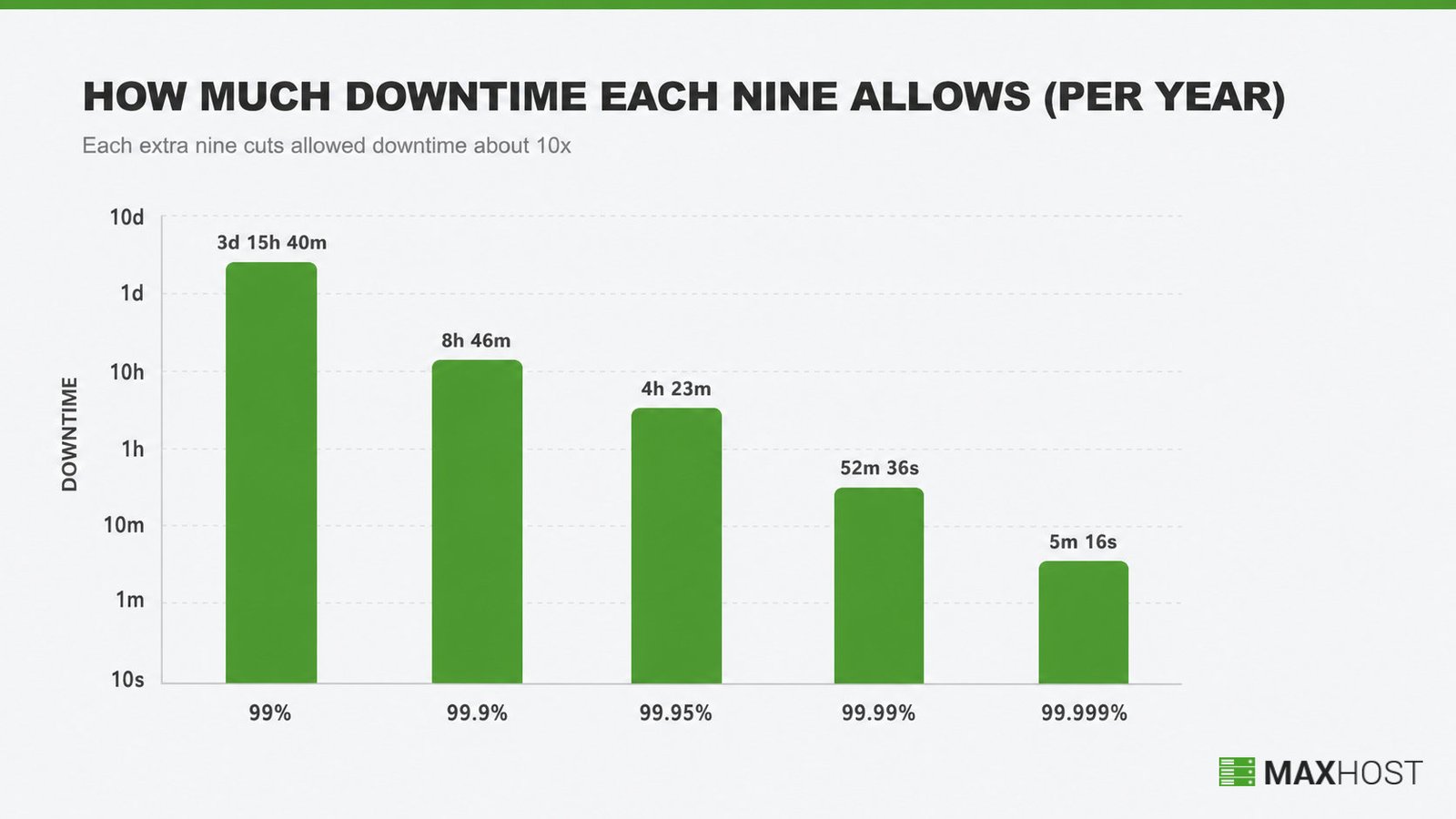
Uptime equals total time minus downtime, divided by total time, then multiplied by 100 to get a percentage. Hosts describe the result in "nines": 99% is two nines, 99.9% is three nines, and 99.999% is five nines. Each extra nine cuts allowed downtime by roughly a factor of ten.
Here is a worked example. A server down 4 hours in a 720-hour month scores (720 minus 4) divided by 720, times 100, which is 99.44% uptime.
The table below shows how much downtime each uptime tier allows, per year and per month. Wikipedia's high availability entry confirms these figures independently.
| Uptime | Downtime allowed per year | Downtime allowed per month |
|---|---|---|
| 99% | 3 days, 15 hours, 40 minutes | 7 hours, 18 minutes |
| 99.9% | 8 hours, 46 minutes | 43 minutes, 50 seconds |
| 99.95% | 4 hours, 23 minutes | 21 minutes, 55 seconds |
| 99.99% | 52 minutes, 36 seconds | 4 minutes, 23 seconds |
| 99.999% | 5 minutes, 16 seconds | 26 seconds |
Moving from 99.9% to 99.99% cuts allowed downtime by about 90%, from nearly 9 hours a year to under an hour. The uptime.is calculator confirms the same figures independently.
What Counts as a Good Uptime Percentage?
No, 98% uptime is not good for a production website: it allows more than seven days of downtime a year. The industry-standard SLA floor for hosting is 99.9%, which caps downtime at under nine hours annually. A guarantee of 99.95% or higher is a stronger commitment worth paying more for.
Cloud hosting often exceeds the 99.9% floor because it spreads load across multiple servers instead of one. That redundancy is why some cloud providers commit to 99.99% instead of the shared-hosting norm.
Uptime is one of several criteria worth weighing before signing a hosting contract. How to choose a web host walks through the full checklist, including uptime, support, and pricing.
How Do Hosts Guarantee and Monitor Uptime?
An uptime SLA is the host's written promise of a minimum percentage, backed by service credits when it misses that number. Hosts hit high uptime through redundancy: duplicate servers, power supplies, and network paths that take over automatically when one component fails. Independent monitoring then verifies the number instead of trusting the host's own dashboard.
A typical hosting SLA ties credits to how far uptime falls below the guarantee. KnownHost's published SLA, for example, guarantees 99.9% uptime and issues a 10% credit at 99.80% uptime. The credit rises in tiers, reaching a full 100% credit if uptime drops to 99.00% for the month. Most SLAs exclude scheduled maintenance, factors outside the host's control, and downtime the customer causes.
Redundancy is the mechanical half of a high uptime number: extra servers, power, and network paths that fail over automatically. A content delivery network adds another layer, spreading traffic across edge locations so one server's outage does not take the whole site down.
A domain reseller that publishes its own uptime SLA plainly earns the same trust a direct host does. Hiding the number, or not measuring it at all, is the bigger red flag.
Third-party monitors such as UptimeRobot and Uptime Kuma check a site independently, on a schedule the host cannot control. Hosts also track mean time between failures (MTBF) and mean time to repair (MTTR) internally, the two numbers that drive the uptime percentage itself.
How MaxHost Helps You Showcase Your Uptime Guarantee
MaxHost does not host anything itself: it is a WordPress theme built for hosting companies and resellers. It gives a hosting company's marketing site the pricing tables and plan-comparison blocks to publish its own uptime SLA where prospects actually see it.
A hosting company using MaxHost still buys its own uptime, from its own infrastructure or upstream provider. What the theme controls is whether that number gets displayed, not what it measures.
MaxHost's pricing tables show a plan's uptime commitment next to its price, instead of burying it in a legal page. Its plan-comparison blocks let a shopper weigh uptime against storage and cost across shared, VPS, and dedicated tiers side by side.
See the pricing-table and plan-comparison components in the MaxHost demo.

FAQs
What is uptime in web hosting?
Uptime in web hosting is the percentage of time a server stays online and reachable, measured against total expected operating time. Hosts most often guarantee 99.9% or higher inside a service level agreement.
Is 98% uptime good?
No. 98% uptime allows more than seven days of downtime a year, well below the 99.9% floor most hosting SLAs guarantee.
What is uptime on a website?
A website's uptime is the same availability percentage whether it runs on shared hosting or a dedicated server. A working DNS record only proves the domain resolves, not that the site itself is up.
How much downtime does 99.9% uptime allow?
99.9% uptime allows about 8 hours and 46 minutes of downtime a year, or roughly 44 minutes a month.
What does 90% uptime mean?
90% uptime means a server can be offline 10% of the time, about 36.5 days a year or roughly 73 hours a month. That is far too low for any hosting plan.
What's a good uptime SLA for web hosting?
99.9% is the common floor for a good hosting SLA. A guarantee of 99.95% to 99.99% is a stronger commitment worth paying more for.
Do free hosting plans guarantee uptime?
Most free and entry-level shared plans carry no formal SLA credit for downtime. A written uptime guarantee typically appears only on paid plans.