A CDN (content delivery network) is a geographically distributed group of servers that caches a website's files at edge locations near each visitor. Hosting sites use one to cut load times, absorb traffic spikes, and stay online when a single server struggles.
How Does a CDN Work?
A CDN routes each visitor to the nearest point of presence (PoP), a cluster of edge servers holding cached copies of a site's files. A cache hit means the edge server already holds the file and serves it directly. A cache miss means it must pull a fresh copy from the origin server first.
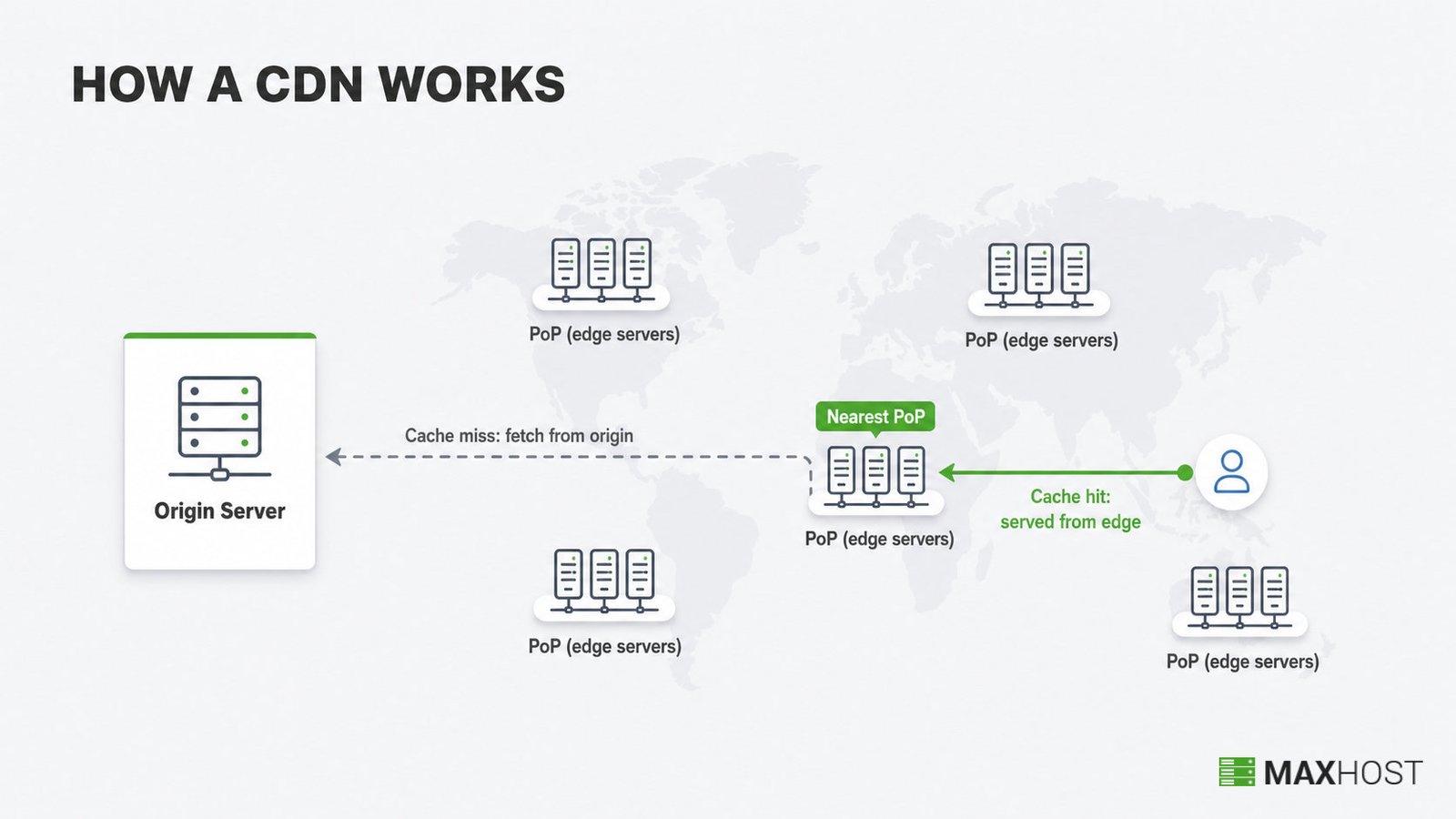
AWS breaks that handoff into a four-step caching process.
- A visitor requests a static file, such as an image or a stylesheet.
- The origin server answers the request and sends a copy to the nearest PoP.
- That PoP stores the copy as a cached file on its edge servers.
- Every later request from that region gets served from the edge, not the origin.
A time-to-live (TTL) value controls how long the edge keeps that copy before treating it as stale. A short TTL refreshes content often. A long TTL favors speed over freshness. Amazon CloudFront alone runs more than 450 points of presence worldwide, so a visitor rarely sits far from a cached copy.
What Are the Benefits of a CDN?
A CDN's main benefits are lower latency, reduced bandwidth costs at the origin, DDoS protection, higher availability, and stronger search rankings. Each traces back to the same root cause: spreading traffic across many edge servers instead of one origin.
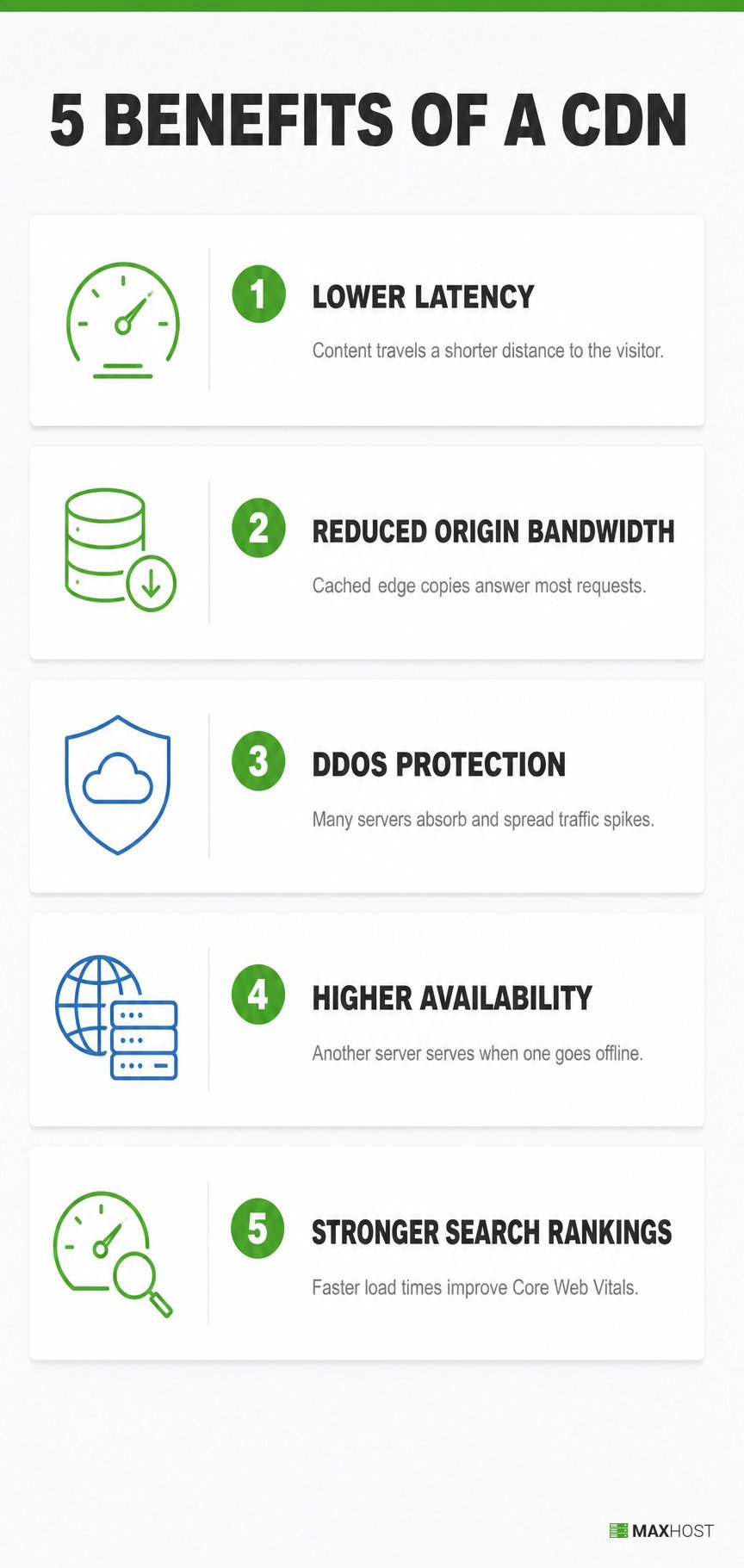
- Lower latency: Content travels a shorter physical distance from the nearest edge server to the visitor, so pages render faster.
- Reduced origin bandwidth: Cached edge copies answer most requests, so the origin server sends far less data itself.
- DDoS protection: Fastly's own documentation notes that a distributed CDN absorbs traffic spikes by spreading the load across many intermediary servers, shielding the origin.
- Higher availability and reliability: Another operational server keeps serving requests when one edge server or PoP goes offline, so uptime does not depend on a single point of failure.
- Stronger search rankings: Faster load times improve Core Web Vitals, the Google page-experience signals that feed search ranking, so a CDN-backed site competes better.
That same principle underpins what uptime measures for a hosting plan overall.
What Are Some Examples of a CDN?
Five CDN providers dominate the market, each with a different specialty.
- Cloudflare: pairs a free CDN tier with DNS and security tools, making it the most common starting point for small sites.
- Akamai: the oldest major CDN, founded in 1998 out of MIT research, now running more than 4,100 points of presence across over 120 countries.
- Fastly: built around real-time cache purging and edge compute, popular with high-traffic media and streaming sites that update content constantly.
- Amazon CloudFront: Amazon's CDN, billed alongside other AWS services and tightly integrated with S3 and EC2 origins.
- Google Cloud CDN: Google's CDN, integrated with Google Cloud Platform and its global edge network, chosen by teams already running on Google Cloud.
Some large platforms run their own CDN instead. Netflix Open Connect, for example, is a private CDN Netflix built to stream video from inside internet providers' networks.
Do You Need a CDN for Your Website?
A CDN pays off once traffic grows, visitors spread across regions, or pages carry heavy images and video. A small, single-region site with light, local traffic gains less from one, since there is little distance for a cache to shorten.
A CDN also helps most with static files like images, CSS, and scripts. Dynamic, personalized content still runs from the origin server, so a purely dynamic app benefits less.
A CDN becomes worth considering when any of these signals show up.
- Rising traffic volume: more concurrent visitors means more load a single origin server has to absorb alone.
- Geographically spread visitors: an audience outside your server's region waits longer without a nearby cached copy.
- Heavy media pages: large images, video, and downloads benefit most from edge caching, since they are the slowest assets to fetch from a distant origin.
- An online store or busy blog: e-commerce sites, high-traffic blogs, and news outlets gain both speed and the search-ranking edge that faster pages bring.
Every hosting stack starts with a domain name and adds web hosting to store the files. It layers a CDN on top for speed and often includes email hosting for a professional inbox. Most CDNs price on usage past a free entry tier. Amazon CloudFront's free tier covers 50 GB of transfer for a new account's first year, and paid plans bill by traffic after that.
How Is a CDN Different From a Cache?
A cache stores one copy of content in a single location, such as a browser or an origin server. A CDN distributes many caches across edge locations worldwide, keeping copies close to every visitor instead of serving everyone from one place.
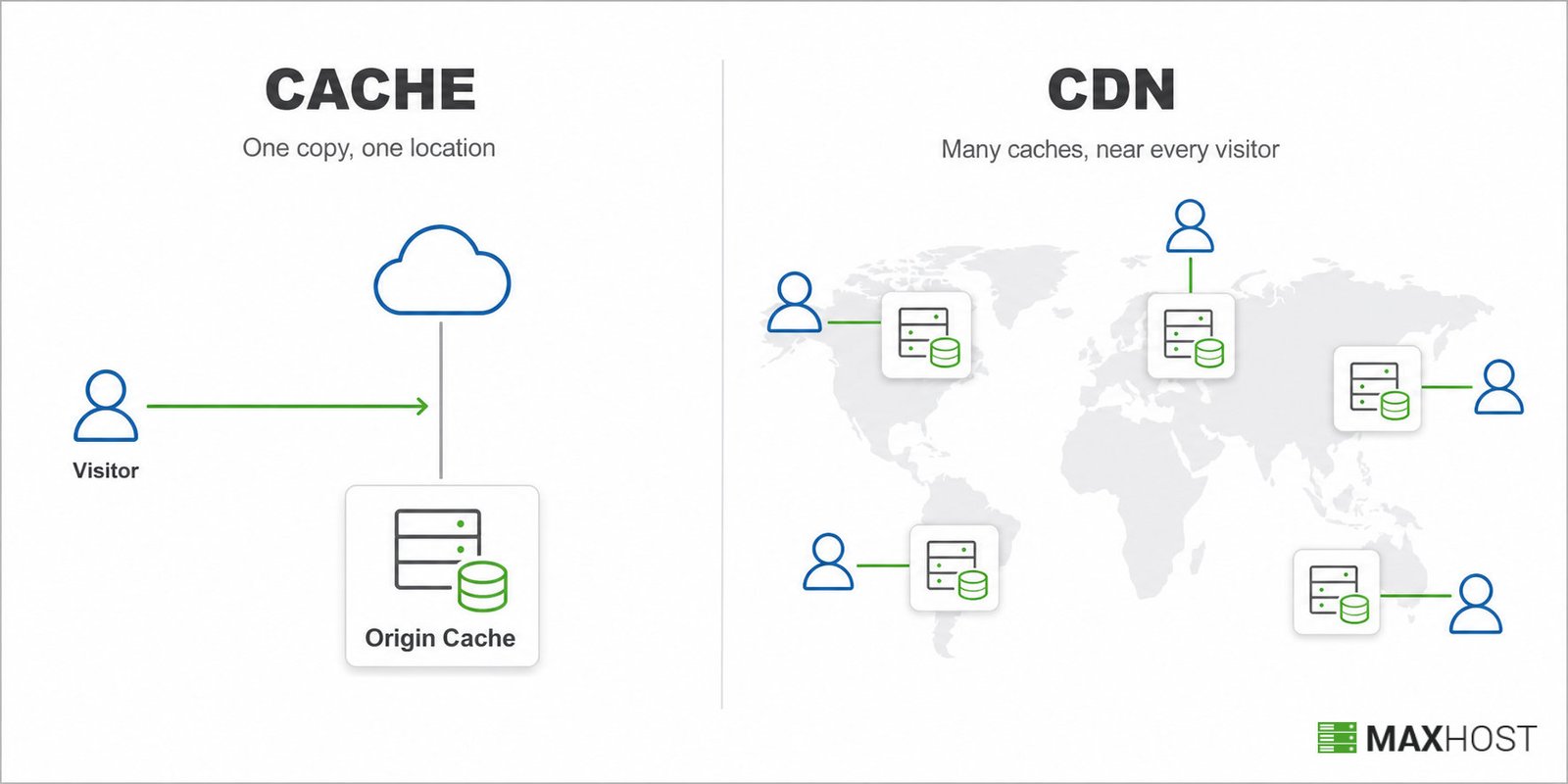
The two are not competing technologies. A CDN uses caching as its core tool, so most sites run browser and server caches together with a CDN, not instead of one.
Mozilla's developer documentation classifies a CDN as one category of managed cache, alongside reverse proxies, deployed specifically to offload the origin server. A browser cache or a single server-side page cache is the narrower case. A CDN is the same idea run at global scale across hundreds of locations.
Many CDNs also terminate HTTPS at the edge, completing the TLS handshake before traffic reaches the origin. Understanding what an SSL certificate does explains why that handshake has to happen on every visitor connection, cached or not.
How MaxHost Helps Hosting Companies Sell CDN-Backed Speed
MaxHost is a WordPress and WHMCS theme built for hosting companies, domain resellers, and IT businesses. It gives a hosting business the pricing tables and plan-comparison blocks needed to show a CDN-backed plan's speed advantage. No custom build is required.
The theme's pricing-table and comparison components let a hosting company list plan tiers side by side and flag which ones include CDN-backed delivery. A reseller marketing a CDN-included plan can show that advantage on the same page as the price. The feature does not have to hide in a list nobody reads.
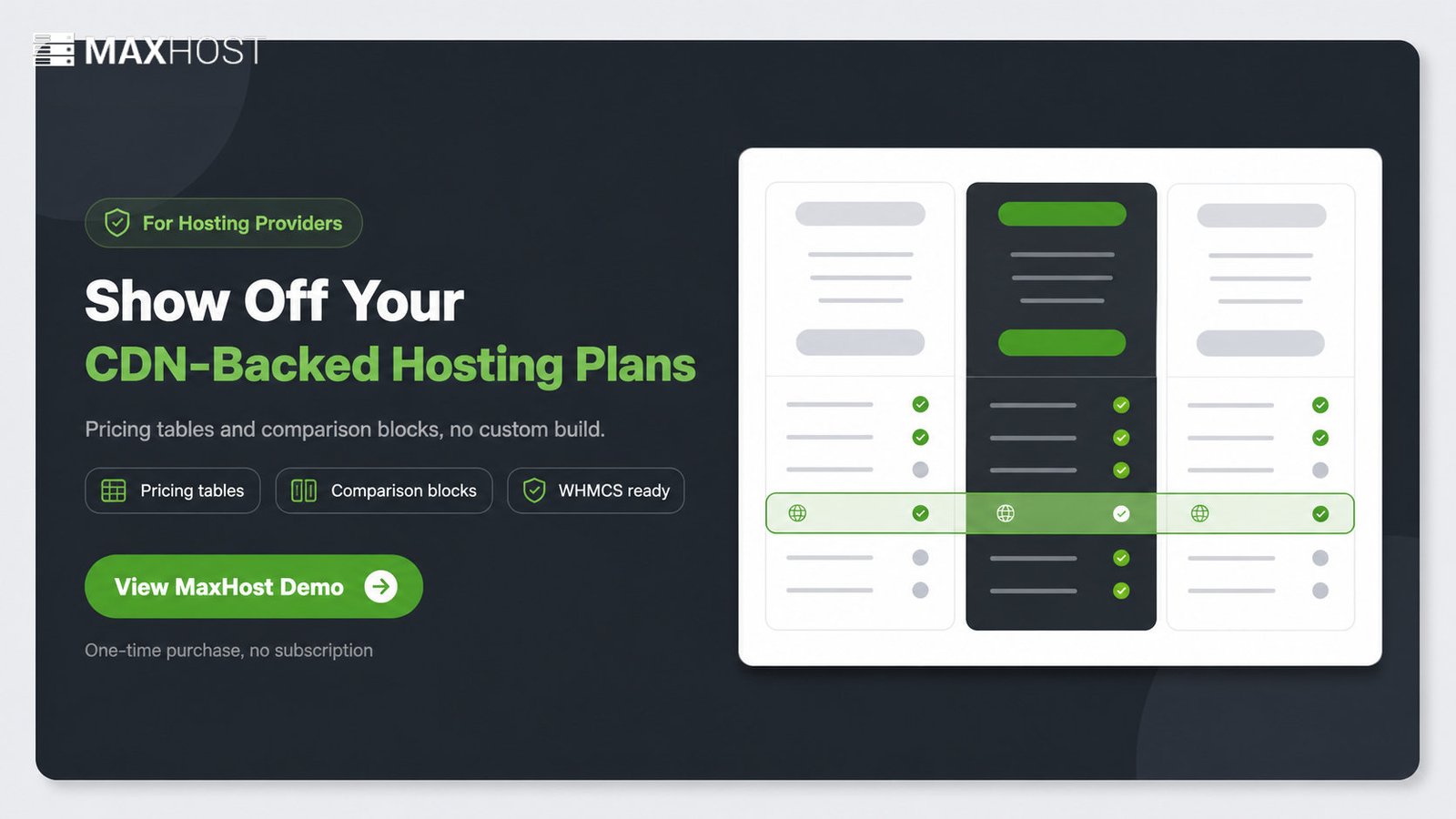
See the how to make a web hosting website guide for the step that builds these pricing tables.
FAQs
What is a CDN?
A CDN (content delivery network) is a geographically distributed group of servers that caches a website's content on edge servers near each visitor. It cuts load times and reduces the load on the origin server.
How much does a CDN cost?
Most CDNs price by usage past a free entry tier. Amazon CloudFront's free tier covers 50 GB of transfer for a new account's first year. Typical paid plans then range from about 20 to several hundred dollars a month, depending on traffic and features.
Is a CDN the same as my web host?
No. Your web host runs the origin server that stores your site's original files. A CDN caches copies of those files at edge locations closer to visitors, working alongside your host rather than replacing it.
Do I need a CDN if my hosting plan already has caching?
Often yes. Hosting-plan caching usually runs from one server location, while a CDN caches content across many edge locations worldwide. The two solve different problems and work well together.