Managed WordPress hosting is a hosting plan where the provider handles WordPress maintenance for you. That includes core, plugin, and theme updates, automated backups, staging, server side caching, and security scanning. It also includes WordPress specific support on a WordPress optimized server stack.
It costs more than shared or regular WordPress hosting because that maintenance work has a price. This guide covers what is included and real costs from Kinsta, WP Engine, and Flywheel. It also covers how managed hosting differs from regular WordPress hosting and whether it is worth paying for.
What Does Managed WordPress Hosting Include?
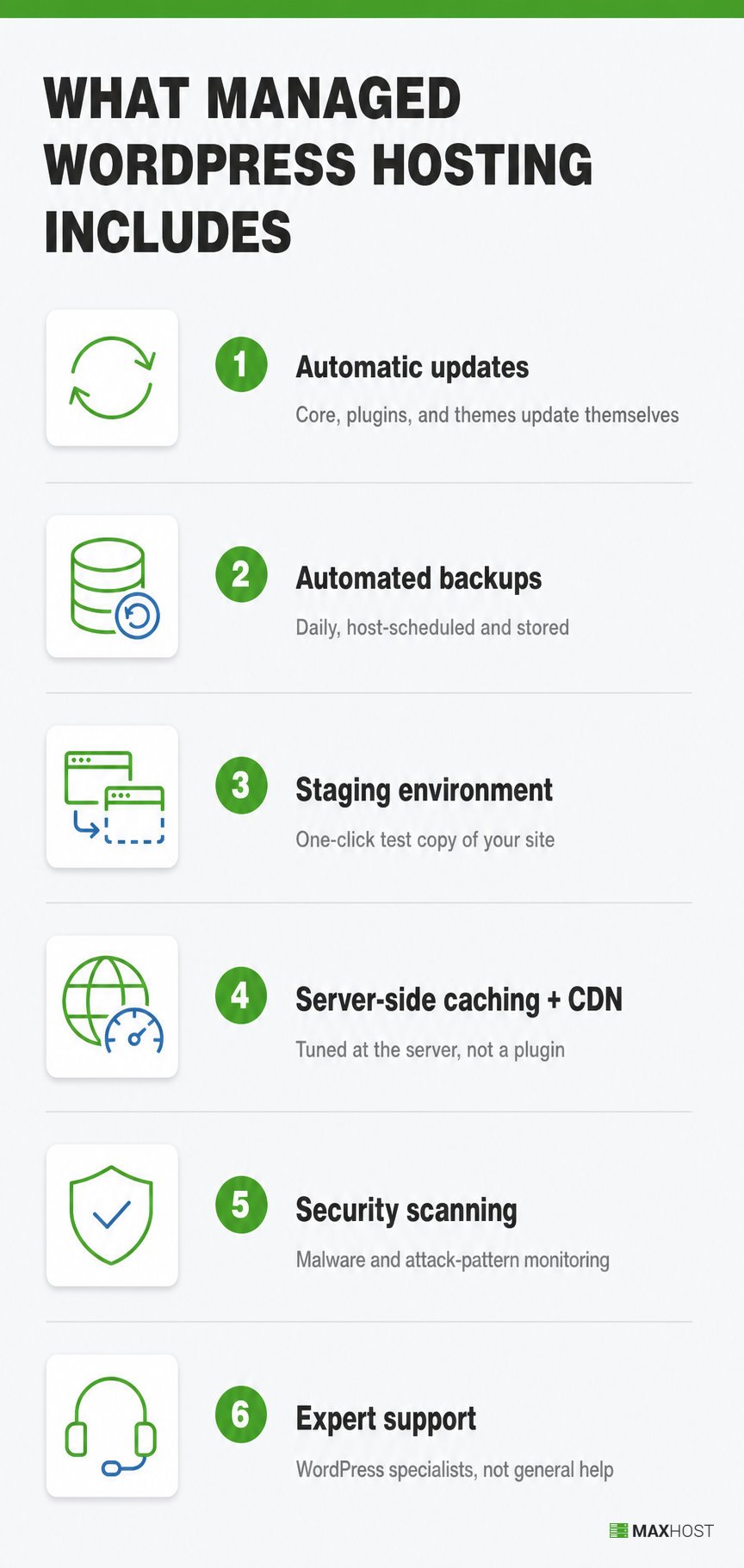
Managed WordPress hosting builds on regular WordPress hosting by adding provider-run maintenance on top of it. It is one of several types of hosting built specifically around WordPress sites. It bundles six services beyond basic server space:
- Automatic updates. WordPress core, plugin, and theme updates install without you clicking anything.
- Automated backups. The host runs and stores backups on a schedule, typically daily.
- A staging environment. A one click copy of your site lets you test changes before they go live.
- Server side caching and a CDN. The host tunes caching at the server level and serves assets from a content delivery network, not a plugin you configure.
- Security scanning. The host monitors for malware and blocks common WordPress attack patterns.
- Expert support. Support agents specialize in WordPress, not general hosting troubleshooting.
These six mechanisms run on a server stack tuned specifically for WordPress, not a generic PHP environment. WordPress.org describes this stack as running "free staging environments to automatic backups and global edge caching". It also expects "24/7 expert support" from in-house WordPress experts.
What Are the Benefits of Managed WordPress Hosting?
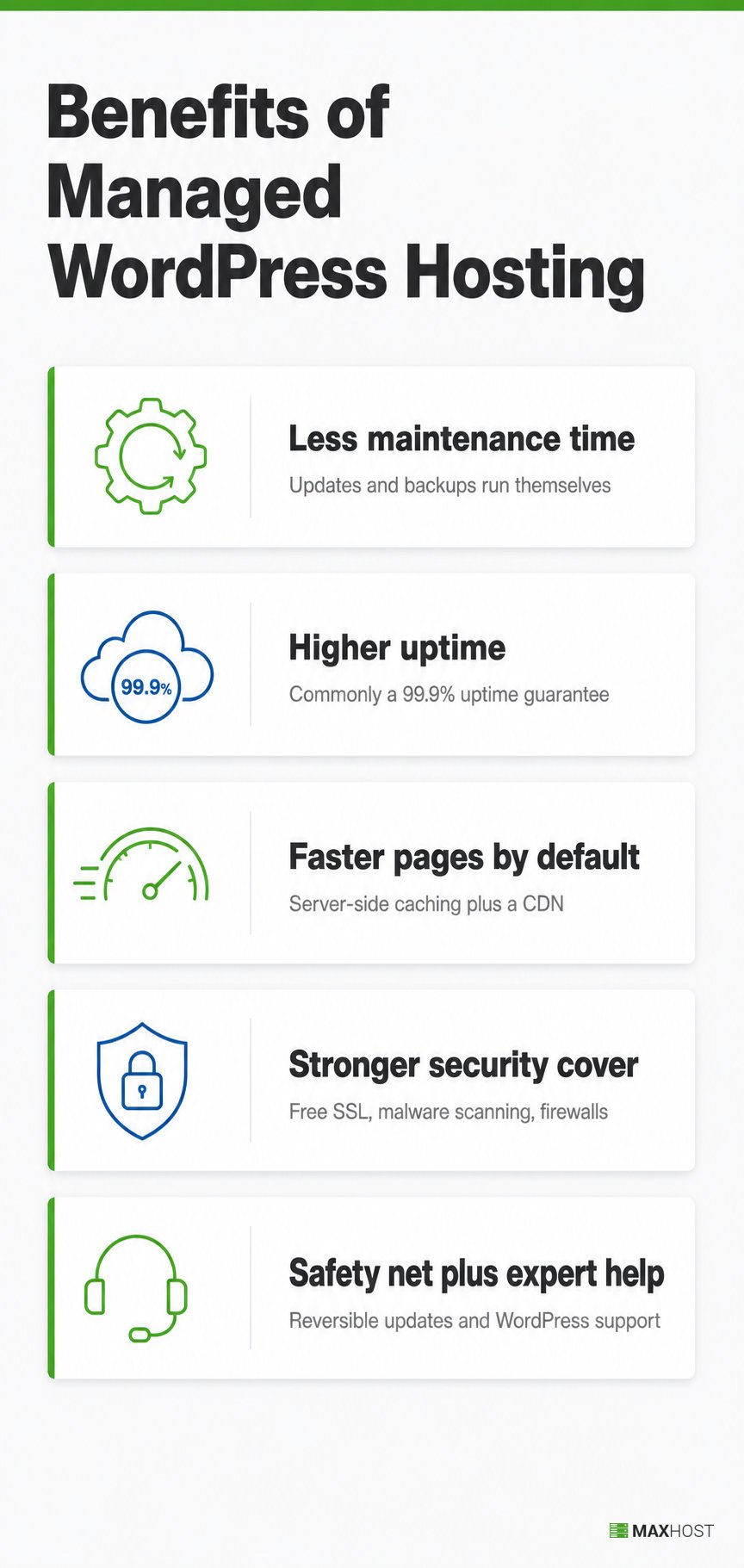
Managed WordPress hosting's core benefit is offloading WordPress maintenance to specialists who do it all day. That trade shows up in five concrete ways.
- Less time on maintenance. Automatic updates and backups remove a recurring task from your calendar.
- Higher uptime. Managed hosts commonly back a 99.9% uptime guarantee on WordPress tuned infrastructure.
- Faster pages by default. Server side caching and a CDN load pages faster than an untuned generic server.
- Stronger security cover. Plans bundle free SSL, malware scanning, and firewalls most owners would set up by hand.
- A safety net plus expert help. Staging and automated backups make bad updates reversible, and WordPress specific support catches issues a general host would miss.
For example, a nightly backup and a staging copy turn a broken plugin update into a two minute rollback.
How Much Does Managed WordPress Hosting Cost?
A single-site managed WordPress plan costs $25 to $35 a month at entry-level pricing. The table below shows three established managed hosts and their entry tiers, verified against live pricing pages.
| Provider | Entry plan | Monthly price | What the tier includes |
|---|---|---|---|
| Flywheel | Starter | $25 | 1 site, 25,000 visits, 10GB storage |
| WP Engine | Startup | $30 | 1 site, price reflects annual billing |
| Kinsta | Single site | $35 | 1 site, 20GB bandwidth, CDN included |
Each plan caps monthly visits, storage, and bandwidth at that tier, then charges more as a site grows.
Regular WordPress hosting costs far less because it skips the added labor. Hostinger's WordPress hosting starts around $3 to $11 a month, depending on the promotional term. That premium, roughly $20 to $25 a month more, pays for the maintenance work managed hosting automates.
How Does Managed WordPress Hosting Differ From Regular WordPress Hosting?
Managed and regular WordPress hosting share the same core software but differ in who runs the maintenance. The table below breaks down the split across eight areas.
| Attribute | Managed WordPress hosting | Regular WordPress hosting |
|---|---|---|
| Core, plugin, and theme updates | Automatic | Manual, your responsibility |
| Backups | Automated, provider scheduled | Often manual or a paid add-on |
| Staging environment | Included, one click | Rarely included |
| Caching and CDN | Server side, WordPress tuned, CDN included | Basic or none |
| Security scanning | Included, proactive | Basic or none |
| Support | WordPress specific experts | General hosting support |
| Server level control | Limited, provider managed | Full root or cPanel access |
| Typical monthly price | $25 to $35 or more | $3 to $15 |
Regular WordPress hosting most often runs on shared hosting or unmanaged VPS hosting infrastructure. Managed plans run on shared, cloud, or dedicated infrastructure tuned specifically for WordPress. The infrastructure matters less than who manages it.
Is Managed WordPress Hosting Worth It?
Managed WordPress hosting is worth it if you would rather pay for maintenance than do it yourself. It fits site owners who lack the time, patience, or technical comfort for WordPress updates, backups, and caching. It is the standard choice for a business site, store, or high traffic blog where downtime costs money.
Skip managed WordPress hosting in three cases:
- You run non WordPress sites. These plans host WordPress only, not other platforms or custom scripts.
- You are on a tight budget. Entry managed plans cost several times more than shared hosting.
- You already self manage confidently. A technical owner who handles updates and backups pays for automation they do not need.
The premium buys specialization, not just convenience. Server administration, security patching, and performance tuning are their own skill set. Most site owners would rather pay someone who does that work daily than learn it themselves. A store or membership site that cannot afford downtime justifies the premium fastest.
If you are still weighing managed hosting against every other tier, not just regular WordPress hosting, use a broader framework. The how to choose a web host guide covers uptime, support, and pricing criteria that apply at any tier.
How MaxHost Helps Hosting Companies Sell Managed WordPress Hosting Plans
MaxHost gives a hosting company selling managed WordPress plans a ready storefront, not managed WordPress hosting itself. MaxHost is a WordPress and WHMCS theme, not a hosting provider, so it never runs, backs up, or updates anyone's WordPress site.
A hosting company that sells a managed WordPress tier still needs a public site that presents that tier clearly. MaxHost is a web hosting WordPress theme built for exactly this job. It ships pricing table and plan comparison components styled to match a WHMCS client area with no bridge plugin required.
That WHMCS templating matters here specifically because a managed WordPress plan sells on trust. A prospective customer who lands on a generic checkout page after browsing a polished managed hosting pitch loses confidence right before paying. MaxHost's coordinated demos keep the pricing page and the checkout looking like one brand.
See MaxHost's hosting plan pricing tables in the live demo before building your own managed WordPress plan page.
FAQs
What is managed WordPress hosting?
Managed WordPress hosting is a hosting plan where the provider handles WordPress maintenance for you, including automatic updates, backups, staging, and caching. It costs more than regular WordPress hosting because of that added work.
What is basic managed hosting for WordPress?
Basic managed hosting for WordPress is an entry tier that automates core updates, daily backups, and server side caching for a single site. It usually carries lower visit and storage caps and covers the essentials without the higher limits or premium support of business tiers.
What is the difference between WordPress hosting and managed WordPress hosting?
WordPress hosting is a server tuned for WordPress; managed WordPress hosting adds provider run maintenance on top of it. WordPress hosting leaves updates, backups, and caching to you, while managed hosting automates them for a higher monthly price.
What is the difference between managed WordPress hosting and VPS hosting?
The difference between managed WordPress hosting and VPS hosting is management and scope. Managed WordPress hosting runs and maintains WordPress for you on a WordPress tuned stack. VPS hosting gives you an isolated server slice with root control, which you configure and maintain yourself unless you pay for a managed VPS.
How much does managed WordPress hosting cost?
A single-site managed WordPress plan costs $25 to $35 a month at entry-level pricing, based on Flywheel, WP Engine, and Kinsta's published rates. Regular WordPress hosting starts around $3 to $11 a month by comparison.