A booking cancellation policy is the set of rules a business uses when a customer cancels or changes a reservation. It states the required notice, the refund or fee that applies, and how no-shows are handled. A clear policy protects revenue and keeps the schedule predictable.
Why Every Booking Business Needs a Cancellation Policy
Every booking business needs a cancellation policy because late cancellations and no-shows cost real revenue and disrupt the schedule for other customers. Without a policy, one cancelled reservation can leave a slot empty that nobody else could book in time. A written policy sets expectations before a booking is even made.
A cancellation policy protects four things.
- Revenue lost to late cancellations and slots nobody can resell in time
- Schedule certainty for staff, resources, and the customers waiting for a slot
- Fairness by applying the same rule to every customer, not case by case
- Utilization by freeing a slot early enough for someone else to take it
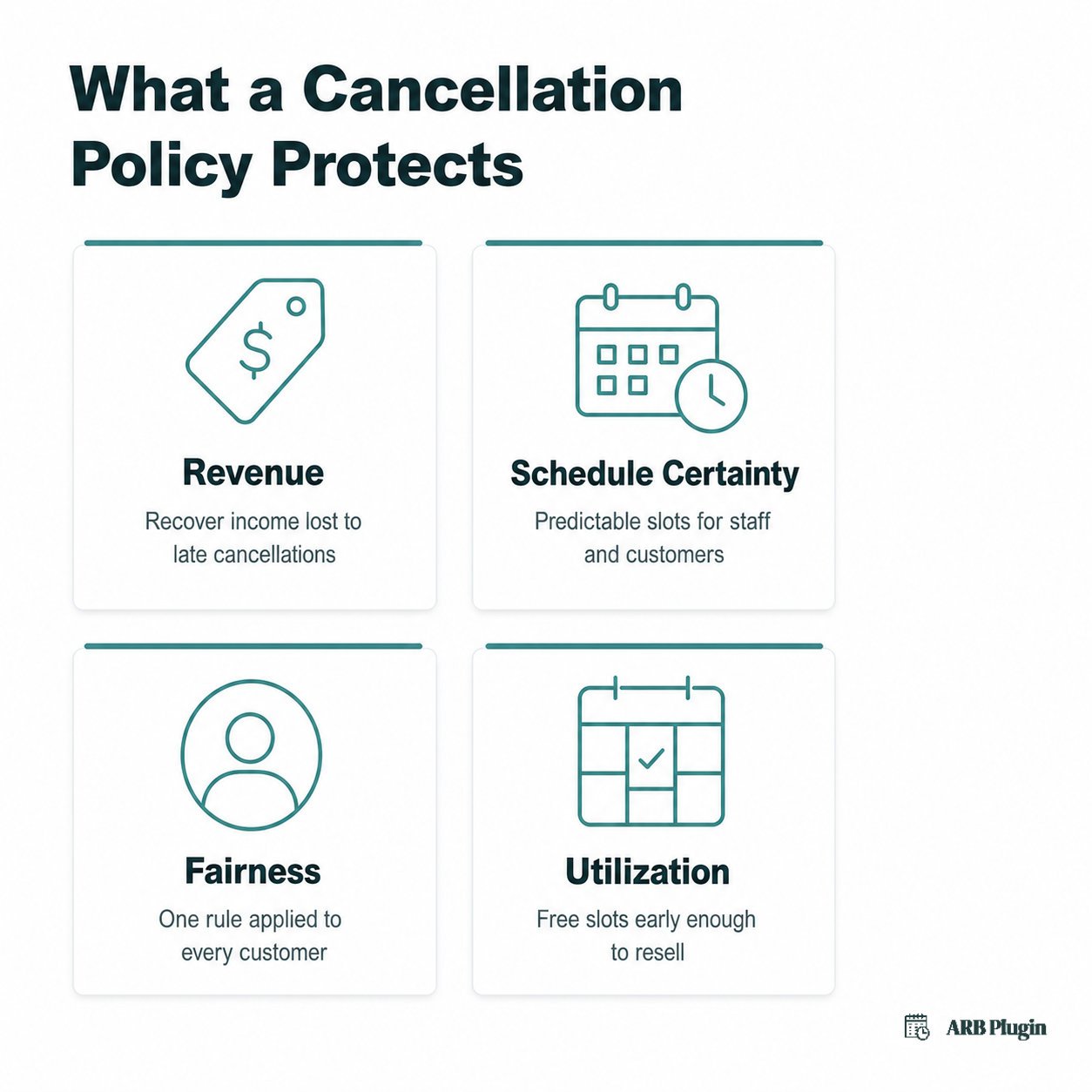
A late cancellation leaves the same empty, unfillable slot as a double booking. Both problems call for the same fix: clear rules and enough notice to refill the gap.
What a Booking Cancellation Policy Should Include
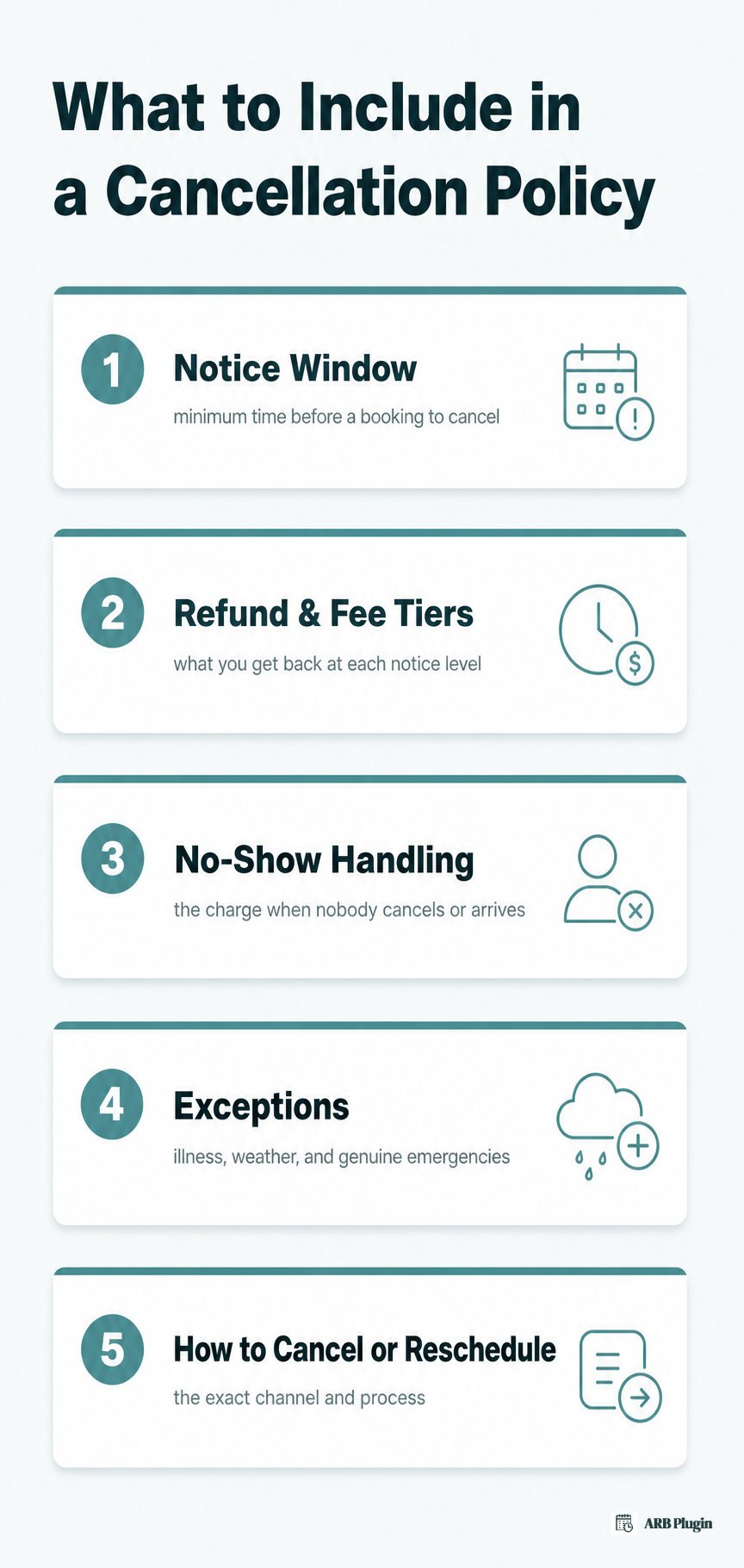
A complete booking cancellation policy covers five elements every customer should see before they book.
- Notice window, the minimum time before a reservation that a cancellation must land
- Refund and fee tiers, what a customer gets back at each notice level
- No-show handling, what happens when nobody cancels and nobody arrives
- Exceptions, illness, weather, and other genuine emergencies
- How to cancel or reschedule, the exact channel and process
Notice Window
The notice window is the minimum time before a reservation that a customer must cancel to avoid a fee or a forfeited slot. Most service businesses set 24 to 48 hours. Hotels and rentals often require 72 hours or more because a longer-held slot is harder to resell.
The notice window is the mirror image of your advance booking notice (lead time). One sets how early a customer must book. The other sets how late they can still cancel.
A 24-hour cutoff is a recognized standard, not just convention. US federal rule 14 CFR 259.5(b)(4) sets this 24-hour standard for airlines. It requires a reservation to be held, or cancelled without penalty, for at least 24 hours after booking. This applies when the booking is made 7 or more days before departure. That rule is the origin of the 24-hour free-cancellation expectation many customers now carry into every industry.
Refund and Fee Tiers
Refund and fee tiers scale the outcome to how much notice a customer actually gave. More notice means a fuller refund; less notice means a bigger fee.
| Notice given | What the customer gets | Typical fee |
|---|---|---|
| 7 or more days before | Full refund | None |
| 3 to 6 days before | Partial refund | 25 to 50 percent of the service cost |
| Less than 48 hours before | No refund | 100 percent of the service cost |
These tiers are typical, not universal. Set your own cutoffs and percentages to match your cancellation rate and margins.
No-Show Handling
A no-show is a customer who never arrives and never cancels, unlike a late cancellation, where the customer at least gives notice. Most businesses charge the full service fee, or forfeit any deposit taken, for a no-show. The slot was held with zero chance to refill it.
Exceptions and Force Majeure
Exceptions cover genuine emergencies a strict notice window cannot anticipate: sudden illness, severe weather, a family emergency, or a documented accident. Most policies waive the fee once, case by case, and ask the customer to state the reason. A written exceptions clause protects goodwill without opening the door to routine abuse.
How Customers Cancel or Reschedule
State the exact cancellation channel: phone, text, email, or an online portal. Repeat it in the booking confirmation email so customers cannot miss it. Confirming the channel at both booking and reminder time cuts down on late no-shows caused by confusion over how to reach the business.
Booking Cancellation Policy Examples by Industry
Cancellation norms vary by industry, mainly in how much notice is required and how strict the exceptions are.
| Industry | Typical notice window | Cancellation fee | No-show rule |
|---|---|---|---|
| Salon or spa | 24 hours | 50 percent of service cost | Full service fee charged |
| Clinic or health provider | 24 to 48 hours | Flat fee, often $25 to $50 | Full fee charged; may require prepayment to rebook |
| Equipment or vehicle rental | 48 to 72 hours | 25 to 50 percent of rental cost | Full rental cost forfeited |
| Hotel or short stay | 24 to 72 hours, depending on the rate type | First night's rate | Full stay or first night charged |
| Restaurant table reservation | 2 to 4 hours, or same day | Rare; sometimes a flat deposit | Table released; deposit forfeited if one was taken |
Treat every figure above as a typical starting point, not a legal requirement. Local consumer-protection rules can set stricter limits in some regions.
Booking Cancellation Policy Template (Copy and Paste)
Copy the template below and replace every bracketed placeholder with your own numbers and channels.
Cancellation and No-Show Policy Effective date: [date] 1. Notice window: We require at least [24 / 48 / 72] hours notice to cancel or reschedule a booking without penalty. 2. Refund and fee tiers: Cancellations made [7] or more days ahead receive a full refund. Cancellations made [3 to 6] days ahead receive a [25 to 50 percent] refund. Cancellations made inside the notice window receive no refund. 3. No-show fee: A missed reservation with no cancellation is charged [100 percent] of the service cost. 4. Grace period for late arrivals: Please arrive [5 to 10] minutes before your scheduled time. Arriving more than [15] minutes late may be treated as a no-show. 5. How to cancel or reschedule: Contact us by [phone / text / email / online portal] at [contact information], at least [X] hours before your reservation. 6. Exceptions: We waive the cancellation fee once, at our discretion, for documented illness, severe weather, or another genuine emergency.
The grace-period line matters as much as the notice window. Without it, a customer arriving 20 minutes late has no defined outcome, and staff end up deciding on the spot every time.
How to Write and Enforce a Cancellation Policy Step by Step
Writing a cancellation policy that actually gets followed takes six steps.
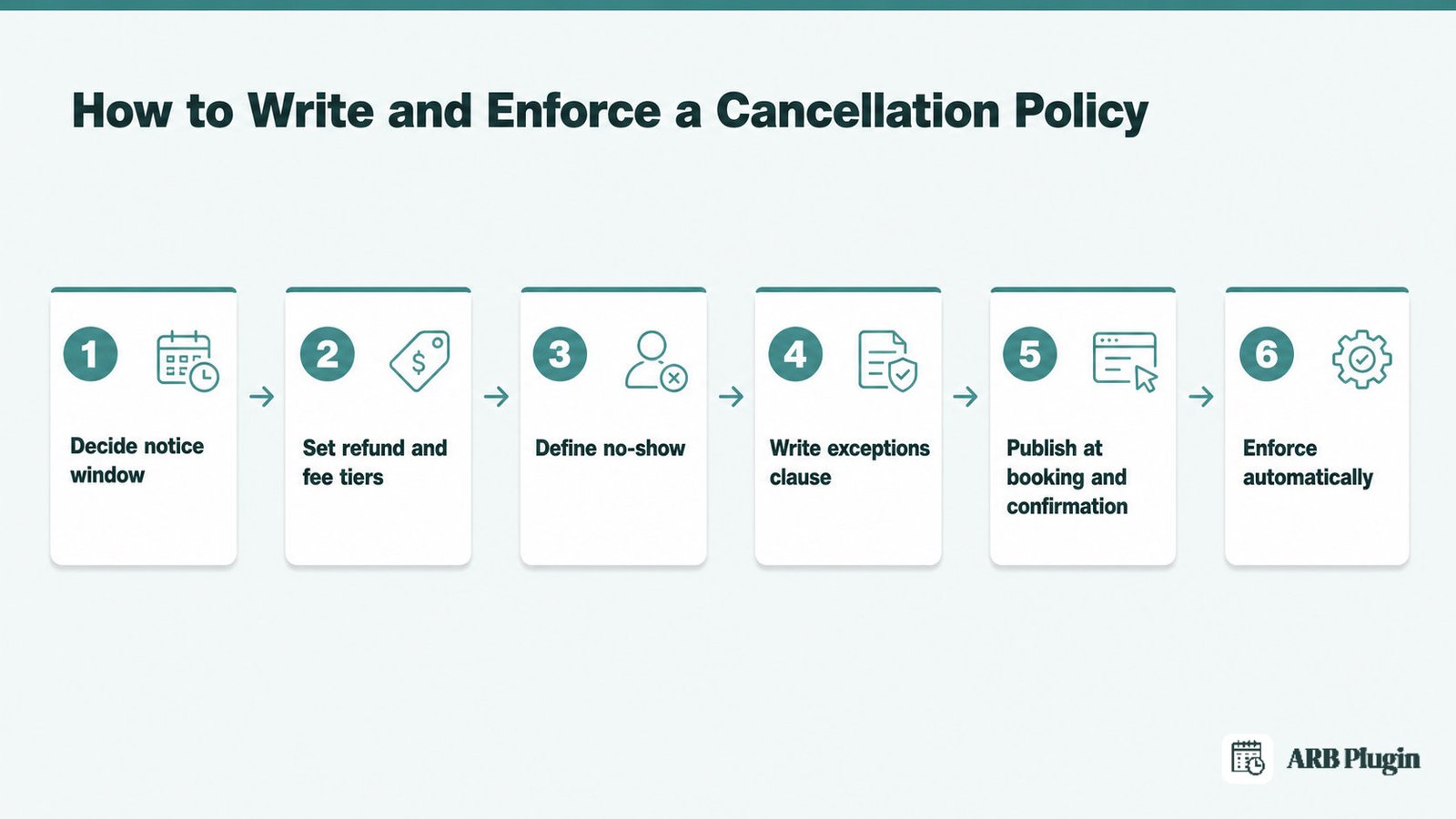
- Decide the notice window your schedule and margins can support.
- Set refund and fee tiers for each notice level.
- Define exactly what counts as a no-show and what it costs.
- Write the exceptions clause for genuine emergencies.
- Publish the policy at booking, then repeat it in the confirmation.
- Enforce it automatically inside your online booking system.
An online booking system enforces the policy without staff manually tracking every cutoff. Setting the rule on the bookable product in WooCommerce itself locks the cancellation window into the booking form. A customer then sees the deadline before they pay. A booking deposit or prepayment is one common way to back the policy with money already collected, though a confirmation-first approval step works without one. Automated appointment reminders sent ahead of the notice cutoff cut late cancellations and no-shows before they happen.
Cancellation Policy vs No-Show Policy vs Refund Policy
A cancellation policy sets the notice window and fee for a customer who cancels ahead of time. A no-show policy covers a customer who never cancels and never arrives. A refund policy sets what money comes back at each outcome.
| Policy | What it governs | When it triggers |
|---|---|---|
| Cancellation policy | Notice window and fee for cancelling ahead of time | Customer cancels before the reservation |
| No-show policy | Charge or forfeiture for a missed reservation | Customer never arrives and never cancels |
| Refund policy | What money, if any, comes back | Any cancellation, no-show, or dispute |
All three policies are rules your reservation system applies the moment a booking changes status. That is why most businesses publish them together as one document.
How ARB Helps You Set and Enforce a Cancellation Policy
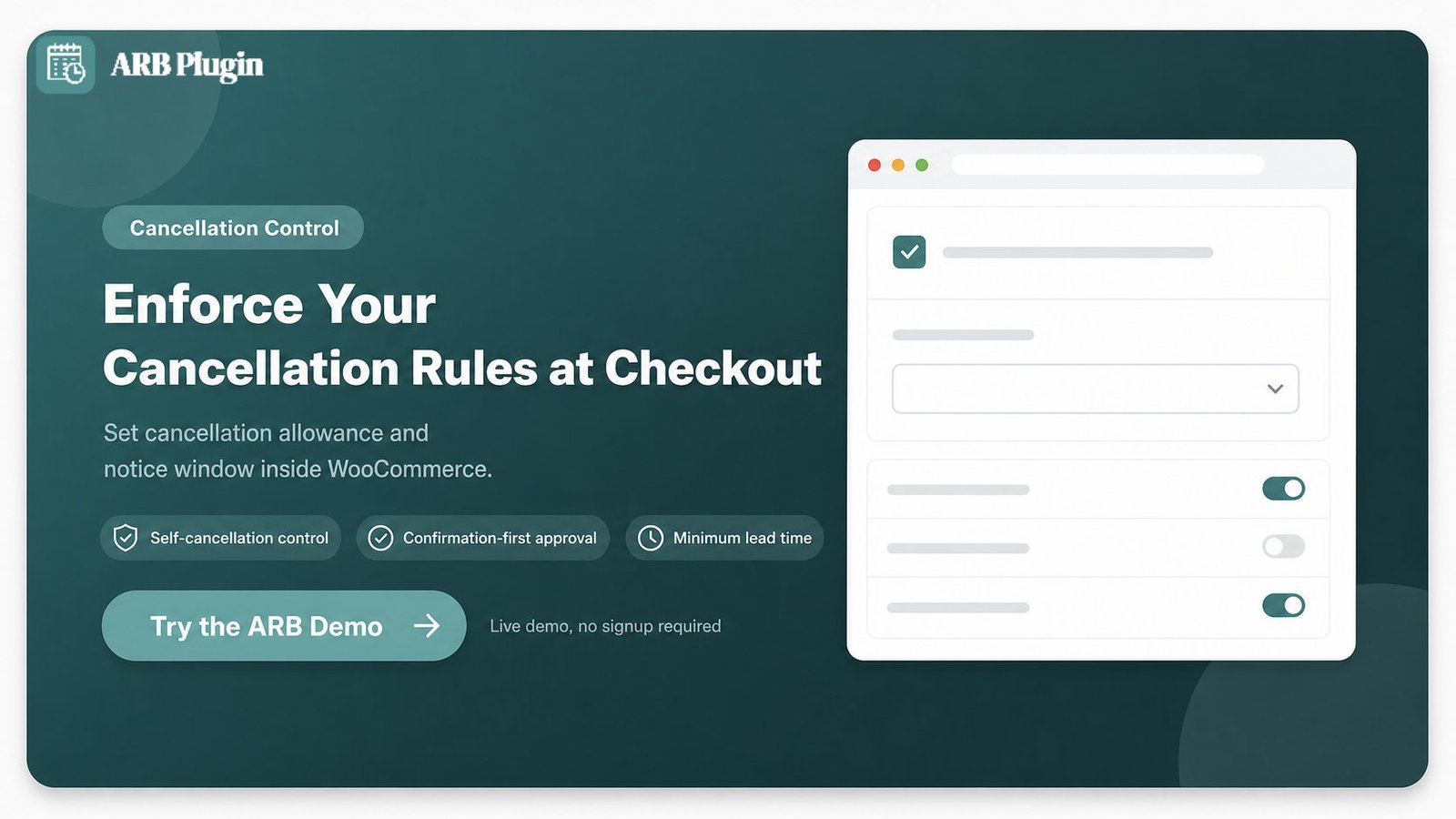
ARB lets you set a per-product cancellation allowance and a minimum notice window. It enforces both inside WooCommerce checkout, so customers see your rules before they book, not after.
ARB is a WooCommerce booking plugin, so every reservation runs through the same order your store already processes. Your store's cancellation, refund, and dispute handling apply to bookings exactly as they do to any other WooCommerce order.
Three settings do the actual enforcement. The per-product Allowing Cancellation checkbox lets a customer cancel their own reservation before the appointment begins, matching the self-cancellation channel your policy promises. The confirmation-required workflow holds payment until an admin approves the booking. A risky reservation can be declined before any money changes hands, since no payment method shows at checkout until that approval happens. The minimum lead time setting under Availability sets how far ahead a slot must be booked. Your notice window relies on the same cutoff, just in reverse.
ARB does not collect deposits or auto-charge a percentage cancellation fee. Its role is controlling whether and when a booking can be cancelled, and confirming it before payment, not forfeiting prepaid money. Try the ARB booking demo to see the cancellation allowance and confirmation workflow configured on a live booking form.
FAQs
What is a booking cancellation policy?
A booking cancellation policy is the set of rules a business uses for cancelling or changing a reservation. It states how much notice is needed, what refund or fee applies, and how no-shows are handled.
What is a fair cancellation notice period?
24 to 48 hours is the common notice period for appointments and service bookings. Hotels, rentals, and multi-day stays often require 72 hours or more because the slot is harder to resell.
Should I charge a cancellation fee?
Yes, when late cancellations are costing you real revenue. A flat fee or a percentage of the service cost recovers part of that loss, but waive it once for genuine emergencies to protect goodwill.
Is a 24-hour cancellation policy standard?
Yes, 24 hours is a widely recognized benchmark. It traces back to the federal aviation rule cited above. That rule requires a reservation to be held or cancelled without penalty for at least 24 hours after booking.
How do I handle no-shows?
Charge the full service fee, or forfeit any deposit taken, since the slot was held with zero chance to refill it. Automated reminders sent ahead of your notice cutoff prevent most no-shows before they happen.
Can customers cancel a booking themselves?
Yes, when your booking system allows it. ARB's per-product "Allowing Cancellation" setting lets a customer cancel their own reservation before the appointment begins, without contacting the business directly.
What is the difference between a cancellation and a no-show?
A cancellation is notice given ahead of time, however short. A no-show is no notice at all: the customer never cancels and never arrives, which is why no-shows usually carry the steeper fee.
Do I need to take a deposit to enforce a cancellation policy?
No. A deposit is one lever, but a clear notice window paired with confirmation-first approval, the way ARB structures it, works without collecting money upfront.