Double booking is scheduling two or more people, appointments, or reservations into the same time slot, resource, or seat. It happens by mistake, from a scheduling conflict, or on purpose, to offset expected no-shows. Either way, someone ends up without the slot they thought they had.
Intentional vs. Unintentional Double Booking
Double booking splits into two distinct types. Unintentional double booking is a scheduling error nobody wanted. Intentional double booking is a deliberate tactic, most common in medical and appointment-based practices.
Unintentional double booking happens when a scheduling conflict slips through, and the same slot ends up promised to two customers by accident. Intentional double booking works differently. A practice books two patients into one appointment slot on purpose, betting that one will no-show, so the slot does not go to waste.
| Type | What it is | Typical setting |
|---|---|---|
| Unintentional | A scheduling conflict: the same slot promised to two parties by mistake | Salons, hotels, and any business relying on manual or unsynced scheduling |
| Intentional | A deliberate hedge: two people booked into one slot to offset a no-show | Medical and appointment-based practices |
The intentional version only works when the provider tracks it closely. Left unmanaged, it produces the same angry-customer outcome as an accident.
Why Does Double Booking Happen?
Double booking almost always traces back to a break in how a business tracks availability. Four root causes explain most cases.
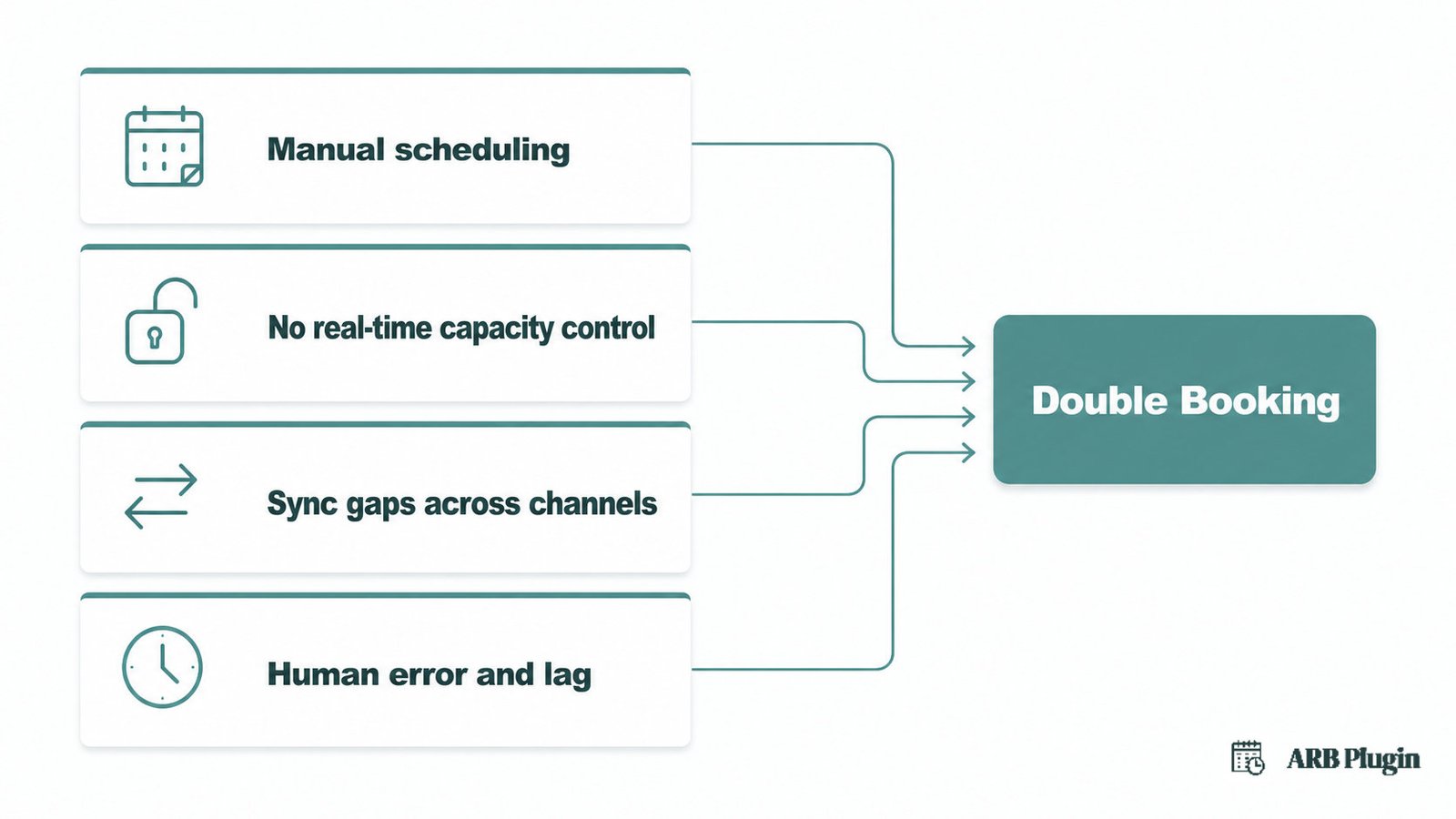
- Manual scheduling across a paper diary, spreadsheet, phone line, and email, with no single source of truth for who booked what.
- No real-time capacity control, so nothing blocks a slot the instant it fills.
- Sync gaps across channels, since a website, phone line, third-party listing, and walk-ins each update availability at a different speed.
- Human error and lag between when a booking happens and when someone records it.
Moving off spreadsheets and phone books onto an online booking system closes most of these gaps at once. Availability updates in one place the moment a slot is taken.
What Does Double Booking Cost Your Business?
Double booking costs more than the awkward moment when two people show up for one slot. The real costs include the following.
- Lost revenue: a refund, a comped service, or an empty slot nobody can resell in time.
- Angry or lost customers, who often book with a competitor after being bumped.
- Damaged reputation, since a bumped customer frequently leaves a public review.
- Staff stress and wasted admin time, spent untangling the conflict on the spot.
- Knock-on scheduling chaos, as fixing one bumped booking pushes every later appointment that day.
No industry-wide dollar figure for double booking is independently verifiable, so treat any specific cost claim you see elsewhere with caution. The pattern above holds regardless of the exact number.
How to Prevent Double Booking
The reliable fix is a booking system that blocks overlaps automatically, not staff vigilance. Five steps prevent double booking.
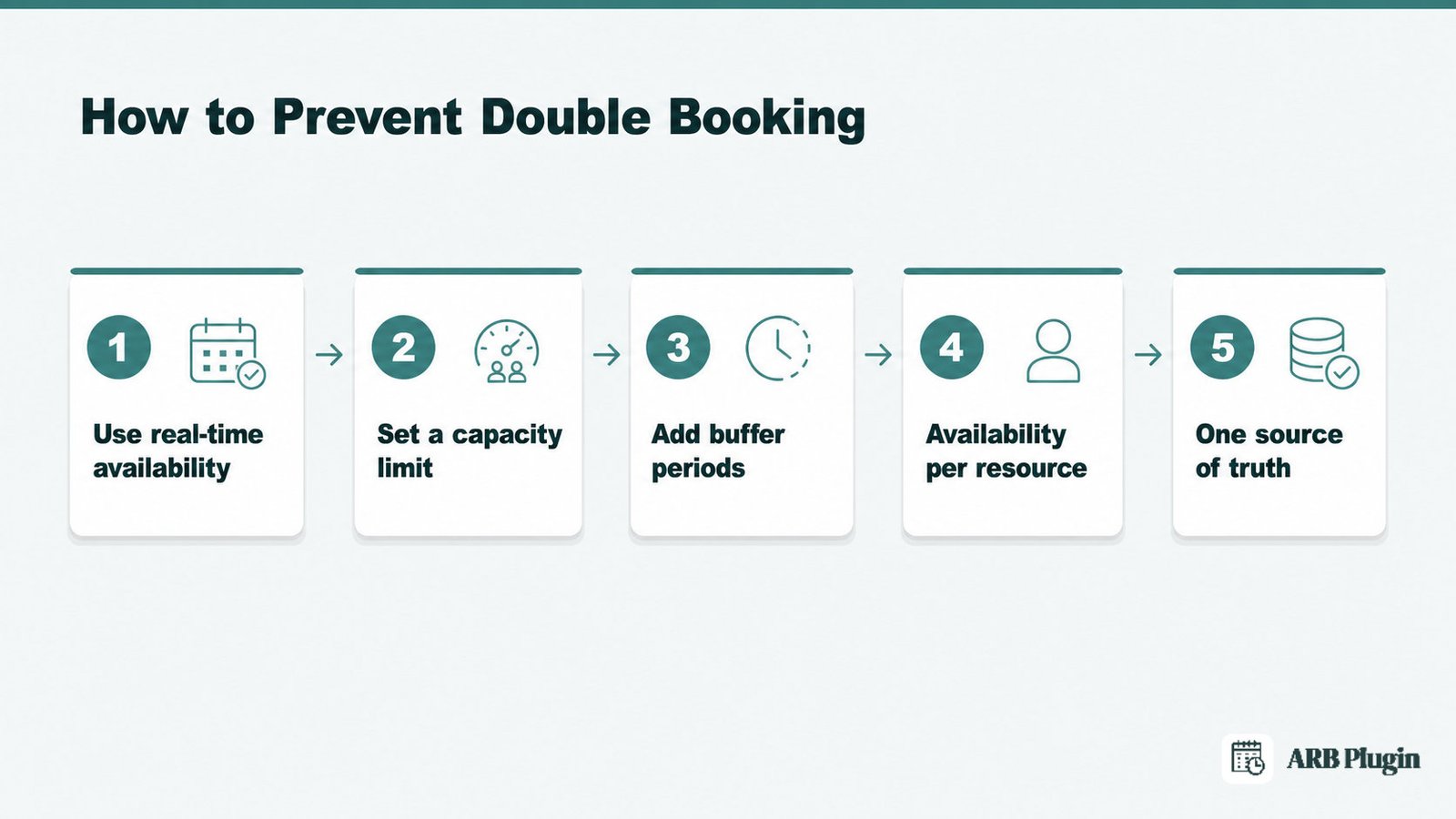
- Use real-time availability so a booked slot disappears from the calendar instantly.
- Set a capacity limit per slot or resource so it cannot be sold twice.
- Add buffer periods, or vacant periods, between reservations to absorb overruns.
- Manage availability per resource so each room, staff member, or unit keeps its own schedule.
- Keep one single source of truth and sync every booking channel to it.
A booking system enforces the first three steps by letting you set booking availability rules and buffer times. A slot closes the moment it fills. Capping how many bookings a single time slot can hold stops two people from ever claiming the same appointment. Giving each room or staff member its own availability per resource keeps one resource's calendar from overlapping another's.
Double Booking vs. Overbooking: What Is the Difference?
Double booking and overbooking are not the same thing. Double booking promises one specific slot or resource to two different parties, usually by mistake. Overbooking deliberately accepts more reservations than capacity allows across a resource pool, a revenue tactic common in hotels and airlines.
| Double booking | Overbooking | |
|---|---|---|
| What it is | The same slot or resource promised to two parties | More reservations accepted than a resource pool's total capacity |
| Intent | Usually accidental, a scheduling conflict | Usually deliberate, a revenue strategy |
| Typical setting | Salons, clinics, single-room rentals, appointment calendars | Hotels, airlines, high-volume rental pools |
Even reputable hospitality sites often use the two terms interchangeably, which blurs a distinction that matters operationally. Knowing whether an overlap was a mistake to prevent or a calculated bet changes how you fix it. That deliberate tactic is overbooking, not double booking, and it calls for different safeguards.
How ARB Prevents Double Booking in WooCommerce
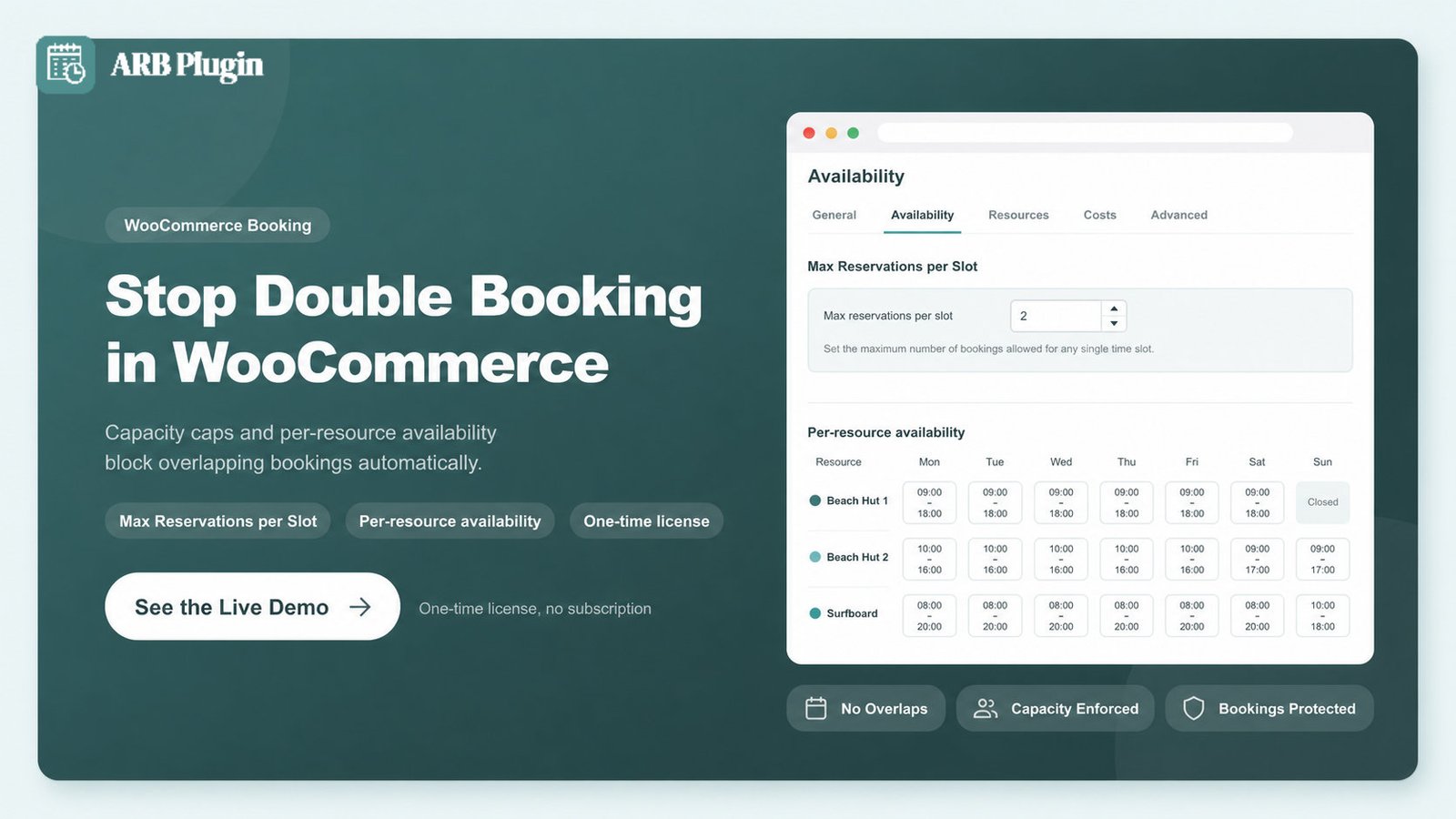
ARB blocks overlapping reservations inside WooCommerce by enforcing capacity and per-resource availability at checkout. No manual conflict-checking is required once those rules are set.
ARB is a WooCommerce-native booking plugin that turns any product into a Reservable Product. Every reservation runs through the store's own cart and checkout, so there is no separate system to keep in sync.
Two settings do the actual work. Max Reservations per Slot caps how many bookings one slot accepts, so a second customer cannot claim it once the cap is hit. Per-resource availability gives each room, staff member, or unit its own schedule, so two customers can never grab the same one. A vacant period setting adds a buffer between bookings for resources that need a gap before the next reservation starts.
This fits salons, clinics, hotels, rentals, and classes: any vertical where a slot or resource can only be sold once. ARB is a one-time license, around $55 on CodeCanyon, not a recurring subscription. See it in the live demo.
FAQs
What is double booking?
Double booking is scheduling two or more people, appointments, or reservations into the same time slot, resource, or seat. It happens by mistake, through a scheduling conflict, or on purpose, to offset an expected no-show.
What is another word for double booking?
The closest terms for double booking are scheduling conflict and booking clash. Overbooking is sometimes used loosely as a synonym. Technically, it means accepting more bookings than capacity allows across a pool of resources, not promising one slot twice.
The Cambridge Dictionary defines double booking as promising the same room, seat, or ticket to more than one person or group. This matches the scheduling-conflict sense above.
What does double booking yourself mean?
Double booking yourself means committing to two appointments, meetings, or events at the same time on your own calendar. It usually happens when you accept a new commitment without checking an existing one first.
Merriam-Webster defines this sense as making plans for yourself to be in two different places at the same time, distinct from the resource-booking sense above.
What does it mean to double book someone?
To double book someone means promising them a slot, seat, or resource that has also been promised to another person at the same time. Both parties show up expecting the same reservation, and only one can keep it.