A booking deposit is a partial, upfront payment a customer makes when scheduling to secure the slot. It is usually applied to the final bill and helps businesses reduce no-shows and last-minute cancellations. A deposit can be a fixed fee or a percentage of the total.
How Does a Booking Deposit Work?
A booking deposit works as a small upfront payment collected the moment a customer schedules, then applied to the final bill at service time. The mechanics run in five steps.
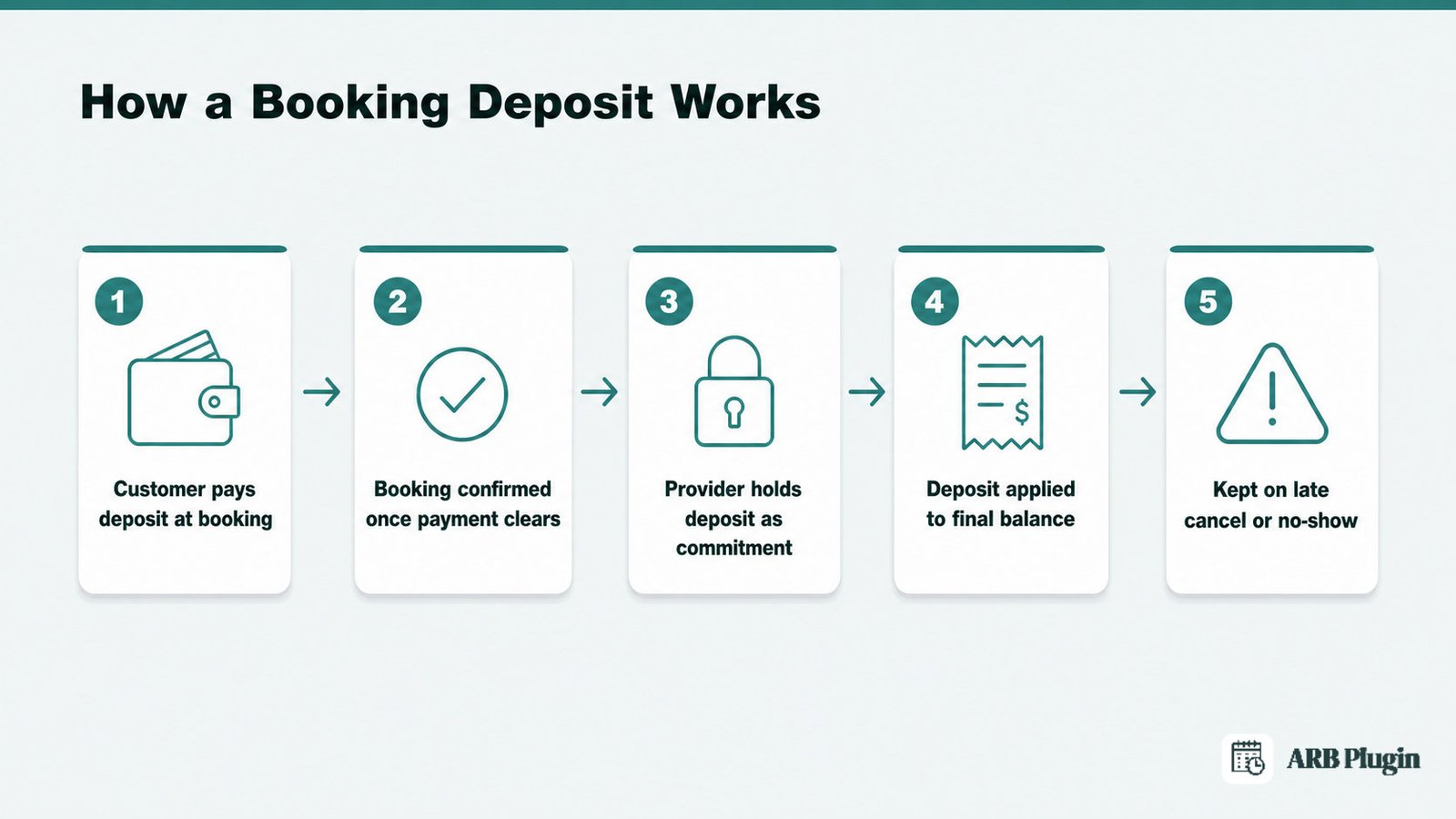
- The customer pays a deposit while completing the booking, as a fixed fee or a percentage of the total.
- The booking is confirmed once the deposit payment clears.
- The provider holds the deposit as the customer's commitment to the reserved slot.
- At the appointment or check-in, the deposit is applied to the remaining balance.
- On a late cancellation or no-show, the provider keeps the deposit instead of refunding it.
Hotels and other card-based businesses sometimes hold the deposit as a pre-authorization instead of charging it directly, releasing the hold once nothing is owed. Whether a deposit comes back on a cancellation depends on the business's cancellation policy, covered below.
Types of Booking Deposits (Service, Damage/Security, Full Prepayment)
People searching "booking deposit" usually mean one of two things. Either a service deposit that secures an appointment, or a damage deposit an online travel agency collects to cover potential harm to a rented room. Full prepayment is a related but distinct third option.
| Deposit type | What it is | When it is used | Applied to the final bill? | Typically refundable? |
|---|---|---|---|---|
| Service or appointment booking deposit | A partial payment collected at scheduling to secure a slot | Salons, clinics, photographers, trades, event venues | Yes | Yes, with adequate notice; no on a late cancellation or no-show |
| Hotel or OTA damage/security deposit | A separate hold or payment covering potential damage or incidentals during a stay | Hotels, vacation rentals, short-term stays | No, it sits apart from the room rate | Yes, refunded after checkout if no damage occurred |
| Full prepayment | Payment of the entire booking cost in advance, not just a portion | Non-refundable-rate hotel bookings, short-term rentals, some tours | Yes, it is the full bill | Depends on the rate's own cancellation terms |
| Non-refundable deposit or retainer | A deposit explicitly forfeited regardless of notice given | Tattoo artists, photographers, high-demand specialty bookings | Yes | No |
A booking deposit also carries a separate, contractual meaning. It is a sum paid to hold a room, function space, or service under a signed agreement. A legal reference for booking deposits defines it this way.
The mix-up between the service sense and the OTA damage-deposit sense is common enough to cause real confusion. Travelers sometimes describe being asked for a "booking deposit" at check-in. Often the charge was actually a property's separate damage deposit, not a fee tied to the original reservation.
Why Do Businesses Take Booking Deposits?
Businesses take booking deposits to protect their time and revenue against the cost a cancellation or no-show creates. Four reasons come up most often.
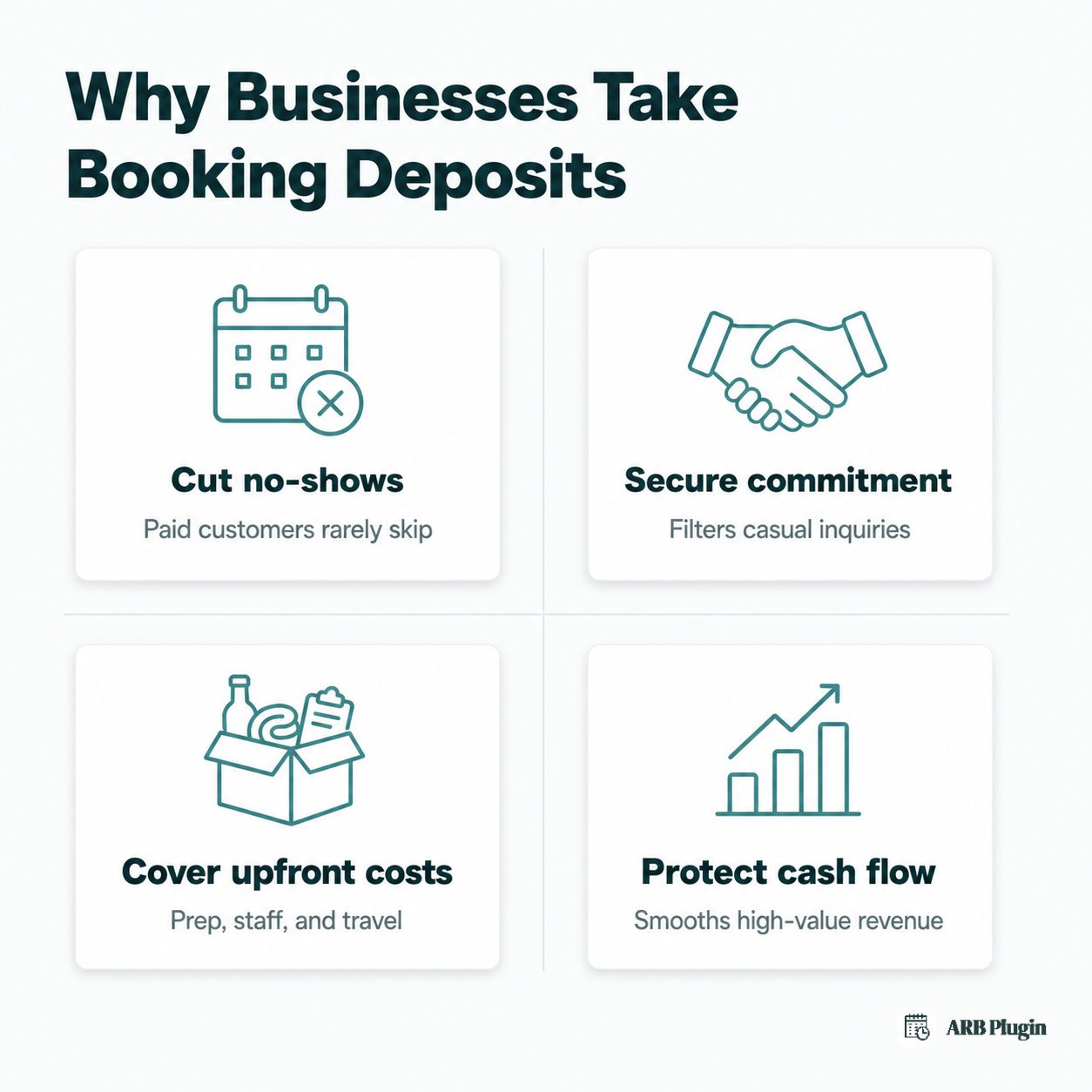
- Cut no-shows and last-minute cancellations. A customer who has already paid something toward a slot is less likely to skip it, a loss-aversion effect that works better than a cancellation fee charged after the fact.
- Secure genuine commitment. A deposit filters casual inquiries from customers who genuinely intend to follow through with the booking.
- Cover upfront costs. Many bookings require a business to prep materials, block staff time, or travel before the appointment happens, costs it cannot recover if the customer never shows.
- Protect cash flow on high-value bookings. Collecting part of the payment early smooths revenue for expensive services, rentals, or multi-day reservations.
How Much Should a Booking Deposit Be?
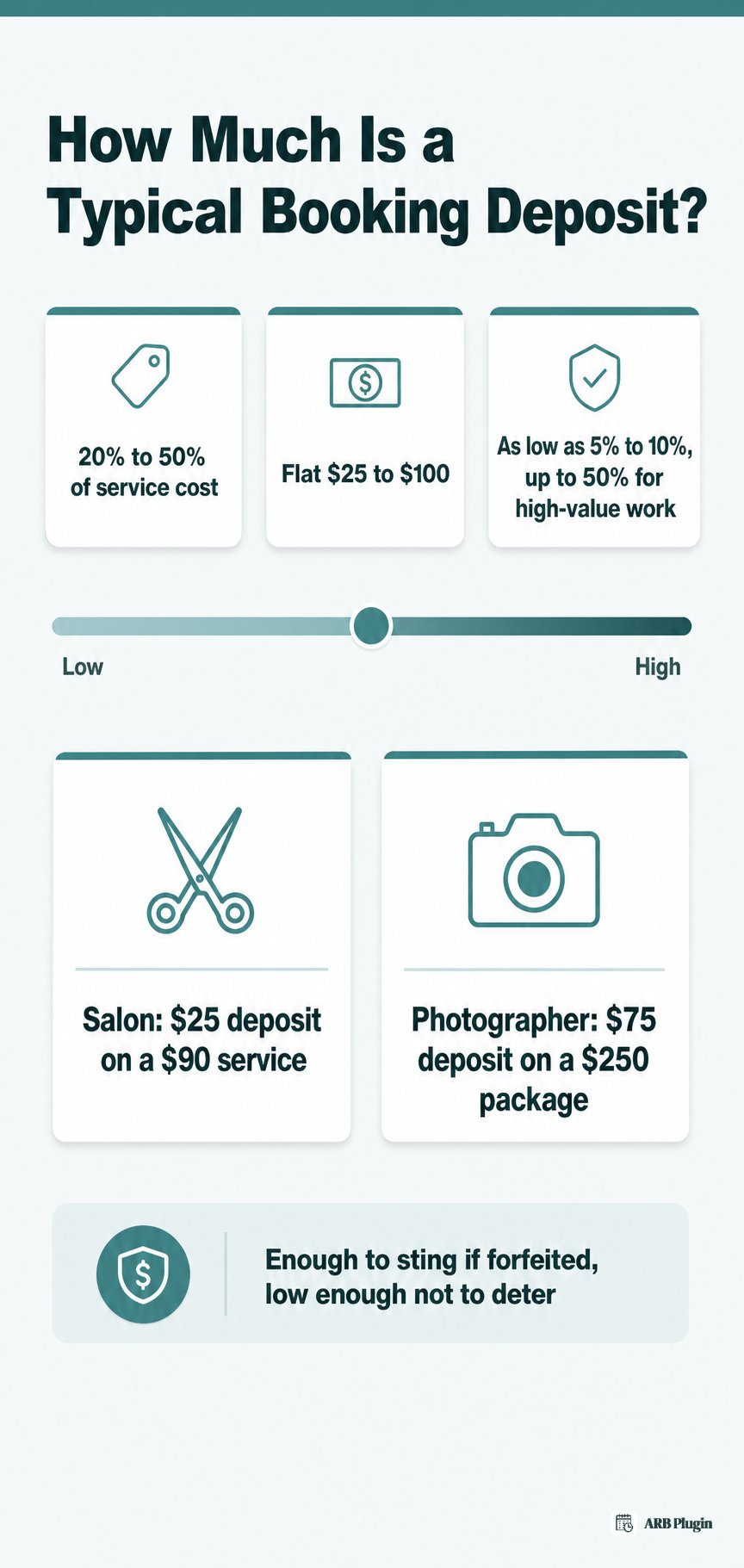
A typical booking deposit runs 20% to 50% of the service cost, or a flat $25 to $100 for shorter, lower-cost appointments. Some businesses charge as little as 5% to 10% for lower-risk bookings, and others require up to 50% for high-value work like photography or weddings.
Two examples make the range concrete. A salon might set a $25 deposit on a $90 haircut and color service. A photographer might set a $75 deposit on a $250 portrait package. The guiding principle stays the same across every amount: enough to sting if forfeited, low enough that it does not deter a genuine customer.
Are Booking Deposits Refundable?
Whether a booking deposit is refunded depends on the business's cancellation policy, not on the deposit itself. There is no universal rule.
Most businesses refund a deposit in full when a customer cancels with adequate notice, typically 24 to 48 hours before the appointment. Cancel later than that, or simply not show up, and the deposit is retained. Some specialty bookings, tattoo appointments, photography sessions, and other high-demand slots, set the deposit as non-refundable from the start, regardless of notice given. The exact terms live in the business's cancellation policy, which is why reading it before booking matters more than the deposit amount itself.
The hotel damage-deposit sense works differently. A property collects it separately from the room rate. Per its own damage-policy terms, it returns the deposit after checkout once no damage or missing items are found. This is a distinct refund path from a service deposit's cancellation-notice rule.
How Booking Deposits Work With an Online Booking System
Most online booking systems collect the deposit automatically by requiring payment before the booking is confirmed. There is no separate deposit step to chase down. An online booking system holds the slot the moment payment clears. A reservation system can be set to require that payment before it confirms the booking at all.
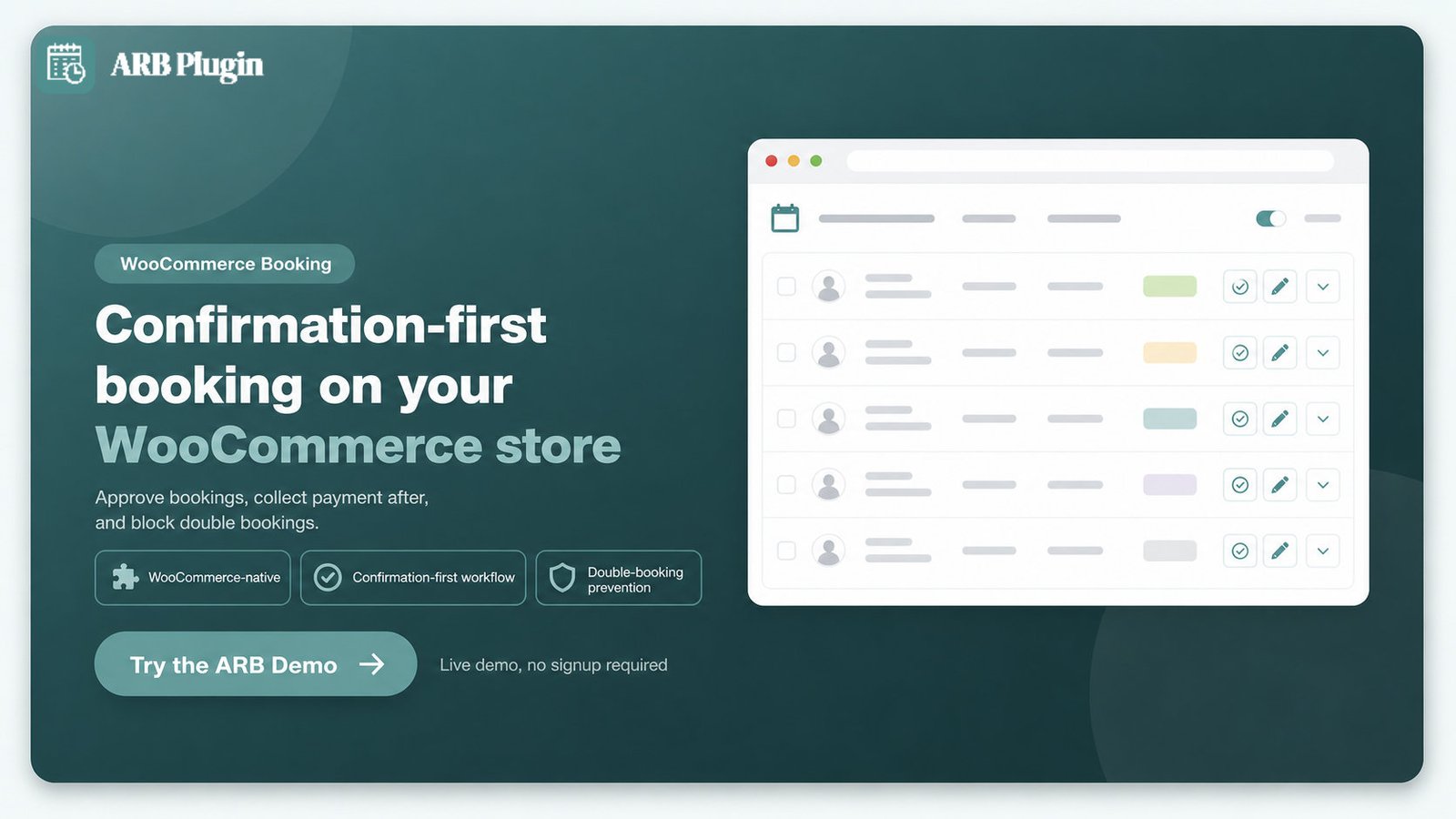
ARB is a WooCommerce-native booking plugin. It turns any product into a bookable product in WooCommerce, running every reservation through the store's existing cart, checkout, and payment gateways. ARB itself does not collect partial deposits. It takes full payment at checkout, or uses a confirmation-first workflow in which payment is collected only after a business approves the booking. To collect a percentage or fixed deposit on a WooCommerce store, pair the booking flow with a separate WooCommerce deposit or partial-payment extension.
ARB's capacity limits also prevent double booking, so the same slot or resource is never promised to two customers regardless of how payment is structured. ARB is a one-time license, around $55 on CodeCanyon, not a recurring subscription. Try the ARB booking demo to see the confirmation-first workflow configured on a live booking form.
FAQs
What is a booking deposit?
A booking deposit is a partial, upfront payment made when scheduling that secures the slot and is usually applied to the final bill. It reduces no-shows and last-minute cancellations by giving the customer a stake in the reservation.
What is a deposit for an appointment?
A deposit for an appointment is a partial payment taken when the appointment is booked, common at salons, clinics, and trade businesses. It holds the slot, applies toward the final service cost, and discourages no-shows.
How do I pay a booking deposit?
A booking deposit is usually paid online by card while completing the booking, before the slot is confirmed. The remaining balance is paid at or after the appointment or reservation.
Does Booking.com charge a deposit fee?
Booking.com itself does not charge a booking deposit. Individual properties may require a refundable damage or security deposit, or a prepayment, set in that property's own reservation policy.