Overbooking is the practice of deliberately accepting more reservations than available capacity, such as seats, rooms, tables, or appointment slots. It bets that no-shows and cancellations will free the extra space before anyone needs it. Airlines, hotels, and restaurants all use it to protect revenue against capacity that would otherwise sit unsold.
Why Do Businesses Overbook?
Businesses overbook to protect revenue against predictable no-shows and late cancellations that would otherwise leave capacity empty. An unsold seat, room, or table cannot be resold after the fact, so operators accept a few extra reservations to keep utilization close to full.
IATA, the airline industry's trade body, argues overbooking lets carriers sell every seat while offsetting no-show passengers. That trade-off keeps fares lower for passengers who do fly. The same math applies to any reservation-based business: a seat, room, or table earns nothing once its booking window passes unused.
Four factors push a business toward overbooking.
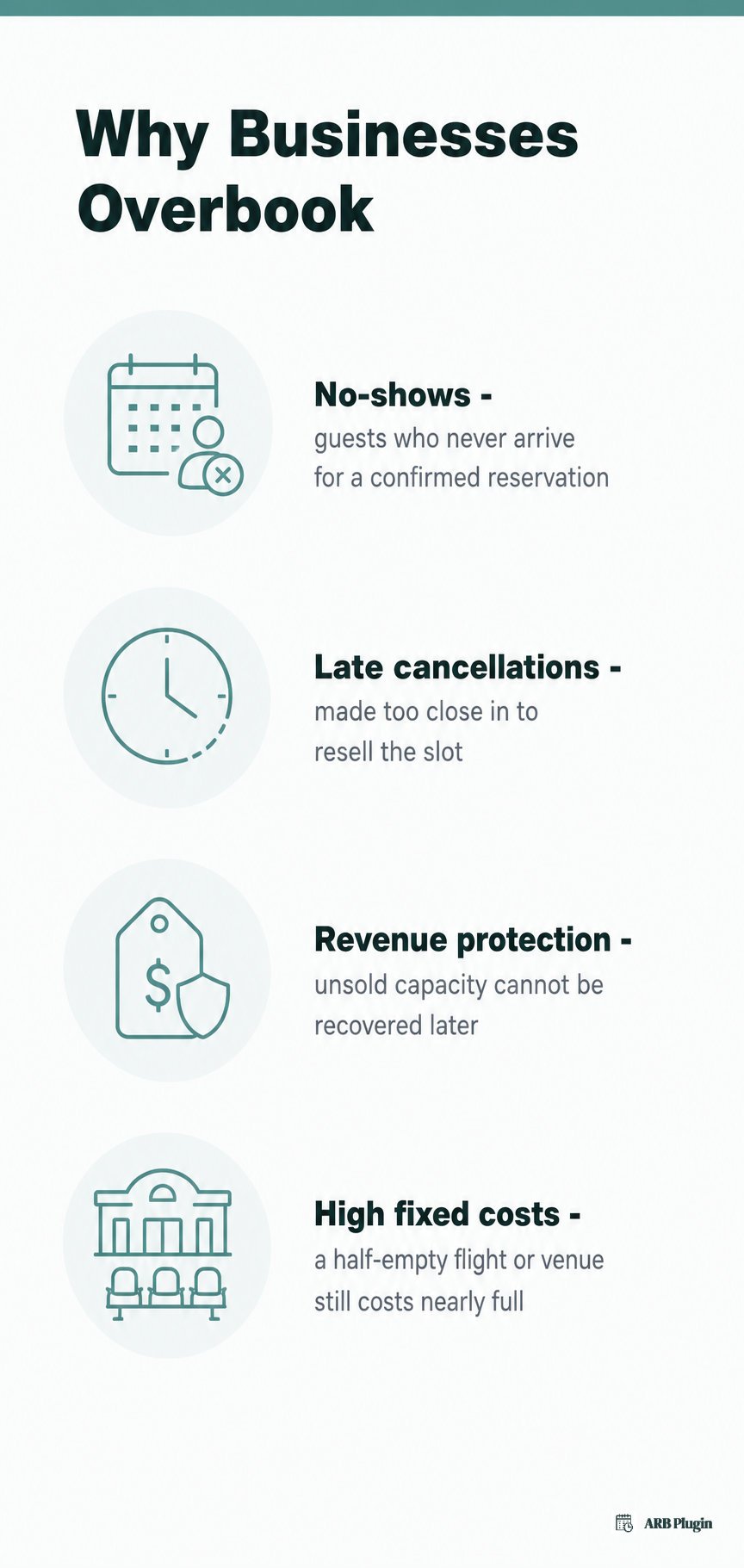
- No-shows, guests or customers who never arrive for a confirmed reservation.
- Late cancellations, made too close to the reservation to resell the slot.
- Revenue protection, since unsold capacity cannot be recovered after the fact.
- High fixed costs, since a half-empty flight, hotel, or dining room still costs nearly the full amount to run.
What Are the Risks of Overbooking?
Overbooking backfires when every reservation holder actually shows up. Capacity runs short, so someone must be turned away, compensated, or rebooked elsewhere, and each of those outcomes costs money and damages reputation.
Airline regulators require compensation for passengers denied boarding involuntarily, the clearest version of this risk. The same categories of harm show up in any overbooked business.

- Turned-away or bumped customers, who arrive with a confirmed reservation and get no seat, room, or table.
- Compensation and refund costs, from vouchers and rebates to a full-price rebooking elsewhere.
- Reputation damage, since a bumped customer often leaves a public negative review.
- Lost future loyalty, as a bumped customer frequently books with someone else next time.
- Staff and operational stress, spent resolving the conflict in front of other customers.
Hotels and rentals listed on third-party platforms face an added risk. Repeated overbooking can trigger a platform-level penalty, such as a lower search ranking or an extra fee.
Overbooking Examples Across Industries
Overbooking looks different in every industry, though the underlying bet, that no-shows will free up space, stays the same.
Airlines
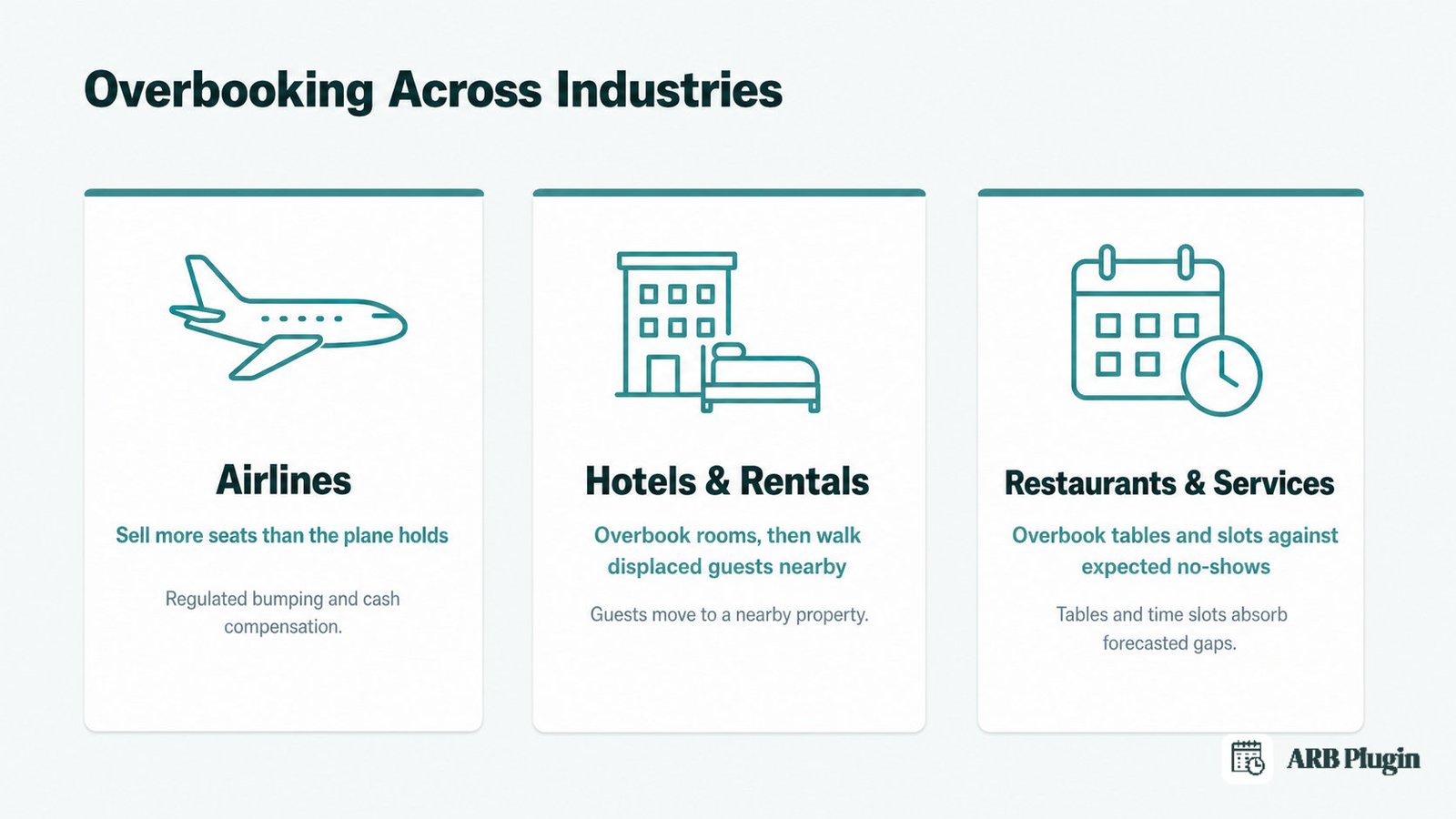
Airlines are the clearest overbooking case: a flight sells more seats than it has, betting some ticketed passengers will not show. US DOT requires airlines to seek volunteers before bumping anyone involuntarily, and to pay cash compensation when an involuntary bump happens. A full flight where everyone shows up forces a real, regulated bumping process.
Hotels and Rentals
Hotels and short-term rentals overbook rooms against expected no-shows, then walk displaced guests to a nearby property when every room fills. Walking a guest means covering that night's stay elsewhere, often at the hotel's expense, plus a credit to smooth over the inconvenience.
Restaurants and Appointment-Based Services
Restaurants overbook tables against expected no-shows on a busy night, accepting the risk of double-seating and a longer wait when everyone arrives. Appointment-based services, salons, clinics, and consultants, do the same with time slots, booking slightly past capacity to offset predictable cancellations.
That is the exact bridge to reservation software: a system with hard capacity limits removes the guesswork airlines, hotels, and restaurants otherwise handle by instinct.
What Is the Difference Between Overbooking and Double Booking?
Overbooking is intentional: a business deliberately accepts more reservations than its capacity, betting some guests will not show up. Double booking is usually accidental: two reservations get assigned the same slot, room, or resource by a scheduling error.
The confusion is understandable. Wikipedia classifies overbooking as travel and hospitality's version of overselling, deliberately selling beyond stock to cover an expected shortfall. Double booking, by contrast, is a single mistake, not a strategy, fixed by closing a tracking gap rather than adjusting a business bet.
| Aspect | Overbooking | Double booking |
|---|---|---|
| Intent | Deliberate capacity strategy | Usually accidental |
| Cause | Betting no-shows and cancellations will free space | A scheduling or sync error assigns one slot twice |
| Typical fix | Set a firm per-slot or per-resource capacity cap | Track availability in real time from one system |
How to Prevent and Manage Overbooking
Overbooking is controlled by capping capacity, tracking availability in real time, and cutting the no-shows that tempt a business to overbook in the first place. Five tactics do most of the work.
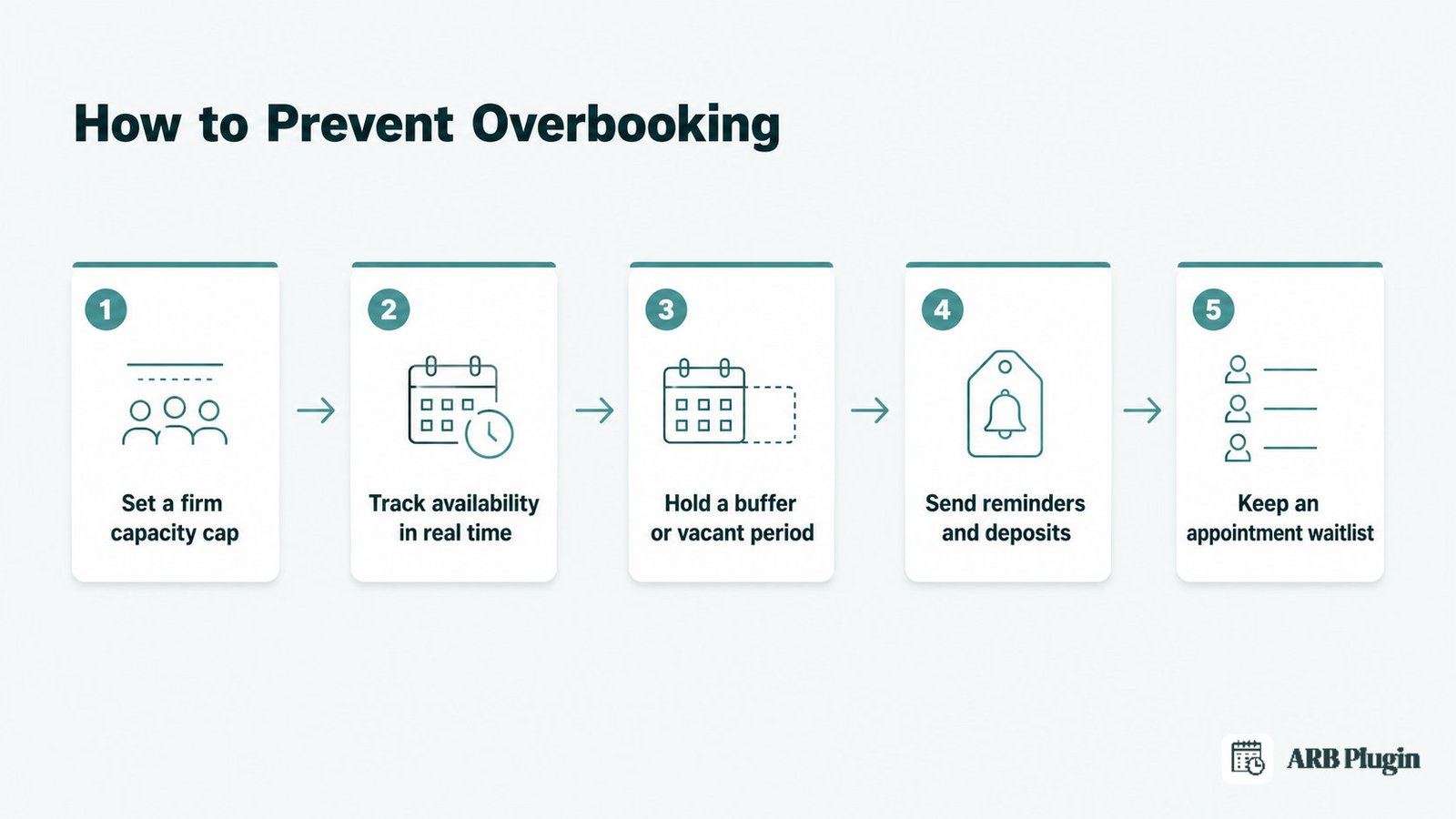
- Set a firm capacity cap per slot or resource so bookings stop the moment it fills.
- Track availability in real time so a booked slot disappears from the calendar instantly.
- Hold a buffer or vacant period between reservations to absorb runovers before the next one starts.
- Send reminders and consider deposits to reduce no-shows, so overbooking becomes unnecessary in the first place.
- Keep an appointment waitlist to backfill genuine cancellations instead of overselling capacity upfront.
How ARB Helps Prevent Unintended Overbooking
ARB is a WooCommerce booking plugin that enforces capacity at checkout, so a store never accepts more reservations than it can actually serve. Overbooking becomes an enforced limit instead of a manual gamble.
ARB does not deliberately overbook the way an airline or hotel chain might. Its job is the opposite: preventing unintended overbooking by capping how many reservations a slot or resource can accept.
Two settings do the work. Max Reservations per Slot sets the maximum bookings one time slot accepts, so a store cannot take more than it can serve. Per-resource availability gives each room, staff member, or resource its own schedule and its own cap. Both settings live on the reservable product's booking availability controls, alongside a real-time left-available-slots counter, plus a vacant-period buffer that stops back-to-back overloading.
Because ARB runs natively inside WooCommerce, that capacity cap applies the moment a customer starts checkout, not after the sale completes. ARB itself is a one-time WooCommerce plugin license, around $55 on CodeCanyon, not a subscription. Try the ARB booking demo to see the cap enforced at checkout.

FAQs
What Is the Meaning of Overbooking?
Overbooking means deliberately accepting more reservations than a business has capacity for. A common example is selling more airline seats than a plane holds. Merriam-Webster defines it as issuing reservations in excess of the space actually available.
Why Is Overbooking Not Illegal?
Overbooking is not illegal because airlines and hotels disclose the practice in their terms of carriage. Regulators require compensation instead of banning it outright. Cornell Law School's Legal Information Institute defines it as intentionally accepting more reservations than available capacity, a disclosed practice rather than a broken promise.
What Happens if a Business Is Overbooked and No One Cancels?
If every reservation holder shows up, someone loses their seat, room, or table despite having a confirmed booking. That customer is typically rebooked elsewhere, given a refund or credit, or compensated on the spot, depending on the industry's policy.
Is Overbooking the Same as Being Overbooked?
No, overbooking is the practice, and being overbooked is the resulting state. A business overbooks when it deliberately accepts excess reservations. A flight, hotel, or restaurant is overbooked once that excess reservation count means not everyone can be served.
What Is a Good Overbooking Rate?
There is no universal good overbooking rate. Hotels typically overbook by a small percentage set from their own historical no-show and cancellation data, not a fixed industry number. The right rate depends entirely on each business's own patterns.
How Do No-Shows Relate to Overbooking?
No-shows are the reason most businesses overbook in the first place: the practice exists to fill the gap a no-show leaves behind. Cut the no-show rate with reminders, confirmations, and deposits, and the pressure to overbook drops with it.