WooCommerce Bookings, the official $249-per-year booking extension by Woo (Automattic), is the most trusted and most WooCommerce-native scheduling tool you can buy. For many stores, that trust is the only reason to accept its price, its setup complexity, and its reliability complaints. It scores 3.8 out of 5 in this review.
Below: what WooCommerce Bookings does, its features, live 2026 pricing, genuine pros and cons, user sentiment, and who should choose it or look elsewhere. This review evaluates the official Automattic extension, not the similarly named booking plugins from WebToffee or PluginHive.
| Dimension | Score |
|---|---|
| Booking Rules & Pricing Flexibility | 4.5/5 |
| WooCommerce / Commerce Integration | 5.0/5 |
| Value & Licensing (Total Cost of Ownership) | 2.0/5 |
| Setup & Admin Experience | 2.5/5 |
| Notifications, Calendar Sync & Customer Management | 3.5/5 |
| Maintenance & Compatibility | 4.5/5 |
| Support & Documentation | 4.0/5 |
| Overall | 3.8/5 |
Verdict: a powerful, genuinely WooCommerce-native booking engine with real first-party trust. For most buyers the $249-per-year price, steep setup, and calendar-sync limits hold it back.
How we score: we rate every booking plugin across seven weighted dimensions, using documentation, the live pricing page, and verified marketplace reviews. The full rubric and evidence method live on our How We Review methodology page, linked from the disclosure below.
What Is WooCommerce Bookings?
WooCommerce Bookings is the official scheduling and reservations extension for WooCommerce, built by Woo (Automattic). It adds a Bookable Product type that lets customers book appointments, reserve slots, or rent equipment through your existing WooCommerce checkout. So yes, WooCommerce has a first-party booking system, and this is it.
One clarification matters before going further. This review covers the official extension sold on woocommerce.com. It is not WebToffee's "Bookings For WooCommerce" or PluginHive's "Booking & Appointment Plugin," which are two different products that share the generic name.
Disclosure: this review comes from the ARB team, and ARB competes in the WooCommerce booking category. We researched WooCommerce Bookings independently and scored it with the same methodology we apply to every plugin we review.
Who WooCommerce Bookings Is For
WooCommerce Bookings fits a specific buyer well. It is the right choice for these groups:
- WooCommerce store owners who value the official, first-party option and Automattic's backing
- Service and rental businesses already on WooCommerce: salons, consultants, tour operators, equipment and vehicle rentals, and venues
- Developers and agencies who want the sanctioned, API-rich, well-documented extension to build on for clients
Who WooCommerce Bookings Is Not For
The plugin is a poor fit for several buyers, and this is where any review is tested. Look elsewhere if you are:
- A budget-conscious buyer who balks at $249 every year with no ownership option
- A non-technical owner who wants a fast, guided setup, since reviewers call the configuration "far too complicated for normal users"
- A business that needs native recurring bookings, deposits, or quote-first workflows without buying separate add-ons
- A multi-unit or multi-vendor operator that needs more than one synced calendar
What Are the Key Features of WooCommerce Bookings?
WooCommerce Bookings covers four capabilities that matter most. They are the native Bookable Product flow, a deep resources and availability engine, range-based cost rules, and built-in Google Calendar sync. Each is evaluated below, not just listed, because depth and limits both decide the purchase.
Bookable Products and Availability Rules
WooCommerce Bookings turns availability into a deep, rule-driven engine. Durations run as fixed blocks or customer-defined blocks, in units from minutes to months. Availability then stacks across three levels, store, product, and resource, and a priority number decides which rule wins when they overlap.
Buffers add blocked time after a slot, and adjacent buffering applies that gap both before and after a booking. You can restrict which weekdays a customer may pick, and build custom ranges by date, day, week, month, or time.
The depth is real, and so is the cost of that depth. The three-level priority model is powerful, but it is also the first place non-technical owners get lost. You must hold the store-over-product-over-resource order in your head to predict what a customer sees.
Costs and Dynamic Pricing
Pricing is range-based and flexible. Every bookable product carries a base cost, charged once per booking, and a block cost, charged per block. An optional display cost changes only the shown price.
Custom cost ranges then adjust the total with add, subtract, multiply, divide, or set-equal operators. Ranges apply by date, day, week, month, time, persons count, or block count, so weekend surcharges, group discounts, and length-of-stay discounts all work without code.
The axes match what most stores need. The practical gap is timing. Prices calculate per block rather than previewing live, so shoppers see the full price later in the flow than a real-time calculator would.
Resources and Person Types
Resources are where WooCommerce Bookings leads the category. A resource is any staff member, room, or piece of equipment, each with its own availability, capacity, and price. A single resource can be shared across several products, so it never double-books.
Person types add per-category pricing. Adults and children, or any named booker, each get their own cost and their own minimum and maximum. You can also count each person as a booking to reserve capacity per head.
One clarification for salon and clinic buyers: resources are generic, not a first-class staff module with individual logins or a per-employee dashboard. If per-staff scheduling with logins is the point, that gap matters.
Google Calendar Sync and Notifications
Native two-way Google Calendar sync ships inside the core extension, with no add-on required, and that is a genuine strength. Bookings you take appear on a connected Google Calendar within about a minute, and external calendar events can flow back to block availability. Automatic emails fire when a booking is made, when it is confirmed, and the day before. You can also attach an ICS file or send a manual reminder.
The limits are specific. Connecting it is not one-click: you must create a Google OAuth Client ID and Secret and paste them into the Bookings settings. Sync then targets a single Google Calendar by default, so multi-unit and multi-vendor operations need external tooling such as Zapier to sync more than one. There is no native Outlook or Apple sync, and no SMS in core.
Reliability is the softer spot here. One marketplace reviewer, Jairo (3 stars), notes that "it only synchronizes with a single calendar," and reminder-email delivery draws recurring complaints in community threads.
Confirmation Workflow and Admin Management
Booking management is solid and native. The Bookings admin menu is well equipped. It offers calendar and list views, filtering by product and resource, manual booking entry for phone orders, CSV import and export, and per-person coupons.
The confirmation workflow lets a customer request approval before paying, using an internal Check Availability gateway. One quirk follows by design: a confirmation-required booking must be checked out on its own, and it removes other items from the cart.
What it is not is a true quote system. There is no admin custom-price or request-for-quote mode, so confirmation is approve-or-decline only, never negotiate-a-price.
How Easy Is WooCommerce Bookings to Use?
WooCommerce Bookings is harder to set up than a guided booking wizard. You build a Bookable Product by hand across five configuration tabs, not through a step-by-step onboarding flow. Getting live takes seven documented steps, from install to a published product taking real bookings. It is powerful, but not beginner-friendly, so expect a real learning curve if you have never configured a booking engine.
Setting up a bookable service ran like this for me, straight from the store-manager guide:
- Install and activate the extension on a WooCommerce store
- Add a new product and select Bookable Product, optionally starting from a template
- Configure the General tab: duration, calendar display, confirmation, and cancellation
- Configure the Availability tab: capacity, lead time, horizon, buffers, and ranges
- Configure the Costs tab: base cost, block cost, and range pricing
- Add Persons and Resources tabs if the service needs them
- Publish and test the front-end calendar
The template picker is the real head start. Bookable Product Templates such as Hair Salon, Equipment Rental, and Tourist Activity pre-create the product, its resources, and its person types together. A first setup then starts from a working example instead of a blank form.
The wall I hit was the three-level availability model. To predict what a customer can actually book, you must reason about store, product, and resource rules and their priority order at once. That is the exact friction the marketplace reviews describe.
For comparison, setting up the same per-person bookable service in ARB also runs through five tabs, so neither tool is a two-click wizard. WooCommerce Bookings' documented edge is those ready-made templates. The honest verdict is split by skill. A developer or an experienced store owner will be productive in an afternoon.
A non-technical owner meets real friction. Reviewer flexitim (2 stars) calls it "far too complicated for normal users," a verdict echoed across the reviews. The same reviewer describes "vendors who join my site and leave because they find creating bookings too complicated," a real cost. Independent reviewers reach the same read, calling the setup complex and unintuitive for non-technical users.
How Much Does WooCommerce Bookings Cost?
WooCommerce Bookings costs $249 per year for a single site, about $20.75 per month, or $398.40 for two years. You buy it only through the WooCommerce marketplace. WooCommerce core itself is free, but this booking extension is a premium annual purchase. There is no one-time license and no free or lite core tier, and several common capabilities are sold as separate paid add-ons.
| Plan | Price | Key inclusions |
|---|---|---|
| 1-Year | $249/yr ($20.75/mo equivalent) | Full extension, all core booking features, updates and Happiness-Engineers support, 30-day money-back guarantee |
| 2-Year | $398.40 (save 20% vs $498) | Same feature set, longer billing commitment |
| Core add-ons (extra) | Separate paid extensions | Deposits, Bookings Availability (on-page calendar), and Subscriptions (recurring) sold separately; Accommodation Bookings is free |
Pricing, version, and ratings on the WooCommerce Bookings product page were live-verified for this review. The extension carries a 30-day money-back guarantee, but no free version of the core plugin exists. If a free tool is what you actually need, the field of free WordPress booking plugins sits outside this product entirely.
For the category, this is premium pricing, and the true cost climbs above the sticker. Deposits, on-page availability calendars, and recurring bookings each require a separately purchased add-on, so a store that needs them pays well past $249. Reviewer belperroud (1 star) called the plugin "really disappointing" for the price. Reviewer flexitim (2 stars) called it "far too expensive... compared to others on the market," a recurring value complaint.
What Are the Pros of WooCommerce Bookings?
WooCommerce Bookings earns its reputation on three things: first-party trust, genuinely native WooCommerce commerce, and the depth of its booking rules. The strengths are real and specific:
- First-party trust. It is built by Woo (Automattic) and runs on 20,000-plus active installs. Google's AI Overview names it the category's #1 official solution. No third-party plugin can match that authority.
- Genuinely native WooCommerce commerce. Bookings are a real WooCommerce product type. They reuse the actual cart, checkout, tax, coupons, orders, and every WooCommerce gateway with no bridge. This is the cleanest commerce integration in the category, and it earns the review's only perfect dimension score.
- Deep, flexible booking rules. Durations from minutes to months, three-level availability, buffers, range-based pricing, and shared resources cover almost any real-world scenario. A third-party roundup calls it "the most flexible plugin on the market today," a fair read of its rule depth.
- Native Google Calendar sync. Many rivals gate calendar sync behind a paid add-on, but here it ships inside the core license.
- A large add-on ecosystem and developer API. Deposits, Subscriptions, Product Add-Ons, AutomateWoo, hooks, and Bookable Product Templates are all first-party. That range makes it the most extensible, most agency-friendly option in the category.
What Are the Cons of WooCommerce Bookings?
The limitations are just as specific, and they cluster around price, reliability, and complexity. None is a dealbreaker alone, but together they explain the 2.7 out of 5 marketplace rating.
- Recurring cost, no ownership. It is $249 every year, with no one-time license. The true cost inflates because deposits, on-page availability, and recurring bookings are separate paid add-ons.
- A reliability reputation. The WooCommerce marketplace rating sits at 2.7 out of 5 across 60 reviews, with 38% at one star. Reviewers report an "API that isn't working at all" (belperroud, 1 star). Another describes a calendar that "got stuck in an infinite loop" (jonathan2138, 1 star).
- Setup complexity. The three-level availability model and five-tab configuration overwhelm many non-technical owners, a complaint that recurs across marketplace and community reviews.
- Calendar-sync limits. Google sync covers a single calendar only, and multi-calendar sync is a 90-vote open feature request. There is no native Outlook, Apple, or SMS.
- Core gaps routed to add-ons or missing. Recurring bookings top the feature-request portal at 281 votes. Deposits need a separate extension, and there is no native quote-or-custom-price mode.
What Do Users Say About WooCommerce Bookings?
WooCommerce Bookings averages 2.7 out of 5 across 60 reviews on the WooCommerce marketplace, its main public rating surface, and the sentiment is mixed-to-negative. The dominant complaint is reliability: reviewers report an API that does not work and a calendar that gets stuck. It has no G2 or Capterra listing. The distribution is bottom-heavy: 20% five-star, 15% four-star, 15% three-star, 12% two-star, and 38% one-star.
The recurring themes are reliability, price, and complexity. Three marketplace reviews capture the pattern:
"Api not working propperly" (seanmomsen, 3 stars, WooCommerce marketplace).
"the calendar never work for me, it got stuck in an infinite loop" (jonathan2138, 1 star, WooCommerce marketplace).
"it only synchronizes with a single calendar" (Jairo, 3 stars, WooCommerce marketplace).
The honest counterweight is authority rather than affection. Third-party roundups still call it the most flexible booking plugin available, and Google's AI Overview names it the category's #1 official solution. On Reddit, the most visible r/woocommerce thread about the plugin is titled "Dont buy WooCommerce bookings," and commenters steer the poster toward a rival plugin.
Is WooCommerce Bookings Worth It?
WooCommerce Bookings is worth it when official trust and native WooCommerce commerce outweigh price and simplicity. It is the wrong buy when budget, ease of setup, or a spotless reliability record decides the purchase. Its 3.8 out of 5 reflects exactly that split.
Choose WooCommerce Bookings if:
- You want the official, first-party extension and value Automattic's backing over cost
- You are already deep in the WooCommerce ecosystem and want bookings inside your real cart and checkout
- You need native Google Calendar sync and a large add-on ecosystem in one place
- Budget and setup effort are secondary to trust and flexibility for your store
Look elsewhere if:
- You want a one-time price instead of $249 every year
- You need a fast, guided setup that non-technical staff can run without training
- You need native quote-or-custom-price bookings, recurring bookings, or deposits without buying add-ons
- The 2.7 out of 5 reliability record worries you, in which case a shortlist of WooCommerce Bookings alternatives is the sensible next step
Considering an Alternative to WooCommerce Bookings?
Maybe the cons that stopped you were price, add-on stacking, or the lack of a native quote mode. If so, ARB is the most direct alternative to weigh. It is WooCommerce-native like the official extension, but it is built and priced very differently.
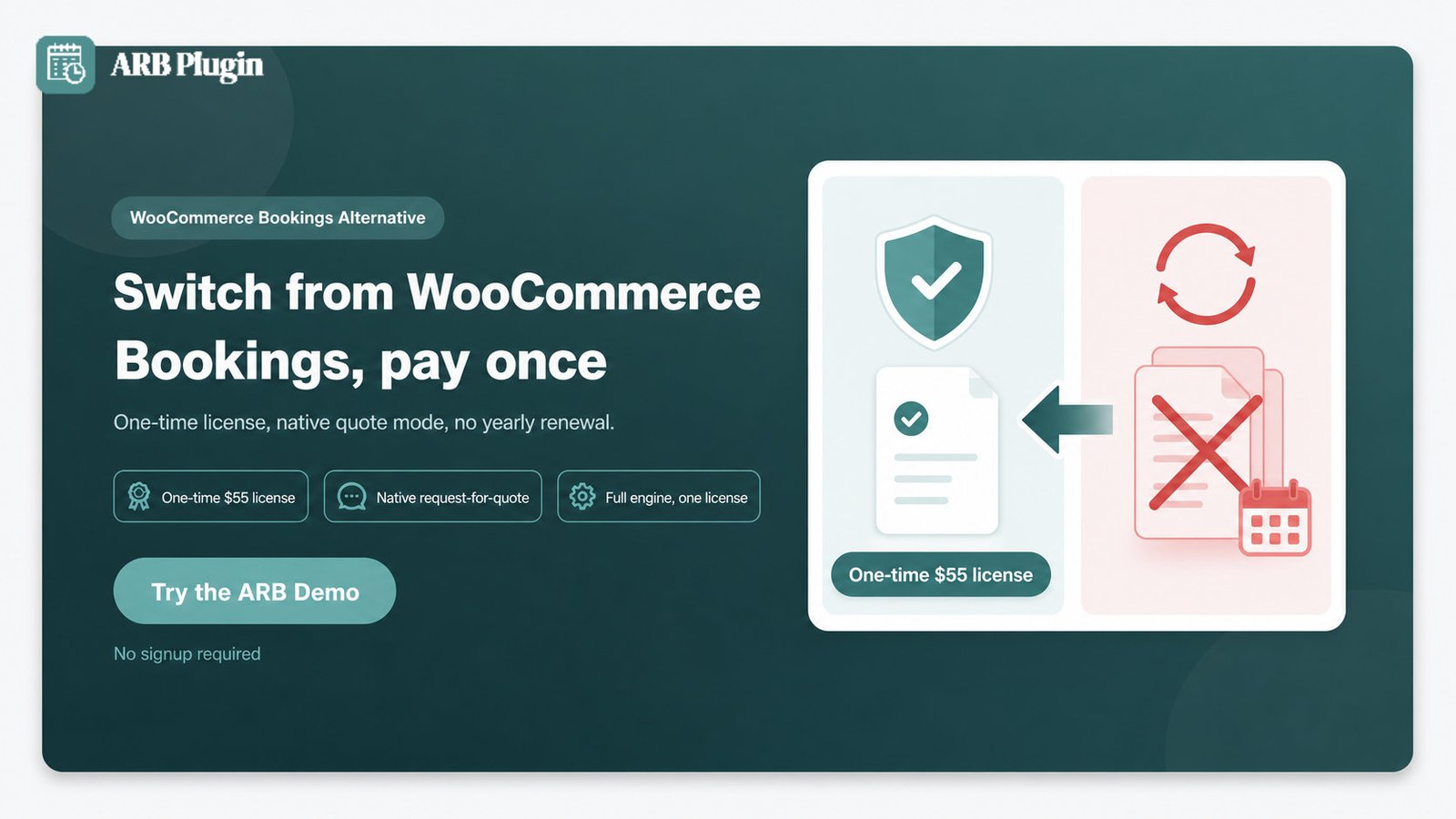
Three differences map straight onto the limitations above. First, ARB is a one-time CodeCanyon license (about $55) rather than $249 every year, so there is no recurring bill. Second, ARB ships a native Request-for-Quote mode with admin-set custom pricing, which WooCommerce Bookings does not offer. Third, ARB includes its full booking engine, range-based pricing, person types, and resources in the single license. Only Google Calendar and SMS are sold as add-ons, so there is far less add-on stacking.
WooCommerce Bookings still wins in real ways worth naming. Its native Google Calendar sync ships in core, while ARB's is a one-way paid add-on. Its first-party Automattic trust is unmatched, and its add-on and template ecosystem is larger. ARB also has no deposits feature, so this is not a clean sweep.
For the full picture, read the ARB vs WooCommerce Bookings head-to-head, or try the booking flow yourself first. Try the ARB demo.
FAQs
What is WooCommerce Bookings?
WooCommerce Bookings is the official scheduling and reservations extension by Woo (Automattic). It adds a Bookable Product type so customers book appointments, reservations, or rentals through your WooCommerce checkout. It is a different product from WebToffee's and PluginHive's similarly named booking plugins.
Does WooCommerce have a booking system?
Yes. WooCommerce Bookings is the official first-party booking system, sold at $249 per year. It is not bundled with core WooCommerce, so you buy it as a separate extension. Free and third-party options also exist across the wider field of best WordPress booking plugins.
Is WooCommerce Bookings worth it?
It is worth it if you want the official extension, native WooCommerce commerce, and built-in Google Calendar sync, and budget is secondary. It is not worth it if you need a one-time price, a simple setup, or native quote and recurring bookings without buying add-ons.
Is there a free version of WooCommerce Bookings?
No. WooCommerce Bookings has no free or lite core tier, and it is an annual subscription starting at $249. It carries a 30-day money-back guarantee, and one companion add-on (Accommodation Bookings) is free, but the core booking engine is paid only.
Is WooCommerce Bookings good for hotels and rentals?
Yes, for single-unit stays. The free Accommodation Bookings add-on enables night-based hotel and rental bookings. The catch is calendar sync. It targets a single Google Calendar, so multi-unit operators that need a separate calendar per unit will hit that limit quickly.
Is WooCommerce Bookings better than Amelia?
It depends on your stack. WooCommerce Bookings is more natively WooCommerce and better for store-based commerce. Amelia has a dedicated staff and employee module plus a free tier, which suits appointment businesses better. See the full Amelia review to compare them directly.
What are the best alternatives to WooCommerce Bookings?
These are the strongest alternatives, ranked by how consistently real users recommend them.
- Amelia: the top Reddit recommendation, with a dedicated staff module and a free tier.
- PluginHive: a lower annual price plus two-way Google Calendar sync.
- Bookly: highly customizable and actively maintained, a frequent community pick.
- YITH: WooCommerce-native, with Airbnb and external-calendar sync.
- ARB: a one-time license with a native request-for-quote mode.
For a ranked shortlist scored on the same rubric, see the best WooCommerce booking plugins comparison.