Review Methodology
How We Review WooCommerce Booking Plugins: Our Scoring Methodology
How ARB reviews WooCommerce and WordPress booking plugins: seven weighted dimensions, live pricing and feature checks, buyer evidence, disclosures, and verdict rules.
A booking-plugin review is only useful if you can see how the verdict was reached. This page explains the method behind ARB's reviews, comparisons, alternatives lists, and best-plugin roundups.
We score every booking plugin from 1 to 5 across the same seven weighted dimensions. The score comes from session-fresh evidence: the live demo or test flow where available, official documentation, current pricing, update history, and real buyer reviews. Then we turn that evidence into a practical verdict on who the plugin fits, who should skip it, and where the tradeoffs sit.
How we score: every plugin uses the same seven-dimension rubric. We do not change the categories because a product is popular, because it is cheaper, or because it competes with ARB.
Disclosure: ARB is our own WooCommerce booking plugin. That creates an obvious conflict of interest, so we state it in competitor reviews and apply the same rubric to ARB, including the areas where another plugin is stronger.
What Does Our Booking Plugin Score Measure?
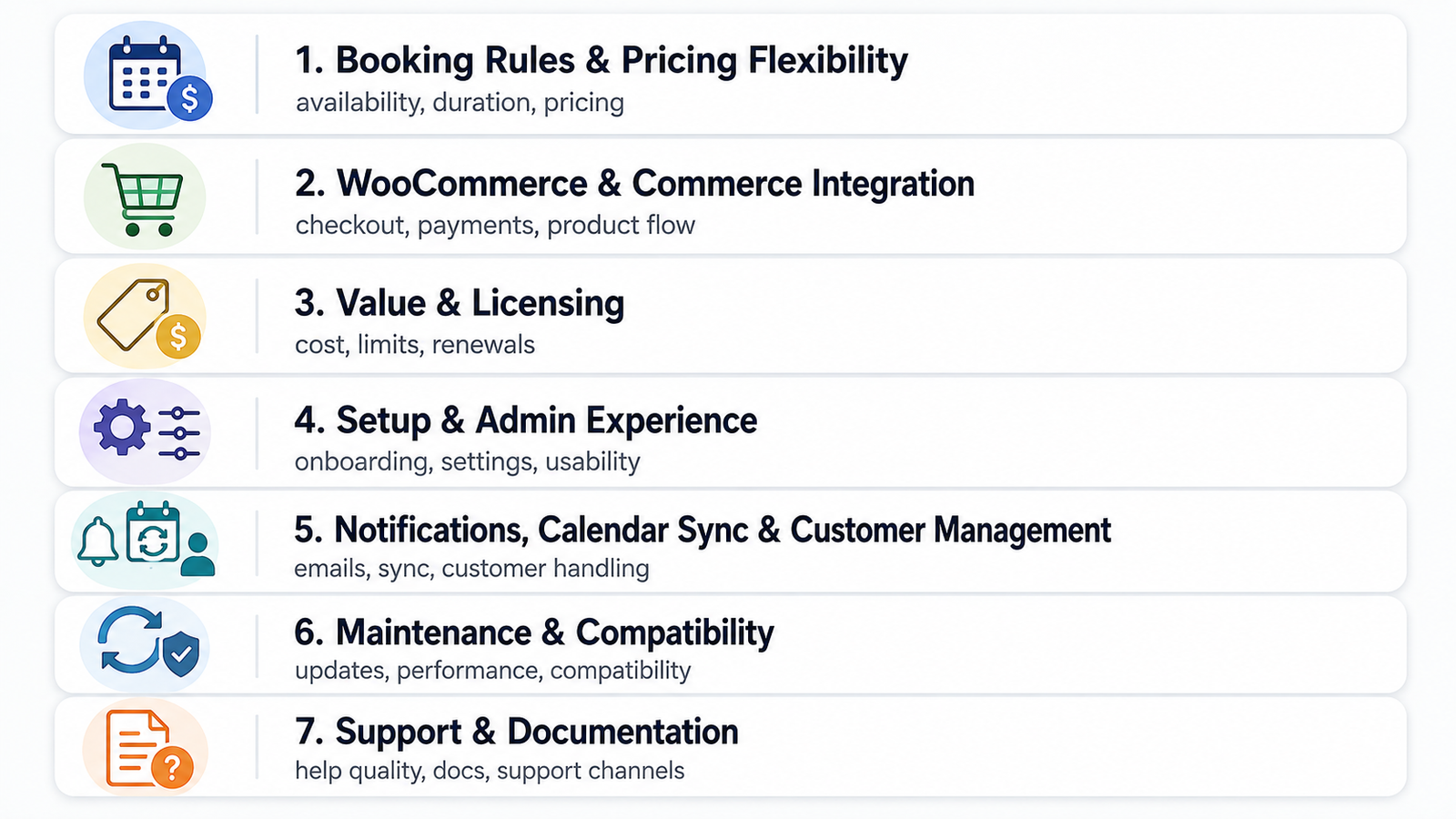
The overall score is a weighted 1-to-5 rating built from seven dimensions. Those dimensions cover both what a booking plugin can do and what it is like to buy, configure, maintain, and use in a real business.

| Dimension | What we examine |
|---|---|
| Booking Rules and Pricing Flexibility | Availability rules, appointment logic, group or recurring bookings, resources, range pricing, person pricing, rentals, stays, and other booking-model depth |
| WooCommerce and Commerce Integration | Native WooCommerce behavior, cart and checkout flow, order handling, payment gateways, taxes, coupons, deposits, and commerce fit |
| Value and Licensing (Total Cost of Ownership) | Entry price, renewals, lifetime options, tier-gating, add-on stacking, metered services, and the real cost of the setup we are reviewing |
| Setup and Admin Experience | Installation, onboarding, settings clarity, learning curve, booking management, and everyday admin friction |
| Notifications, Calendar Sync and Customer Management | Email, SMS or WhatsApp reminders, calendar sync, staff or customer panels, self-service changes, and communication tools |
| Maintenance and Compatibility | Update activity, changelog quality, WordPress and WooCommerce compatibility, recent stability, and signs of continued maintenance |
| Support and Documentation | Documentation depth, public support evidence, recurring support complaints, and how clearly the vendor explains features and limitations |
A high feature count does not automatically mean a high score. A plugin can be excellent at staff scheduling and still lose points if its WooCommerce flow is a bolt-on. A cheap base license can also lose value points if the features most buyers need sit behind six separate add-ons.
That is why the final number is only the summary. The dimension scores and the written verdict matter more.
Why Do We Use the Same Seven Dimensions for Every Plugin?
The fixed rubric makes unlike products easier to compare without pretending they are identical.
Amelia, Bookly, WooCommerce Bookings, and ARB do not follow the same product model. One may lead on staff scheduling, another on events, another on native WooCommerce checkout, and another on rental or range pricing. The seven dimensions give each strength a place without letting one headline feature dominate the whole review.
They also expose the tradeoffs buyers usually discover after purchase.
- A polished booking form does not fix a poor checkout architecture.
- A low entry price does not guarantee a low total cost of ownership.
- A long feature list does not prove the plugin fits hotels, rentals, classes, or staffed appointments equally well.
- A strong product can still be the wrong buy for a specific business model.
Our reviews are therefore written around fit, not a universal "best" label.
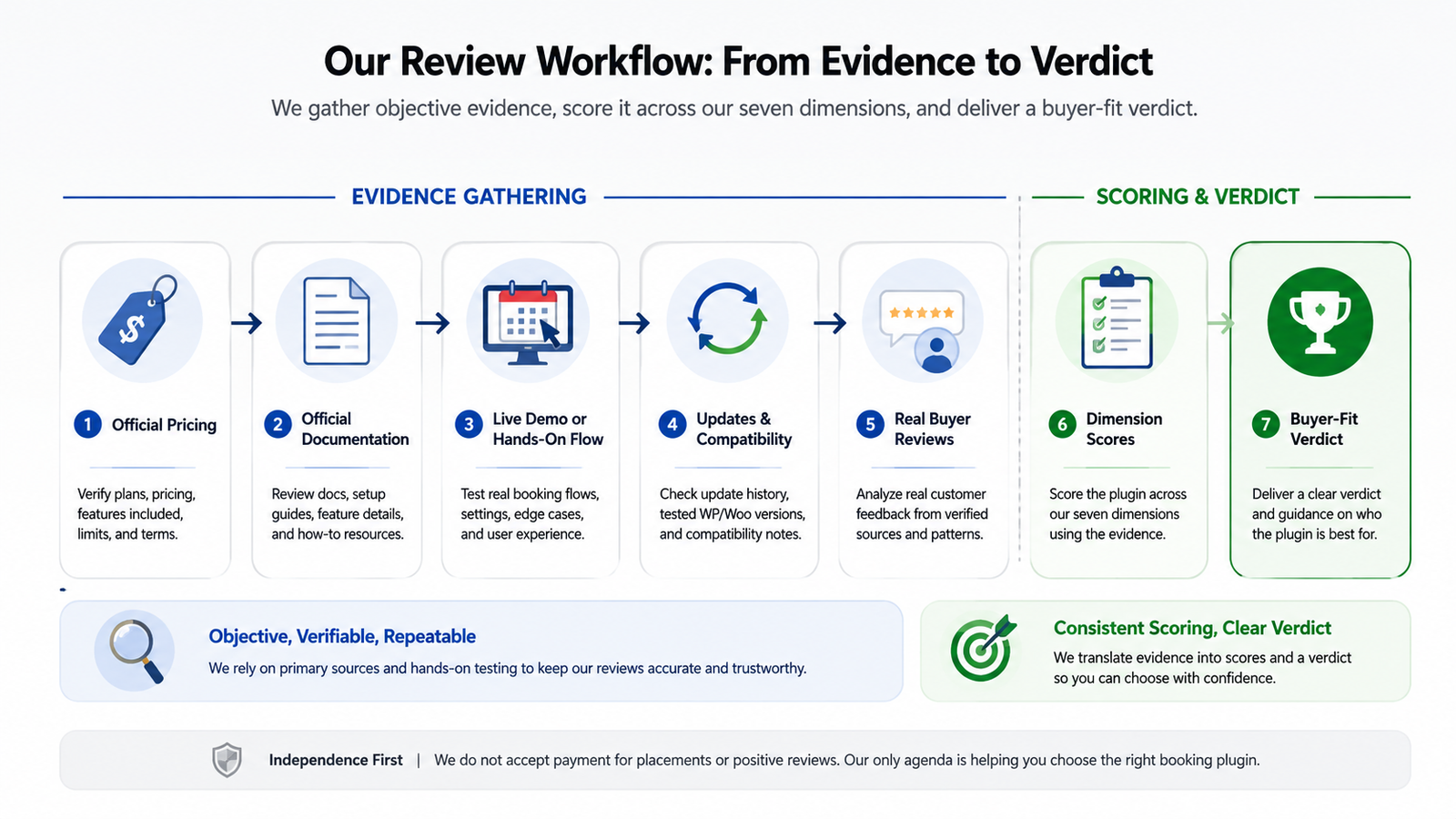
What Evidence Do We Use for a Booking Plugin Review?
We do not score from vendor marketing copy or a feature checklist alone. The strongest claims in a review should be traceable to current product evidence.

Official Pricing
We verify the current public price and the licensing model. That includes annual versus lifetime pricing, plan limits, add-on costs, transaction or cloud fees where relevant, and any feature that moves behind a higher tier.
The point is to report the real cost of the reviewed setup, not just the cheapest number on the pricing page.
Official Documentation
Documentation is where many important limitations become clear. We use it to confirm how WooCommerce integration works, whether calendar sync is one-way or two-way, what a deposit feature actually does, whether resources are supported, and which features require an extension or higher plan.
When marketing copy and documentation create different impressions, the implementation details carry more weight.
Live Demo or Hands-On Product Flow
Where a live demo, sandbox, or usable product flow is available, we inspect the booking experience directly. We look at the front-end form, admin workflow, checkout path, staff or customer controls, and the amount of setup required to reach a usable configuration.
This is where a feature that sounds simple on a sales page can turn into three settings screens, an add-on, or a separate checkout step.
Update History and Compatibility
A booking plugin is infrastructure. Stores depend on it for availability, payments, customer records, and confirmations, so maintenance matters.
We look at recent updates, changelogs, WordPress or WooCommerce compatibility information, and any recent stability issue that materially changes the buying decision. An old complaint does not automatically describe the current product, and a recent regression does not get ignored because the plugin has a long history.
Real Buyer and User Reviews
We use public user feedback to find patterns that product documentation cannot show. Depending on the plugin, that can include WordPress.org, Trustpilot, GetApp, Reddit, and other public buyer-review sources.
One angry review is not a verdict. Neither is one glowing testimonial. We look for repeated themes: support quality, reliability, add-on cost, ease of setup, post-update problems, or long-term satisfaction.
User sentiment is secondary evidence. It helps test whether the product experience described by the vendor holds up for real buyers.
How Do We Verify Pricing and Feature Claims?
Pricing and features change, so our review packages record verification dates when the article needs them. A review may include fields such as pricing_verified and features_verified to show when those claims were last checked during the research pass.
Before publication or a major refresh, we re-check the claims that can materially change the verdict.
- Current license price and renewal model
- Free versus paid plan limits
- Paid add-ons or tier-gated features
- WooCommerce integration behavior
- Calendar-sync direction and requirements
- Payment, deposit, notification, and customer-management features
- Recent compatibility or stability changes
If a vendor changes one of those facts, the article should change with it. A 2026 review is not useful if the price, feature tier, or integration model comes from an older version.
How Do We Turn the Evidence Into a Score?
Each of the seven dimensions receives a score from 1 to 5, and the review publishes an overall weighted score alongside the dimension table.
The number is not meant to create fake precision. It is a compact way to show the shape of the product.
For example, two plugins can finish close together overall while being right for completely different buyers. A staffed appointment plugin may score strongly on calendar sync and employee management. A WooCommerce-native reservation plugin may score more strongly on checkout integration, range pricing, or rental use cases.
That is why every review pairs the score with four things:
- A short verdict near the top
- Clear "who it is for" and "who it is not for" guidance
- Specific pros and cons
- A final buyer-fit recommendation
The score tells you how the plugin performed. The verdict tells you whether that performance matches your use case.
How Do We Handle Conflicting or Incomplete Evidence?
Not every vendor page is perfectly consistent. Pricing pages can disagree with blog posts. Documentation can lag a newly released feature. Buyer reviews can describe an older version that has already changed.
When evidence conflicts, we prefer the source closest to the current product state.
- Current official pricing or product documentation
- Current live demo or hands-on behavior
- Recent changelog and support evidence
- Recent buyer reviews
- Older reviews or older vendor content, used as historical context only
If we cannot verify a claim confidently, it should not be presented as a settled fact. Where the uncertainty itself matters to a buyer, we say so in the article.
How Do We Handle ARB's Conflict of Interest?
ARB competes with several plugins we review. We do not hide that.
Every competitor review should make the relationship clear near the top, and the comparison section should name areas where the competing product genuinely wins. In the Amelia and Bookly reviews, for example, the verdict does not pretend ARB has every capability those products offer.
Our safeguards are straightforward.
- The same seven scoring dimensions apply to ARB and competitors.
- Competitor strengths stay in the article even when they weaken ARB's positioning.
- Pricing and feature claims should come from current evidence, not sales framing.
- A competitor does not lose points merely because its architecture differs from ARB; it loses points only where that architecture creates a real tradeoff in the scored dimension.
- We separate the review verdict from the later ARB-alternative section.
The disclosure does not remove bias. It makes the commercial relationship visible and gives readers enough information to judge the recommendation themselves.
What Do We Not Count as Good Review Evidence?
Some inputs are useful for discovery but weak as final evidence.
We do not base a score on:
- A vendor feature list without checking how the feature works
- A single user complaint or testimonial
- An outdated price repeated by a third-party blog
- Raw install count or popularity by itself
- The number of add-ons as proof of either quality or poor value
- A comparison table copied from another reviewer
Popularity can show market maturity. A large add-on catalog can show extensibility. Neither tells you whether the plugin is the right fit without the rest of the evidence.
How Should You Read One of Our Plugin Reviews?
If you want the answer quickly, read the review in this order.
- Score table and verdict: the overall shape of the product
- Who it is for / who it is not for: the fastest fit check
- Key features: where the product is genuinely strong
- Setup and pricing: the practical burden and total cost
- Pros, cons, and real user sentiment: the tradeoffs that repeat across the evidence
- Final verdict: whether the plugin is worth buying for the stated use case
Then read the ARB comparison section only if a WooCommerce-native alternative is relevant to you. It is intentionally separate from the main review so the competitor assessment can stand on its own first.
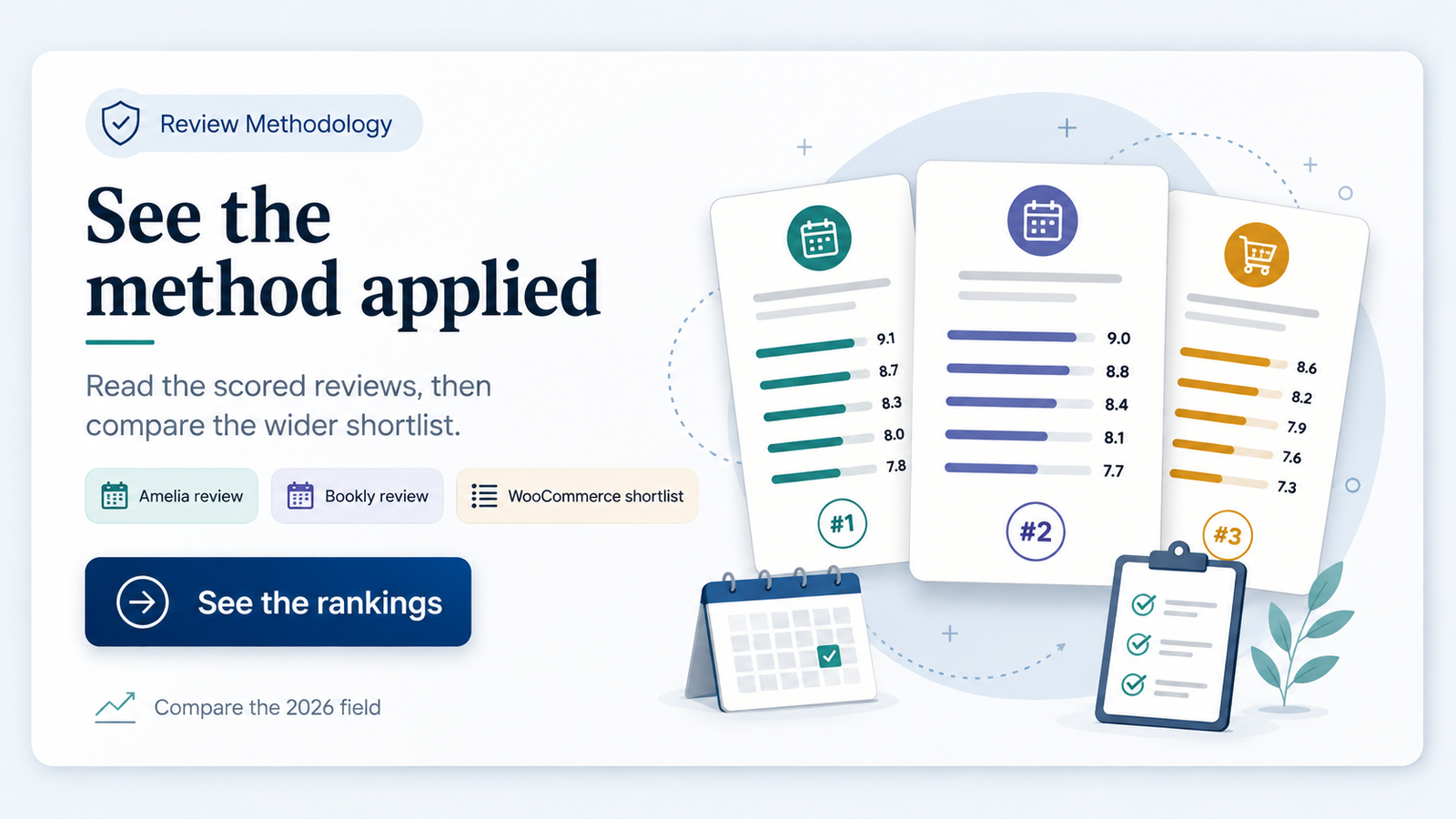
See This Method Applied
The easiest way to judge a methodology is to see whether the finished reviews are consistent with it.

- Read our Amelia review for a plugin that scores strongly on staff scheduling, events, and calendar sync but has a non-native WooCommerce flow.
- Read our Bookly review for a mature appointment plugin where add-on cost and WooCommerce fit materially affect the verdict.
- Compare the wider field in our best WooCommerce booking plugins guide.
- If budget comes first, start with the best free WordPress booking plugins roundup.
The same scoring vocabulary, disclosure standard, and buyer-fit framing should carry across all of them.
FAQs
Do you score every booking plugin on the same dimensions?
Yes. Every scored review uses the same seven dimensions: booking rules and pricing flexibility; WooCommerce and commerce integration; value and licensing; setup and admin experience; notifications, calendar sync and customer management; maintenance and compatibility; and support and documentation.
Do you only review WooCommerce-native booking plugins?
No. We review standalone WordPress booking plugins as well as WooCommerce-native products. WooCommerce integration is one scoring dimension, not an eligibility requirement.
Do user reviews determine the final score?
No. User reviews are secondary evidence. We use them to identify repeated real-world patterns, then check those patterns against documentation, current product behavior, pricing, and update history where possible.
How often do you update a review?
We update a review when a material change makes the existing verdict stale: a pricing change, major feature release, integration change, compatibility issue, or corrected factual claim.
Does ARB get a higher score because it is your own plugin?
No. ARB uses the same seven-dimension rubric. Competitor reviews also disclose that ARB is our product and should state clearly where the competing plugin is stronger.
Why can two plugins with similar scores receive different recommendations?
Because the overall number compresses seven dimensions into one result. A plugin can be better for multi-staff appointments while another is better for WooCommerce-native checkout, rentals, or complex pricing. The recommendation follows the buyer fit, not the total alone.