Blesta, HostBill, ClientExec, FOSSBilling, WISECP, and Ubersmith are the six strongest alternatives to WHMCS for hosting businesses in 2026. Hosts switch because WHMCS charges per client on a tiered scale. Some also want open source code or a lower fixed cost.
Each platform below is compared on pricing, licensing, and open source status, then covered individually in its own section. A comparison table, a how-to-choose guide, and an honest verdict on whether switching from WHMCS is actually worth it follow below.
WHMCS Alternatives at a Glance
WHMCS charges $34.95 to $84.95 a month for self-hosted plans, tiered by client count, and ships as closed source software. The table below compares WHMCS against six alternatives on pricing model, open source status, and best-fit use case.
| Platform | Pricing model | Open source | Best for |
|---|---|---|---|
| WHMCS (reference) | $34.95 to $84.95/mo self-hosted, tiered by client count; cloud plans from $9.99/mo | No | Hosts already built on the WHMCS ecosystem |
| Blesta | $17.95 to $23.95/mo, or $350 to $1,495 one-time | Source-available | Unlimited-client billing at a flat license cost |
| HostBill | $599 to $5,999 one-time, perpetual license | No | Larger hosts wanting deep automation and 106+ integrations |
| ClientExec | $16.95 to $19.95/mo, 30-day free trial | No | A low-cost SaaS swap with no server to manage |
| FOSSBilling | Free, self-hosted, no license fee | Yes | Budget-constrained hosts comfortable self-hosting and auditing code |
| WISECP | $25.90 to $30.90/mo, or $1,025 to $1,290 lifetime | No | Hosts wanting a built-in WHMCS migration tool |
| Ubersmith | Quote-based, demo-gated, no public price | No | Colocation, data center, and telco-scale operators |
Readers new to WHMCS itself can start with our what is WHMCS guide before comparing alternatives.
The Top WHMCS Alternatives
Six billing platforms cover most of the WHMCS-swap conversation, from unlimited-client flat licenses to one truly free, open source option. Each entry below states its pricing model, licensing status, and the host it fits best.
Blesta
Blesta is widely regarded as the closest direct competitor to WHMCS. It is a client management, billing, and support platform priced as a flat license instead of per-client tiers.
Blesta costs $17.95 to $23.95 a month, or $350 to $1,495 as a one-time purchase, with unlimited clients and staff on every tier. It uses a proprietary license, but ships almost entirely as readable, unencoded source, so it is source-available rather than closed.
Support and update renewals cost $62 a year for owned licenses. Hosted subscriptions include support for the life of the plan.
See Blesta's pricing page for the full tier breakdown.
HostBill
HostBill is a one-time-license billing and automation platform with no monthly fee, ever. Four editions run $599 to $5,999, each granting a perpetual license and unlimited clients. HostBill lists 106 or more integrations across hosting platforms and domain registrars, the deepest automation surface of the six.
Access to yearly software updates costs $125 a year after the first year, and HostBill is proprietary.
Full tier and support-case details are on HostBill's pricing page.
ClientExec
ClientExec is a leased-license billing platform that markets itself directly as a WHMCS and Blesta alternative. It costs $16.95 to $19.95 a month after a discounted $1 first month, with a 30-day free trial. Every plan includes unlimited clients, products, servers, tickets, and orders, so pricing stays fixed regardless of how large the business grows.
ClientExec is proprietary and runs as self-hosted software you download and install, with an optional managed host if you prefer no server to maintain.
Details are on ClientExec's pricing page.
FOSSBilling (Free and Open Source)
FOSSBilling is the one genuinely free and open source alternative among the six, licensed under AGPL 3.0. It costs nothing to license, runs on a server you control, and ships with no encoded files, so the entire codebase is auditable.
FOSSBilling forked from the stalled BoxBilling project in 2022 and remains actively maintained today. It is the pick for budget-constrained hosts comfortable self-hosting and patching their own billing stack.
Paymenter is a newer free, open source option in the same vein, though it is younger and less feature-complete than FOSSBilling.
Read more on FOSSBilling's own site.
WISECP
WISECP is a proprietary billing platform with a 30-day free trial and no credit card required upfront. Lifetime licenses cost $1,025 for Startup or $1,290 for Professional, or $25.90 to $30.90 a month, with unlimited clients and staff on both tiers.
WISECP ships a dedicated WHMCS import tool that transfers customer, domain, and invoice data, a direct answer for hosts moving an existing client base. Support on owned licenses is free for the first year, then $89 a year.
See WISECP's pricing page for the full tier list.
Ubersmith
Ubersmith is a quote-based billing and subscription-management platform built for cloud, hosting, colocation, and data center providers. Pricing is not public; the vendor gates it behind a demo and a sales conversation instead of a self-serve checkout.
Ubersmith targets a larger-scale audience than the typical small hosting reseller comparing WHMCS alternatives, including telcos, ISPs, and managed service providers alongside hosts. It is worth a look for operators outgrowing hosting-specific billing, not for a first WHMCS swap.
See Ubersmith's own site for its full feature set.
How Do You Choose a WHMCS Alternative?
Choosing a WHMCS alternative comes down to four factors. Weigh the pricing model, client-cap policy, migration support, and how much ecosystem depth you are willing to trade away.
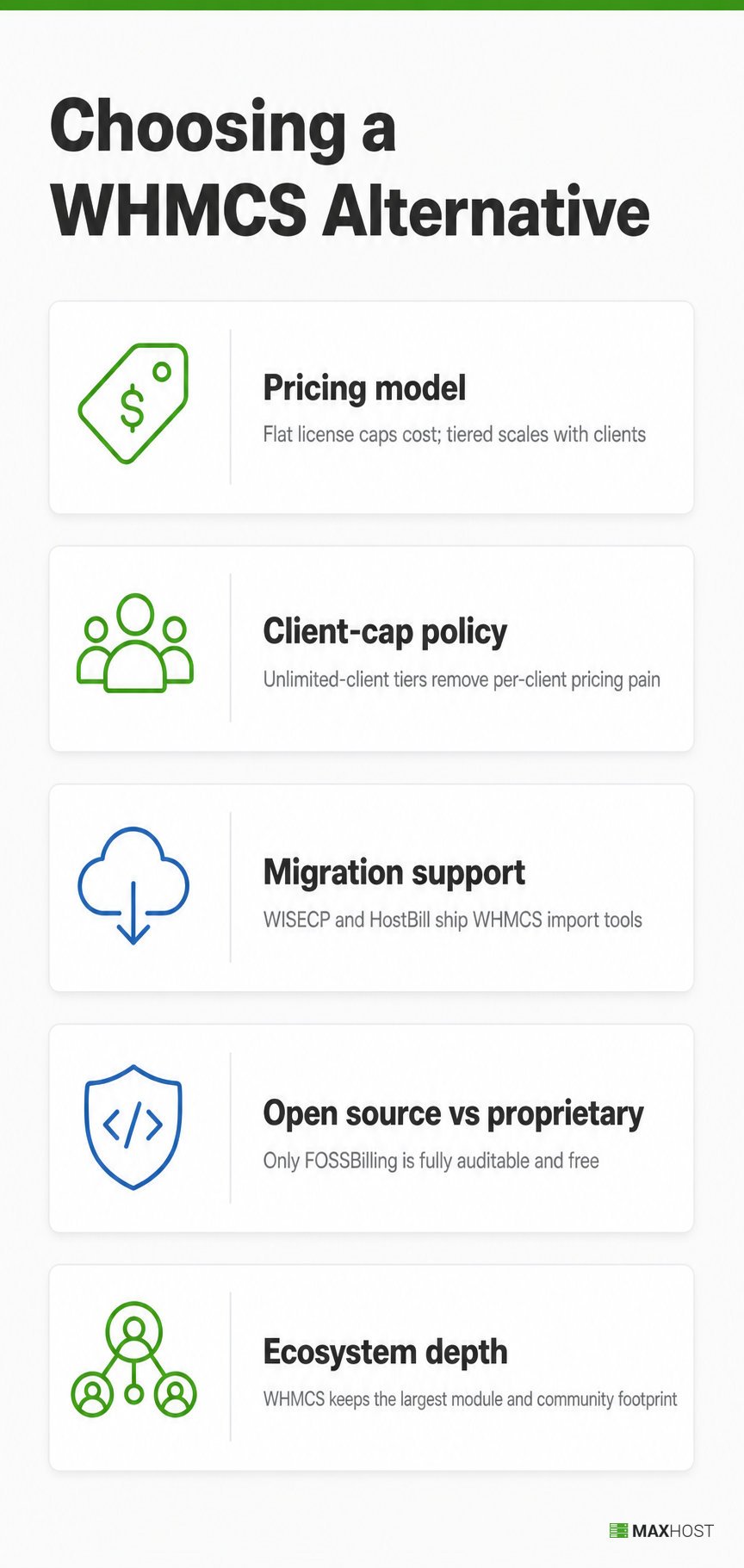
- Pricing model: a flat license such as Blesta or HostBill caps cost regardless of growth, while a per-client tiered plan like WHMCS scales with your client count.
- Client-cap policy: Blesta, HostBill, ClientExec, and WISECP all include unlimited clients on every tier, removing WHMCS's per-client pain point entirely.
- Migration support: WISECP ships a built-in WHMCS import tool, and HostBill provides an official import module plus a paid managed-migration option.
- Open source versus proprietary: FOSSBilling is the only entry you can audit, modify, and self-host with zero licensing risk.
- Ecosystem depth: WHMCS has the largest module, integration, and support-community footprint of any platform here, and every alternative trades some of that depth away.
Hosts who conclude WHMCS is still the right fit can follow our how to set up WHMCS guide instead of switching.
Is Switching Away From WHMCS Worth It?
WHMCS remains the deepest, most established billing platform for hosting businesses, and every alternative here trades away some of that depth. Switching makes sense when a lower fixed cost, simpler licensing, or open source code matters more than WHMCS's ecosystem size.
Much of the switching conversation traces back to WHMCS's 2021 shift to subscription-only pricing. That change ended its old lifetime licenses and raised costs for many hosts, which is what pushes long-time users to look around.
It rarely makes sense to switch just to save a few dollars a month if a business already runs smoothly on WHMCS. The trade is depth for cost, licensing, or code freedom, never a strictly better product across every dimension.
Go Deeper: WHMCS vs Blesta vs HostBill Head to Head
Readers deciding among WHMCS, Blesta, and HostBill specifically want more depth than a six-way roundup gives. Our WHMCS vs Blesta vs HostBill comparison breaks down pricing, integrations, and control-panel support feature by feature.
How MaxHost Fits If You Choose a Different Billing Platform
MaxHost ships as a wordpress theme with whmcs integration, bundling 20 client-area templates that skin WHMCS's cart and client portal to match your site's design. No bridge plugin is required, and that relationship is WHMCS-specific.
Choosing Blesta, HostBill, ClientExec, FOSSBilling, WISECP, or Ubersmith instead means none of those 20 WHMCS templates apply to your new platform's client area. MaxHost's design-matching value only holds if you stay on WHMCS.
Hosts staying on WHMCS can browse our best WHMCS WordPress themes roundup, or see MaxHost's own WHMCS templates directly.
FAQs
What are the best alternatives to WHMCS?
The best alternatives to WHMCS are Blesta, HostBill, ClientExec, FOSSBilling, WISECP, and Ubersmith. Blesta and HostBill offer flat licensing, FOSSBilling is the only fully open source option, WISECP ships a WHMCS migration tool, and Ubersmith targets larger-scale operators.
Is there a free, open source alternative to WHMCS?
Yes. FOSSBilling is free, licensed under AGPL 3.0, and fully open source, so anyone can audit and modify the code. It is self-hosted, carries no licensing fee, and is funded by optional community donations rather than a product price.
What's the cheapest WHMCS alternative?
FOSSBilling is free. Among paid options, Blesta and ClientExec are the cheapest, starting at $17.95 and $16.95 a month. Blesta's lowest one-time tier costs $350.
Can I migrate my existing WHMCS clients to Blesta or HostBill?
Blesta and HostBill both support WHMCS migration. HostBill provides an official WHMCS import module plus a paid managed-migration option, and Blesta offers migration as a professional service. Neither imports as instantly as WISECP's built-in WHMCS importer.
What is the difference between Upmind and WHMCS?
The difference between Upmind and WHMCS is hosting model and cost. Upmind is a fully hosted, SaaS billing and automation platform that is free to start, with no server to run. WHMCS is self-hosted software with per-client license tiers. Upmind is newer, cloud-only, and API-first; WHMCS is the established, self-hosted standard.
Does MaxHost support billing platforms other than WHMCS?
No. MaxHost's bundled templates are WHMCS-specific, skinning only the WHMCS client area and cart. Choosing Blesta, HostBill, ClientExec, FOSSBilling, WISECP, or Ubersmith means none of MaxHost's 20 WHMCS layouts apply.
Is switching away from WHMCS worth it for most hosting businesses?
Usually not just to save money. WHMCS remains the deepest, most established billing platform for hosts, and every alternative trades away some of that depth. Switch when open source code, a flat license, or a specific feature like WISECP's migration tool matters more than WHMCS's ecosystem size.