Review Methodology
How We Review WordPress Hosting Themes
Our scoring method for WordPress hosting and WHMCS themes: seven weighted dimensions, real evidence, and one overall score out of 5.
We test WordPress hosting and WHMCS themes the way a real hosting business buys one. Every theme is scored 1 to 5 on seven weighted dimensions, then given one overall score out of 5.
What our score answers
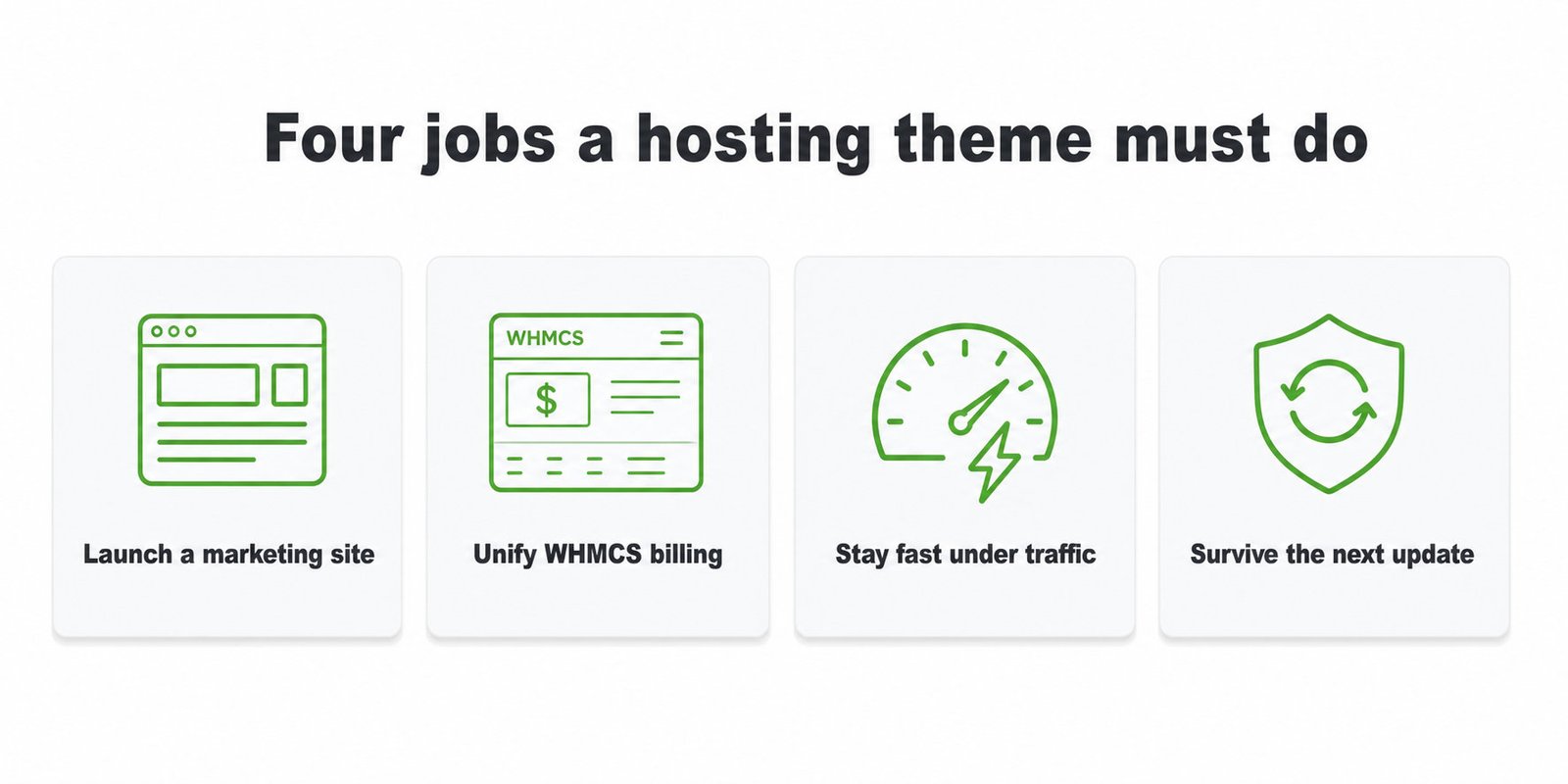
A good hosting theme has to do four jobs at once. It has to launch a professional marketing site. It has to unify cleanly with WHMCS billing. It has to stay fast under real traffic. It has to keep working after the next WordPress and WHMCS update.
Our score measures exactly those jobs, weighted by how much they decide a real purchase. We do not reward long feature lists. We reward the theme that gets a hosting company live and selling.
The seven dimensions we score
Each theme earns a 1 to 5 score on every dimension below. The overall score is the weighted average, published as a scorecard near the top of each review.
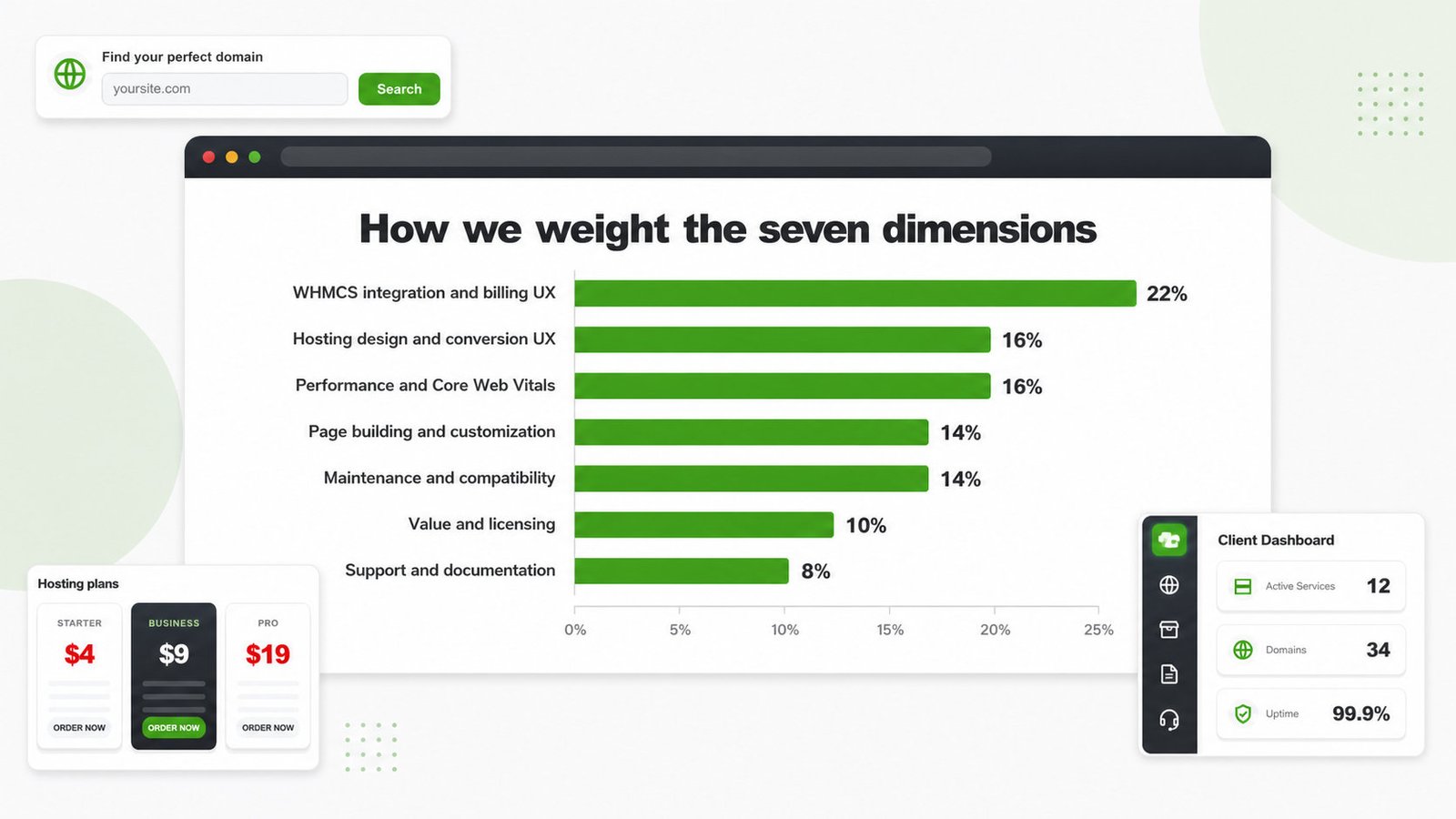
| Dimension | Weight | What it measures |
|---|---|---|
| WHMCS integration and billing UX | 22% | How cleanly the marketing site and the WHMCS client area become one brand |
| Hosting design and conversion UX | 16% | How well the demos and components fit the way hosting is actually bought |
| Performance and Core Web Vitals | 16% | Real out-of-the-box speed, because hosting buyers judge you on it |
| Page building and customization | 14% | Whether a non-developer can edit pricing and pages without hiring help |
| Maintenance and compatibility | 14% | Update cadence and current WordPress, WooCommerce, and WHMCS support |
| Value and licensing | 10% | Real cost per capability, including what is bundled |
| Support and documentation | 8% | Docs, tutorials, and how responsive support is when something breaks |
WHMCS integration carries the most weight because it is the make-or-break for a hosting theme. Performance and hosting design come next, because a hosting site is revenue infrastructure that lives or dies on speed and a smooth path into billing.
How we gather the evidence
Every score comes from real evidence gathered during the review, never from guesswork. For each theme we work through the same checklist.
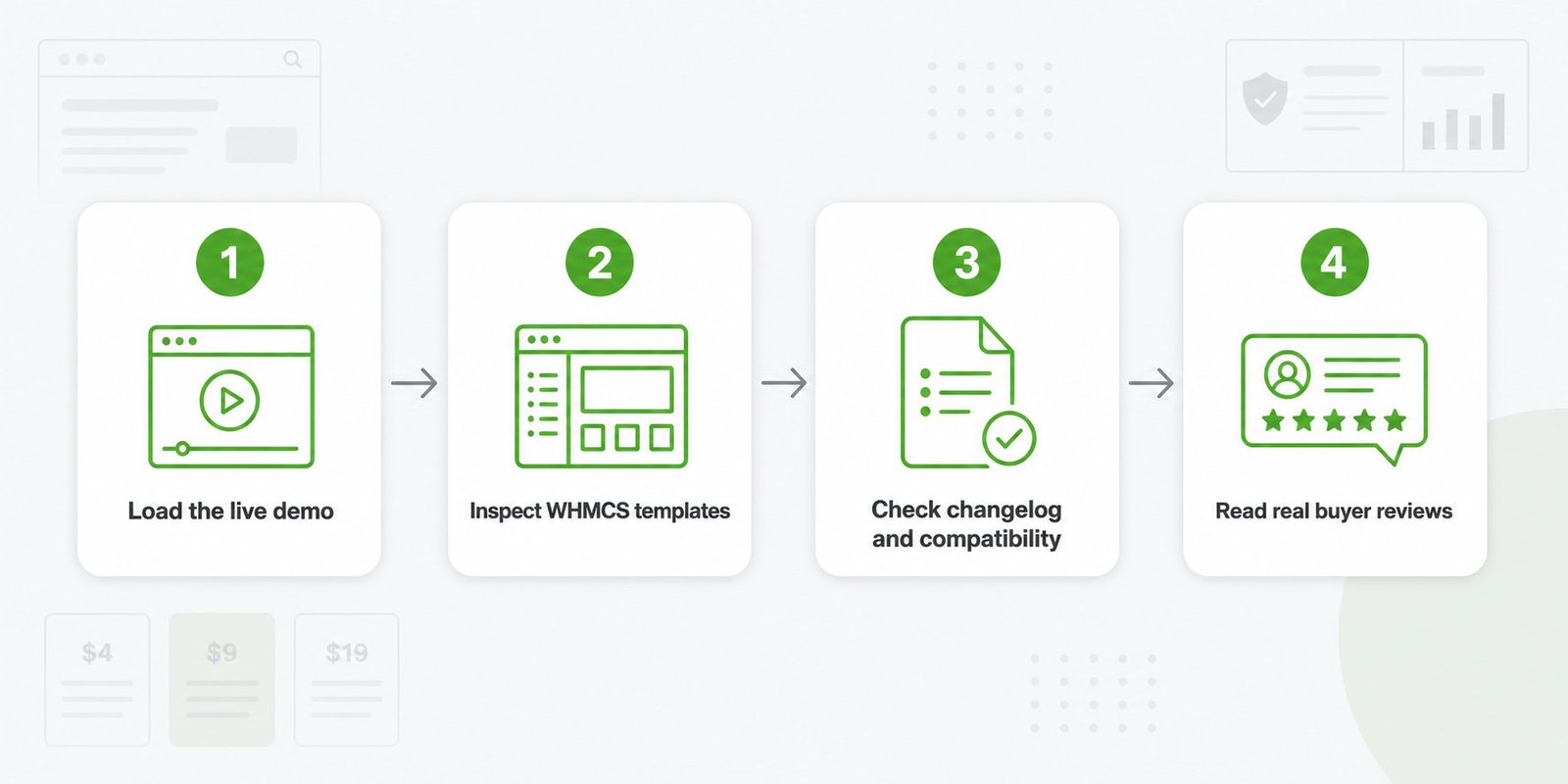
- Buy or load the live demo and click through the hosting and client-area layouts.
- Install and inspect the WHMCS templates, or the bridge setup when the theme uses one.
- Read the changelog and the compatibility list for current WordPress, WooCommerce, and WHMCS versions.
- Read real buyer comments and reviews on the marketplace and on independent platforms.
When a theme is delisted or clearly unmaintained, we say so plainly and cap its maintenance score. We do not fabricate benchmark numbers or invent test results.
Our scoring scale
The overall score maps to a clear recommendation, so you can act on it fast.
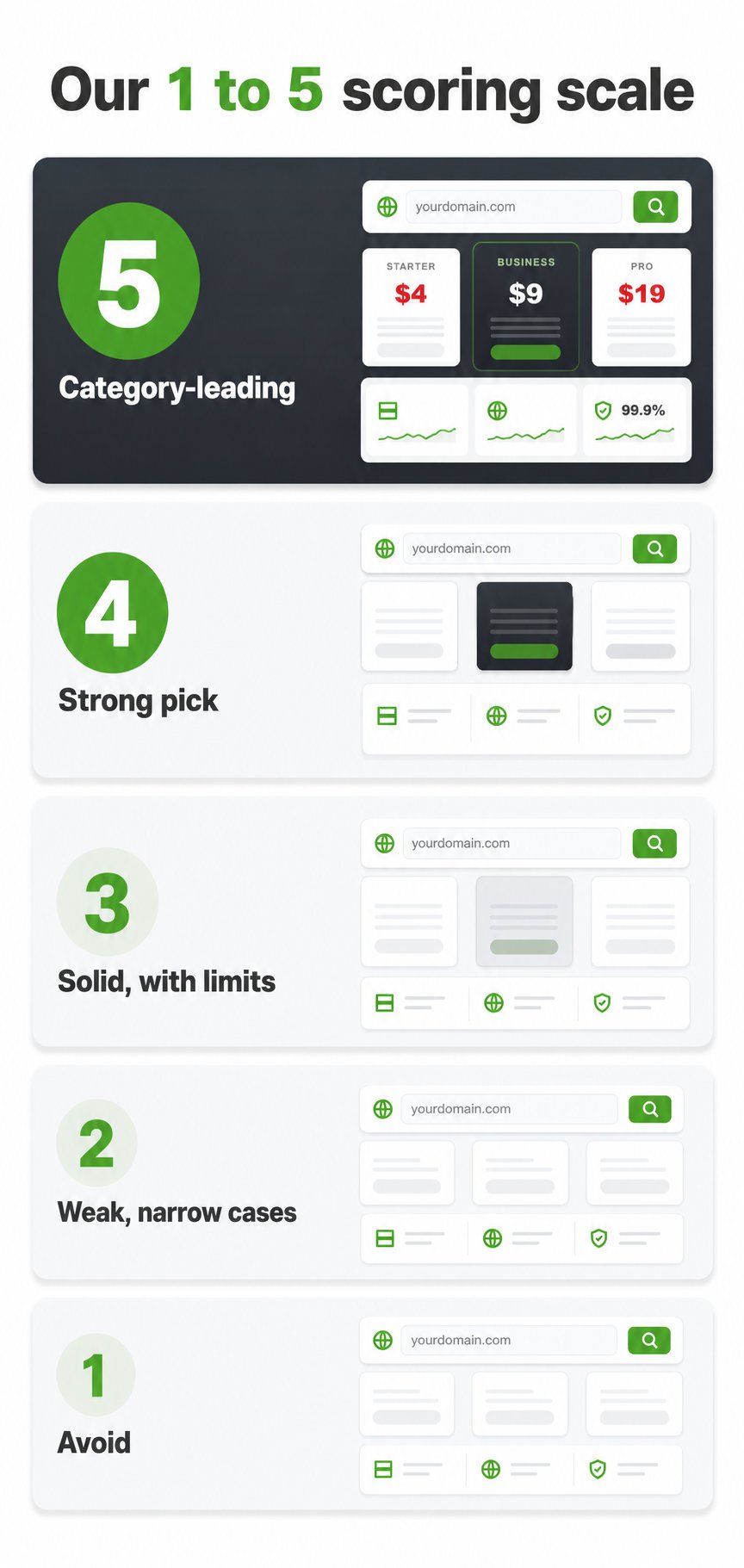
- 5: category-leading, the best in class on this dimension.
- 4: strong, a confident pick with minor gaps.
- 3: solid, but with real limits worth knowing before you buy.
- 2: weak, only right in narrow cases.
- 1: avoid for a production hosting business.
An overall near 4.5 or higher is a top pick. A 3.5 to 4.4 is a strong option for the right buyer. Below 3.0 we do not recommend it for a live hosting business.
How we rank our best-of lists
Our comparison and best-category lists rank by the recorded overall score, so the ranking is consistent and defensible across every page. A general list, like the best WordPress hosting themes, ranks each theme by its overall score, highest first.
An audience-scoped list re-weights the same seven scores for that audience and adds a decisive gate. On a reseller-focused list, a theme with no reseller-storefront path cannot be the top pick, no matter its overall score. On a free-theme list, a premium theme is never ranked as free. We show the scoped score next to the global overall, so you always see both.
Delisted or abandoned themes appear only as a legacy caution, never as a live pick. Same-vendor siblings are scored on the identical rubric, and we frame that choice as picking within one catalog rather than switching away.
Independence and disclosure
MaxHost is our own theme. We score it on the exact same rubric as every competitor, including the dimensions where it loses. MaxHost is a builder-heavy theme, so its performance needs discipline to run fast, and we score that honestly rather than hide it.
Where a rival genuinely beats MaxHost, we say so. Some competing themes outsell MaxHost, update more often, or cost less, and our reviews state that plainly. A scoring method is only worth trusting if it can rank our own product below a better one, so ours does.
Want to see the method applied? Start with MaxHost and its own honest scorecard. Then compare it against the alternatives buyers cross-shop. For a buyer's checklist built on these same dimensions, see how to choose a WordPress hosting theme.
Frequently asked questions
Straight answers to the questions that matter most
How many themes do you compare on this rubric?
Every theme we review is scored on the same seven weighted dimensions. Any two reviews are therefore directly comparable, and every best-of list ranks on one consistent number.
Do you score your own theme differently?
No. MaxHost is scored on the identical rubric, with the same evidence standard, and it loses dimensions where a rival is genuinely better.
What makes a theme score high on WHMCS integration?
Bundled, installable WHMCS templates that need no bridge plugin. Several distinct client-area layouts, and support for the current WHMCS version. Plus buyer evidence that the marketing site and client area feel unified.
Why does performance carry so much weight?
Hosting customers judge reliability by how fast your site loads. A slow, bloated theme costs signups before a visitor ever reaches your pricing page, so we weight speed heavily.
How often are scores updated?
We re-score a theme when its evidence changes, such as a major update, a compatibility jump, a price change, or a delisting. A stale or abandoned theme has its maintenance score capped and flagged.
Do you get paid to rank a theme higher?
No. Rankings come only from the recorded scores. There are no paid placements, and our own theme is ranked on the same evidence as everything else.